
CBSE Class 10 Science Chapter 5 Life Process is one of the most important Biology chapters for board exams. It explains the basic functions that keep living organisms alive, including nutrition, respiration, transportation, and excretion. These concepts are frequently asked in exams, especially in MCQs and short-answer questions.
These notes of Life Process are prepared strictly according to the latest CBSE syllabus and follow the updated NCERT textbook. They are written in simple language to help students understand concepts easily and revise quickly before exams.
Life Processes: Nutrition, Respiration, Transportation, and Excretion
Life Process
These are essential activities that all living organisms perform to maintain life, even during rest/sleep.
Main life processes: Nutrition, Respiration, Transportation, Excretion (sometimes Reproduction & Control are included).
Nutrition – Life Process
Process by which organisms take in food (nutrients) and use it for energy, growth, repair, and maintenance.
Why do organisms need nutrition?
- Provides energy for all activities.
- Helps in growth and repair of body parts.
- Maintains body temperature and health.
Nutrients
Substances obtained from food:
- Macronutrients (needed in large amounts): Carbohydrates, Proteins, Fats.
- Micronutrients (needed in small amounts): Vitamins, Minerals.
- Water and roughage (fibre) are also essential.
Modes of Nutrition
- Autotrophic Nutrition (“self-feeding”)
- Organisms make their own food from simple inorganic substances.
- Examples: Green plants, blue-green algae (cyanobacteria), some bacteria.
- Process: Photosynthesis.
- Heterotrophic Nutrition (“other-feeding”)
- Organisms cannot make food; depend on others (directly or indirectly on autotrophs).
- Examples: Animals, humans, fungi, most bacteria.
- Sub-types:
- Holozoic – Whole solid food intake → digestion (e.g., humans, dogs).
- Saprophytic – Absorb digested food from dead matter (e.g., fungi, some bacteria).
- Parasitic – Obtain food from living host (e.g., tapeworm, cuscuta plant, plasmodium).
Autotrophic Nutrition – Photosynthesis (in Plants)
Definition
Process by which green plants make their own food (glucose) using sunlight, CO₂, and water in presence of chlorophyll.
Overall Equation
6CO₂ + 6H₂O → C₆H₁₂O₆ (glucose) + 6O₂
(in presence of sunlight + chlorophyll)
Raw Materials
- Carbon dioxide (from air through stomata).
- Water (from soil through roots).
- Sunlight (energy source).
- Chlorophyll (green pigment in chloroplasts – traps light).
Site
Chloroplasts in leaves (mainly in mesophyll cells).
Steps take in Photosynthesis
- Absorption of light energy by chlorophyll.
- Conversion of light energy → chemical energy; splitting of water (photolysis) → 2H₂O → 4H⁺ + 4e⁻ + O₂.
- Reduction of CO₂ to form carbohydrates (glucose) using H⁺ and energy.
Important Points
- Occurs in two phases: Light-dependent (produces ATP, NADPH, O₂) and Light-independent (Calvin cycle – fixes CO₂ into glucose).
- Stomata regulate gas exchange (CO₂ in, O₂ out) and transpiration.
- Guard cells control opening/closing of stomata.
- Chlorophyll absorbs mainly blue & red light (reflects green → plants look green).
Experiments related to Photosynthesis (frequent exam questions)
- Starch test on leaf (iodine test): Shows presence of starch only in green parts exposed to light.
- Variegated leaf experiment: Shows chlorophyll is necessary.
- Bell jar experiment with KOH: Shows CO₂ is necessary.
- Aquatic plants (Hydrilla) experiment: Shows O₂ is released (bubbles).
Heterotrophic Nutrition in Animals (Focus: Human Nutrition)
Holozoic Nutrition in Humans
- Ingestion – Taking food into mouth.
- Digestion – Breaking complex food into simple soluble form.
- Mechanical (teeth, churning).
- Chemical (enzymes).
- Absorption – Taking digested nutrients into blood (mainly small intestine).
- Assimilation – Using absorbed nutrients in cells for energy/growth.
- Egestion – Removal of undigested waste (faeces) through anus.
Human Digestive System
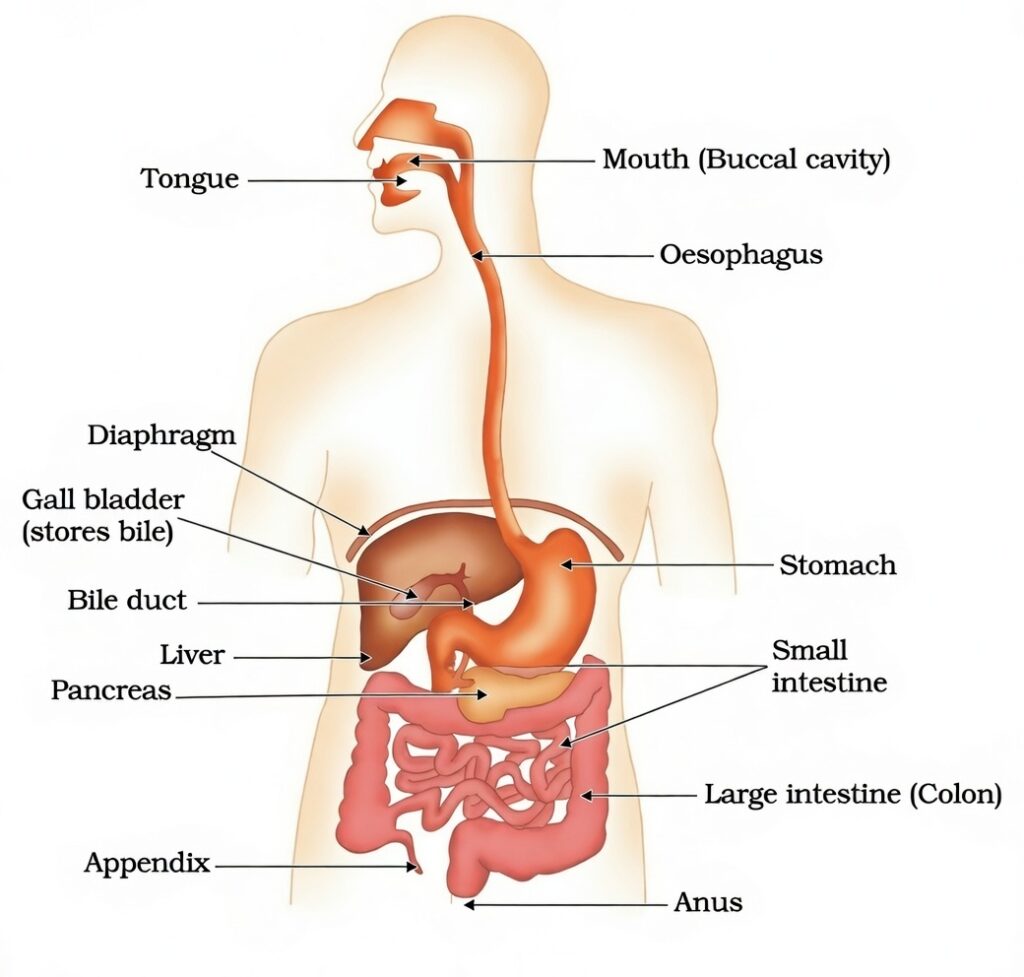
- Mouth → Teeth (cutting, crushing) + Tongue + Salivary glands
- Saliva contains salivary amylase (ptyalin) → starch → maltose.
- Saliva also has mucin (lubrication) + lysozyme (kills bacteria).
- Oesophagus (food pipe) → Peristalsis (wave-like movement pushes food).
- Stomach
- Gastric glands → Gastric juice (HCl + pepsin + mucus).
- HCl – kills bacteria, activates pepsin, makes acidic medium.
- Pepsin – proteins → peptones.
- Mucus – protects stomach wall.
- Small Intestine (main site of digestion & absorption)
- Duodenum receives bile (from liver) + pancreatic juice.
- Bile (emulsifies fats → small droplets).
- Pancreatic juice: Trypsin (proteins → peptides), Amylase (starch → maltose), Lipase (fats → fatty acids + glycerol).
- Intestinal juice: Maltase, Sucrase, Lactase, Peptidases → final digestion into glucose, fructose, amino acids, fatty acids.
- Large Intestine
- Absorbs water + some salts.
- Undigested matter → faeces → rectum → anus.
Key Enzymes & Their Actions (Memorize table)
| Organ/Part | Enzyme | Food Digested | Product |
| Mouth | Salivary amylase | Starch | Maltose |
| Stomach | Pepsin | Proteins | Peptones |
| Pancreas | Trypsin | Proteins | Peptides |
| Pancreas | Pancreatic amylase | Starch | Maltose |
| Pancreas | Lipase | Fats | Fatty acids + Glycerol |
| Small Intestine | Maltase | Maltose | Glucose |
| Small Intestine | Sucrase | Sucrose | Glucose + Fructose |
| Small Intestine | Lactase | Lactose | Glucose + Galactose |
Absorption
- Mainly in small intestine (villi + microvilli increase surface area).
- Glucose, amino acids → blood capillaries.
- Fatty acids + glycerol → lacteals (lymph).
Assimilation
Nutrients used by cells (e.g., glucose → energy via respiration, amino acids → proteins, fats → stored energy).
Respiration – Life Process
- Respiration is the process by which living organisms break down food (mainly glucose) to release energy in a usable form (ATP – Adenosine Triphosphate).
- It is a biochemical process that occurs in cells (cellular respiration).
- Energy released is used for all life activities: movement, growth, repair, transport, etc.
- Respiration ≠ Breathing
- Breathing (or ventilation) is the physical process of taking in oxygen and giving out carbon dioxide.
- Respiration is the overall process including breathing + cellular breakdown of food.
Types of Respiration
| Feature | Aerobic Respiration | Anaerobic Respiration |
| Oxygen requirement | Requires oxygen | Does not require oxygen |
| Site | Cytoplasm + Mitochondria | Only cytoplasm |
| Breakdown of glucose | Complete (to CO₂ + H₂O) | Incomplete (to ethanol/lactic acid + CO₂) |
| Energy released | High (38 ATP per glucose molecule) | Low (2 ATP per glucose molecule) |
| End products | CO₂ + H₂O + Energy | Lactic acid / Ethanol + CO₂ + Energy |
| Occurrence | Most plants & animals (normal conditions) | Yeast, bacteria, muscle cells during heavy exercise |
| Example | Human body during normal activity | Muscle cramps, fermentation in yeast |
Aerobic respiration equation (most important for exams):
C₆H₁₂O₆ + 6O₂ → 6CO₂ + 6H₂O + Energy (38 ATP)
Anaerobic respiration in muscles (lactic acid fermentation):
C₆H₁₂O₆ → 2 Lactic acid + Energy (2 ATP)
Anaerobic respiration in yeast (alcoholic fermentation):
C₆H₁₂O₆ → 2 Ethanol + 2CO₂ + Energy (2 ATP)
Breakdown of Glucose – Common First Step
In both aerobic & anaerobic respiration, glucose is first broken down in the cytoplasm:
Glucose (6-carbon) → Pyruvate (3-carbon)
(This step is called glycolysis → produces small amount of energy)
Then pyruvate takes different paths:
- With oxygen → enters mitochondria → complete breakdown (aerobic)
- Without oxygen → converted to lactic acid or ethanol + CO₂ (anaerobic)
Human Respiratory System
Main function: To bring oxygen into the body and remove CO₂.
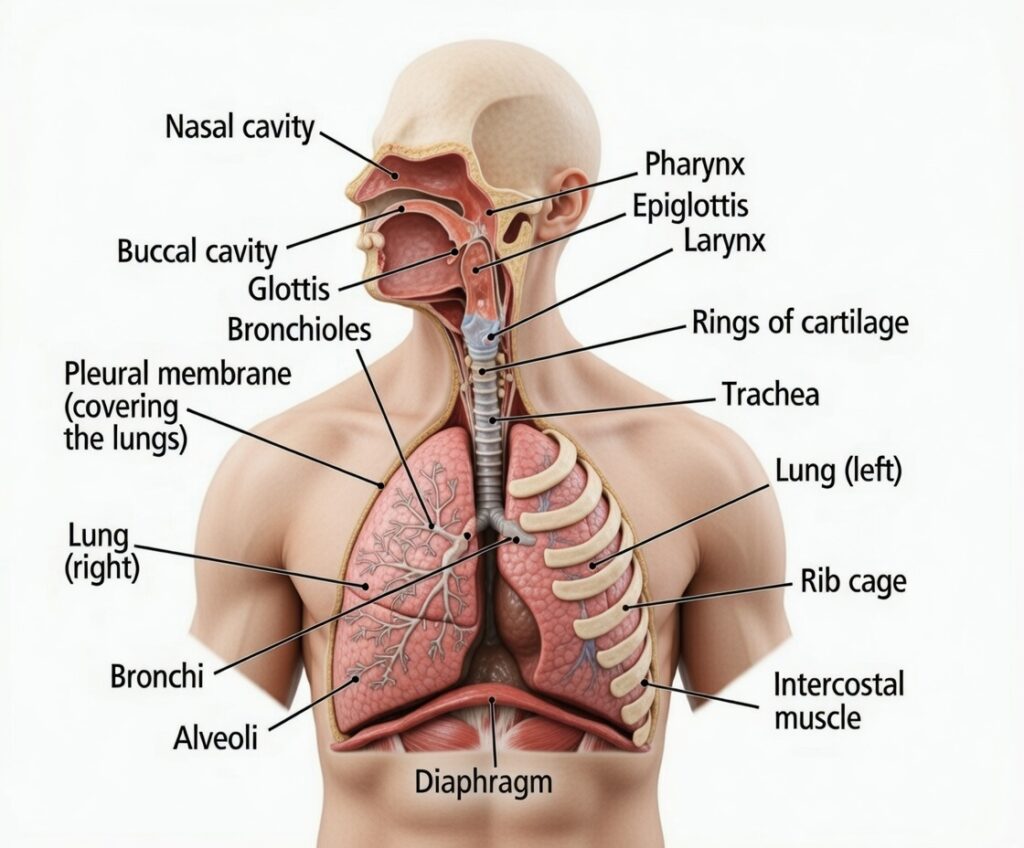
Main Parts and Their Functions
- Nostrils / Nasal cavity
- Air enters through nostrils.
- Fine hair & mucus trap dust, germs.
- Air is warmed & moistened.
- Pharynx
- Common passage for food & air.
- Epiglottis closes during swallowing to prevent food entering trachea.
- Larynx (Voice box)
- Contains vocal cords (sound production).
- Glottis opens/closes during breathing & speaking.
- Trachea (Wind pipe)
- 10–12 cm long tube.
- Has C-shaped cartilage rings → prevent collapsing.
- Lined with ciliated mucus → traps dust & moves it upward.
- Bronchi
- Trachea divides into two bronchi (right & left).
- Enter lungs → further branch into bronchioles.
- Bronchioles
- Fine tubes → end in alveoli.
- Alveoli (Air sacs)
- Tiny balloon-like structures (about 300–500 million in lungs).
- Thin walls (one-cell thick).
- Surrounded by blood capillaries.
- Site of gaseous exchange by diffusion.
- Lungs
- Spongy, elastic organs in thoracic cavity.
- Right lung – 3 lobes, left lung – 2 lobes (to accommodate heart).
- Covered by double-layered pleura (reduces friction).
- Diaphragm
- Dome-shaped muscle below lungs.
- Separates thoracic & abdominal cavity.
- Plays main role in breathing.
Mechanism of Breathing (Inspiration & Expiration)
| Phase | Inspiration (Inhalation) | Expiration (Exhalation) |
| Diaphragm | Contracts & flattens (moves down) | Relaxes & becomes dome-shaped (moves up) |
| Ribs | External intercostal muscles contract → ribs up & outward | Internal intercostal muscles contract → ribs down & inward |
| Thoracic volume | Increases | Decreases |
| Pressure in lungs | Decreases (lower than atmospheric) | Increases (higher than atmospheric) |
| Air movement | Air rushes in (from high to low pressure) | Air rushes out |
| Common example | Normal breathing – active process | Normal breathing – passive process (at rest) |
- Breathing rate in humans: ~15–18 times/min at rest.
- During exercise: rate increases to supply more O₂ & remove extra CO₂.
Exchange of Gases
- In alveoli
- O₂ from alveolar air → diffuses into blood (high O₂ in alveoli, low in blood).
- CO₂ from blood → diffuses into alveoli (high CO₂ in blood, low in alveoli).
- In tissues
- O₂ from blood → diffuses into cells (low O₂ in cells).
- CO₂ from cells → diffuses into blood (high CO₂ in cells).
Transport of Gases in Blood
- Oxygen transport
- ~97% binds with haemoglobin → forms oxyhaemoglobin (in RBCs).
- ~3% dissolved in plasma.
- Carbon dioxide transport
- ~20–25% as carbamino-haemoglobin.
- ~7% dissolved in plasma.
- ~70% as bicarbonate ions (HCO₃⁻) with help of enzyme carbonic anhydrase.
Respiration in Plants
- Plants do not have special respiratory organs.
- Gaseous exchange occurs through:
- Stomata (leaves) – mainly during day & night.
- Lenticels (stems, roots in woody plants).
- General surface of roots.
- Plants respire day & night (unlike photosynthesis which occurs only in day).
- Rate of respiration is low compared to animals → less energy needed.
Transportation – Life Process
- Transportation is the life process by which substances (oxygen, nutrients, water, hormones, waste products like CO₂, urea) are moved within the body of an organism.
- In unicellular organisms → diffusion is enough (no special system needed).
- In multicellular organisms → special transport systems are required because diffusion alone is too slow over long distances.
- Two main topics in Class 10:
- Transportation in Human Beings (Circulatory system)
- Transportation in Plants (Xylem & Phloem)
1. Transportation in Human Beings
- Carried out by the human circulatory system (also called cardiovascular system).
- Main components: Heart + Blood + Blood vessels.
A. Blood – The Transport Fluid
- Blood is a fluid connective tissue.
- Volume in adult: ~4–6 litres.
- Functions: Transports O₂, nutrients, hormones, CO₂, wastes; regulates temperature & pH; protects against diseases.
Composition of Blood
| Plasma | ~55% | Straw-coloured fluid; 90–92% water + proteins (albumin, globulin, fibrinogen), salts, nutrients, wastes. Transports dissolved substances. |
| Red Blood Cells (RBCs) | ~40–45% | Contain haemoglobin (red pigment); biconcave, no nucleus; transport O₂ (as oxyhaemoglobin) & some CO₂. Produced in bone marrow. Life ~120 days. |
| White Blood Cells (WBCs) | ~1% | Fight infections (phagocytosis, antibodies); larger, have nucleus; types: neutrophils, lymphocytes, etc. |
| Platelets | Very few | Cell fragments; help in blood clotting (fibrinogen → fibrin). |
B. Heart – The Pumping Organ
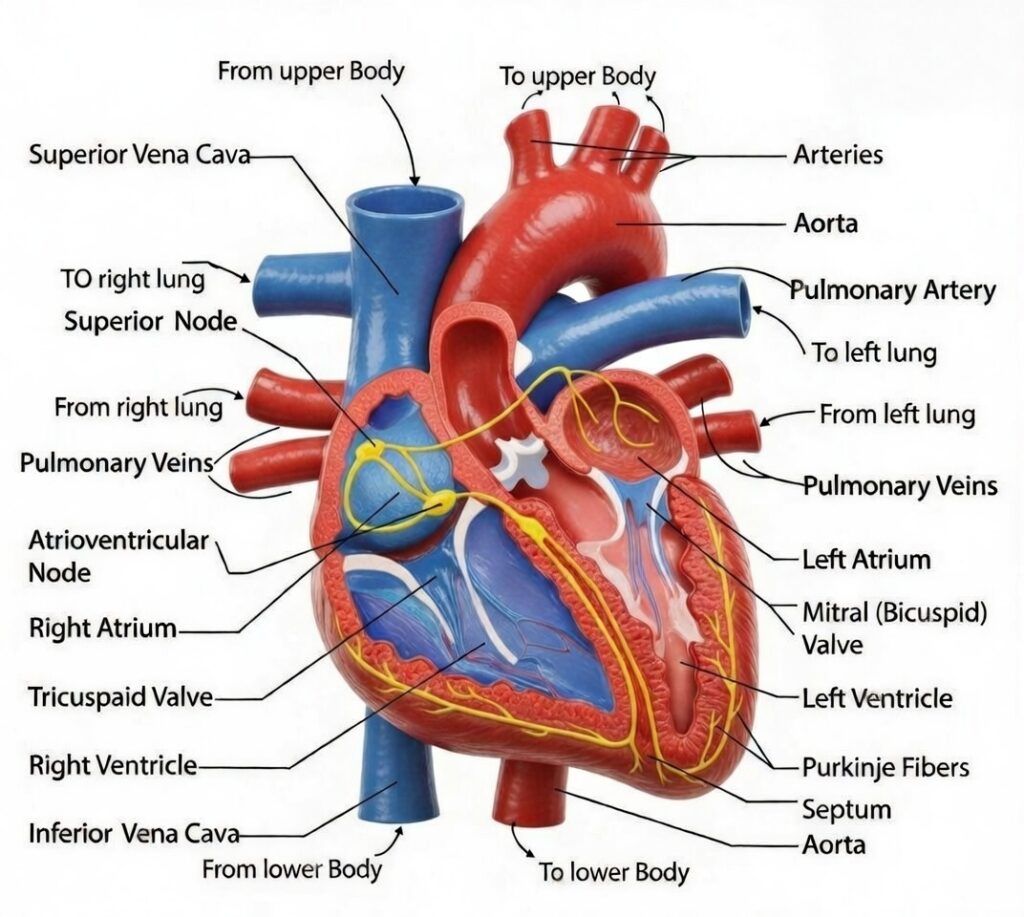
- Muscular organ, size of a fist, located in thoracic cavity between lungs (slightly left side).
- Protected by pericardium (double membrane).
- Has 4 chambers: 2 atria (upper, thin walls) + 2 ventricles (lower, thick walls).
- Right side → deoxygenated blood; Left side → oxygenated blood → prevents mixing (double circulation).
- Valves prevent backflow:
- Tricuspid (right atrium → right ventricle)
- Bicuspid (left atrium → left ventricle)
- Pulmonary & aortic semilunar valves
Double Circulation (most important point for exams)
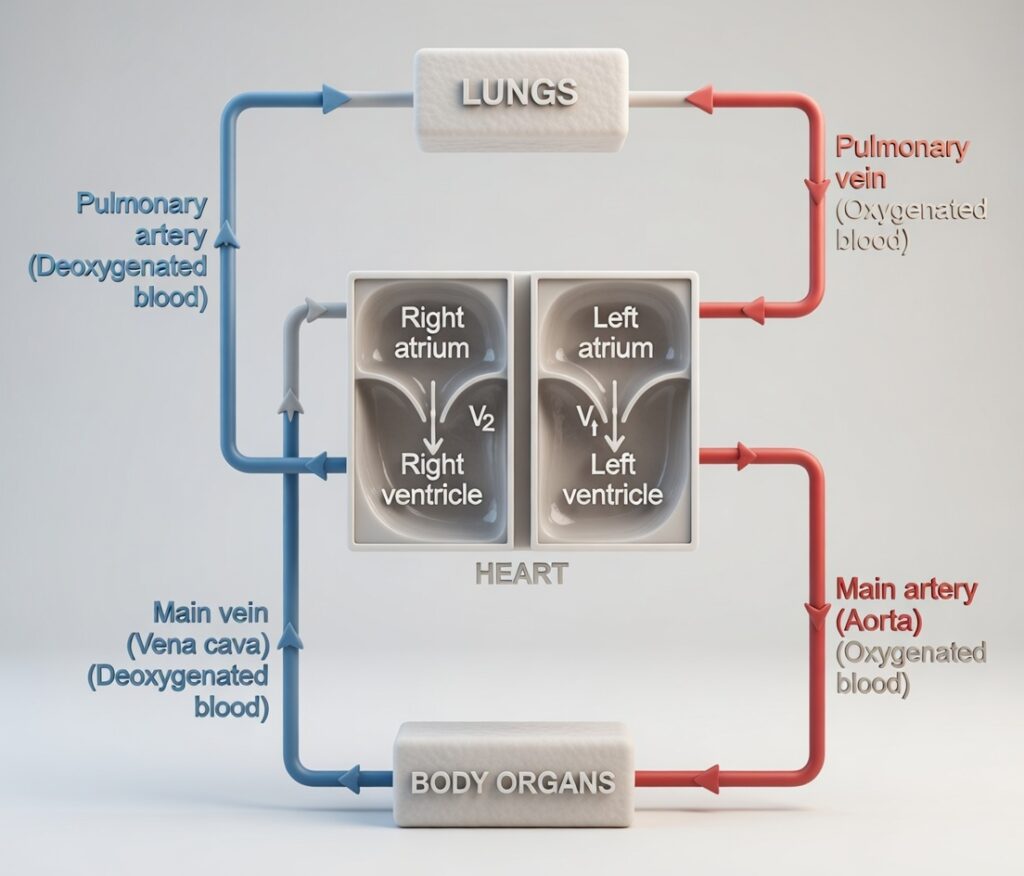
- Blood passes through heart twice in one complete cycle.
- Pulmonary circulation: Right ventricle → lungs → left atrium (for oxygenation).
- Systemic circulation: Left ventricle → body parts → right atrium (supplies oxygenated blood).
C. Blood Vessels
| Arteries | Thick, elastic walls; narrow lumen | Carry blood away from heart under high pressure | Mostly oxygenated (except pulmonary artery) | Heart → organs |
| Veins | Thin walls; wide lumen; valves present | Carry blood towards heart under low pressure | Mostly deoxygenated (except pulmonary vein) | Organs → heart |
| Capillaries | Extremely thin (one-cell thick); no valves | Exchange of gases, nutrients, wastes by diffusion | Both | Connect arteries & veins |
D. Blood Flow / Cardiac Cycle
- Heart beats ~60–100 times/min (average 72–75).
- Systole: Ventricles contract → blood pumped out.
- Diastole: Ventricles relax → blood fills in.
- Heartbeat sound → “LUB-DUB” (valves closing).
E. Lymphatic System (Mentioned briefly)
- Carries lymph (colourless fluid with WBCs).
- Returns excess tissue fluid to blood; absorbs fats from intestine.
2. Transportation in Plants
- No circulatory system like animals.
- Two separate vascular tissues for transport:
- Xylem → unidirectional (upward) transport of water & minerals.
- Phloem → bidirectional transport of food.
A. Xylem – Transport of Water & Minerals
- Made of: Tracheids, vessels (dead, hollow tubes), xylem fibres, xylem parenchyma.
- Water absorbed by root hairs → root xylem → stem → leaves.
- Ascent of sap mechanisms:
- Root pressure – Pushes water upward (small contribution).
- Transpiration pull (main force) – Evaporation of water from leaves (transpiration) creates suction → pulls water column upward (cohesion + adhesion).
- Transpiration also helps in cooling & mineral transport.
B. Phloem – Transport of Food (Translocation)
- Made of: Sieve tubes, companion cells, phloem parenchyma, phloem fibres.
- Transports sucrose + amino acids from leaves (source) to other parts (sink: roots, fruits, seeds).
- Occurs via mass flow / pressure flow hypothesis:
- Sugar loaded in phloem at leaves → osmotic pressure increases → water enters → creates pressure gradient → food moves to low-pressure areas.
Key Differences – Xylem vs Phloem
| Transports | Water + dissolved minerals | Food (sucrose, amino acids) |
| Direction | Unidirectional (roots → leaves) | Bidirectional (leaves → other parts) |
| Cells involved | Mostly dead (tracheids, vessels) | Mostly living (sieve tubes + companion cells) |
| Energy required | No (passive – transpiration pull) | Yes (active loading of sugar) |
| Main process | Transpiration pull | Translocation |
Excretion – Life Process
- Excretion is the biological process of removing harmful metabolic waste products from the body to maintain homeostasis.
- Metabolic wastes include nitrogenous wastes (urea, uric acid, ammonia), excess water, salts, CO₂, and other toxins produced during metabolism.
- Importance: Prevents poisoning of body cells, maintains water & ion balance, and regulates pH.
Excretion in Unicellular Organisms
- Simple organisms (e.g., Amoeba, Paramecium) remove wastes by diffusion directly through the cell membrane into surrounding water.
- No special excretory organs needed.
1. Human Excretory System
- Main function: Remove nitrogenous wastes (mainly urea) from blood and maintain water/salt balance.
- Humans are ureotelic (excrete urea).
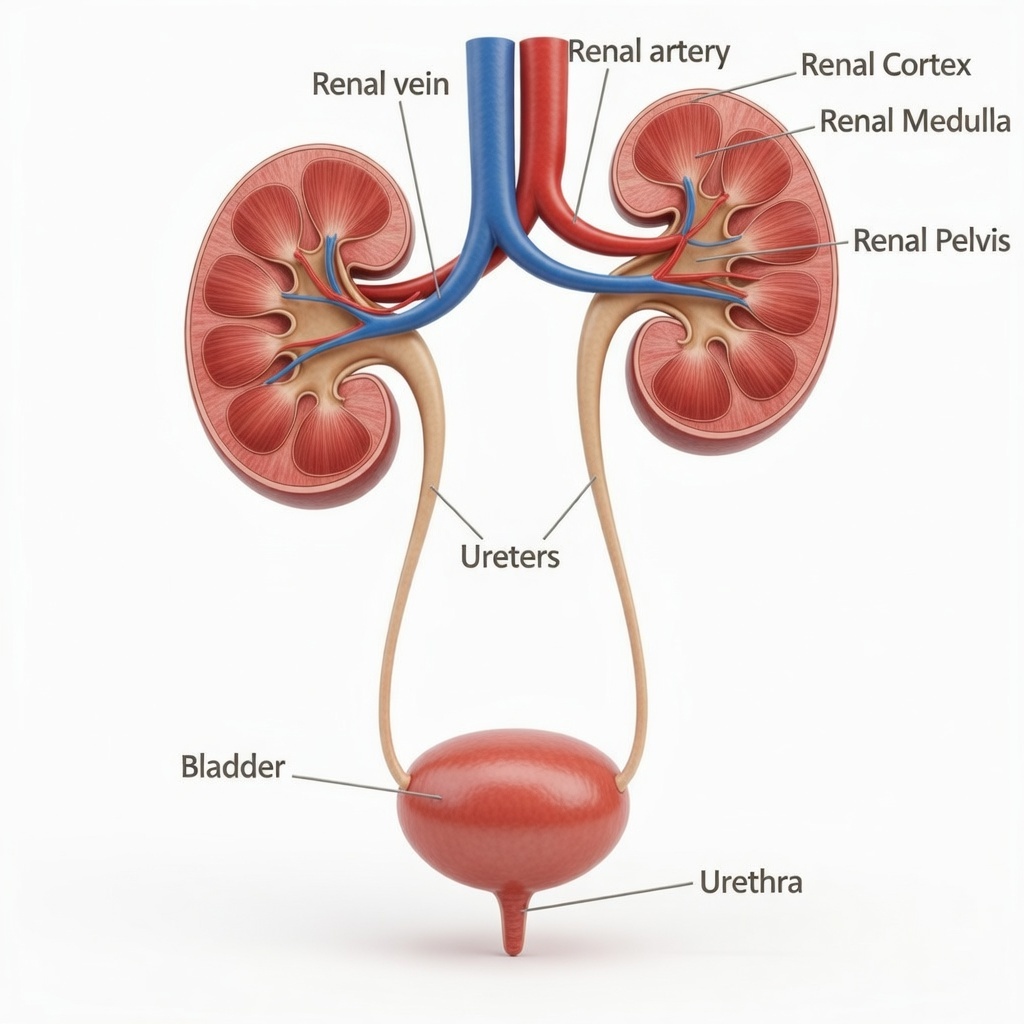
Main Organs of Human Excretory System
| Organ | Description & Location | Function |
| Kidneys | Pair of bean-shaped organs, located on either side of backbone (in abdomen) | Filter blood, remove wastes → form urine; regulate water & electrolytes |
| Ureters | Pair of thin muscular tubes | Carry urine from kidneys to urinary bladder (by peristalsis) |
| Urinary Bladder | Muscular sac in pelvic cavity | Stores urine temporarily (can hold ~400–600 ml) |
| Urethra | Tube from bladder to outside | Releases urine from body (micturition); longer in males |
Other excretory organs (accessory):
- Lungs → CO₂ and water vapour (exhaled)
- Skin → Sweat (water, salts, small amount of urea)
- Liver → Processes toxins, converts ammonia to urea
Structure of Kidney
- Outer: Cortex (light brown)
- Inner: Medulla (darker, with pyramids)
- Each kidney has ~1 million functional units called nephrons (structural & functional unit).
Nephron – Detailed Structure
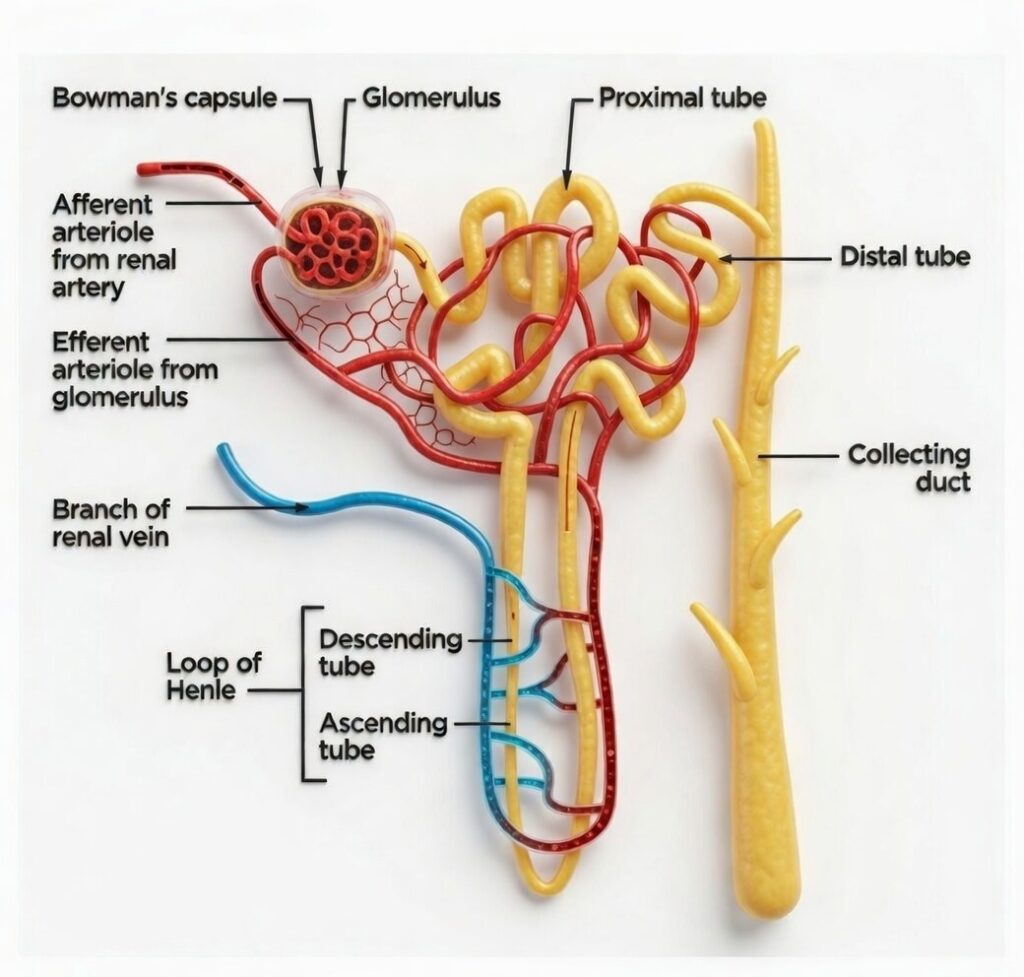
- Bowman’s capsule → Cup-shaped, encloses glomerulus.
- Glomerulus → Cluster of capillaries (from afferent arteriole).
- Renal tubule → Proximal convoluted tubule (PCT) → Loop of Henle → Distal convoluted tubule (DCT) → Collecting duct.
Glomerular filtration occurs in Bowman’s capsule + glomerulus (Malpighian body).
Mechanism of Urine Formation (3 Steps)
- Glomerular Filtration
- Blood enters glomerulus under high pressure.
- Water, glucose, amino acids, urea, salts filter into Bowman’s capsule → forms glomerular filtrate (similar to plasma but no proteins/RBCs).
- Filtration rate: ~125 ml/min (GFR – Glomerular Filtration Rate).
- Tubular Reabsorption (mainly in PCT & DCT)
- Useful substances reabsorbed back into blood:
- 100% glucose, amino acids
- Most water, Na⁺, Cl⁻, etc.
- Selective reabsorption (active & passive).
- Useful substances reabsorbed back into blood:
- Tubular Secretion
- Extra wastes (H⁺, K⁺, ammonia, drugs) secreted from blood into tubule.
- Final urine concentrated in collecting duct (due to counter-current in Loop of Henle).
Urine composition: ~95% water + urea + salts + traces of other wastes.
Regulation of Urine:
- ADH (Antidiuretic hormone from pituitary) → increases water reabsorption → concentrated urine (less volume).
- Aldosterone → increases Na⁺ reabsorption → water follows.
Artificial Kidney (Haemodialysis)
- Used in kidney failure.
- Blood taken out → passed through dialyzer (artificial nephron) → wastes removed by diffusion → clean blood returned.
- Patient needs regular sessions.
2. Excretion in Plants
- Plants lack specialized excretory organs (no kidneys).
- Wastes produced in small amounts → removed or stored harmlessly.
- Plants are autotrophic → different wastes from animals.
Main Excretory Products in Plants
- Gaseous: O₂ (from photosynthesis), CO₂ (from respiration).
- Excess water.
- Nitrogenous wastes (rare, small amounts).
- Organic wastes: Resins, gums, tannins, latex.
Methods of Excretion in Plants
| Method | Description | Examples/Wastes Removed |
| Diffusion through stomata | Gaseous wastes diffuse out during day/night | O₂ (day), CO₂ (night) |
| Transpiration | Loss of excess water as vapour through stomata | Excess water (helps in cooling & ascent of sap) |
| Storage in vacuoles / old tissues | Wastes stored in cell sap or old xylem | Tannins, resins, gums, latex |
| Shedding of leaves / bark / fruits | Waste-laden parts fall off | Wastes stored in falling leaves, peeled bark |
| Excretion into soil | Some wastes released through roots | Organic acids, salts |
| Guttation | Excess water + dissolved substances drip from leaf tips (hydathodes) | Water + small wastes (early morning) |
- Plants reuse some wastes (e.g., O₂ from photosynthesis used in respiration).
- No concentrated urine-like product → no energy wasted on excretion.
Read More
Control and Coordination Class 10 Complete Notes
Conclusion
Life Processes is an important chapter in Class 10 Biology as it explains how living organisms survive and function. Regular revision of nutrition, respiration, transportation, and excretion helps students understand concepts clearly and score better in exams.