
Electricity is one of the most important chapters in CBSE Class 10 Physics. It explains how electric current flows in a circuit, how resistance affects current, and how electrical energy is calculated. In this chapter, students learn key concepts such as electric potential difference, Ohm’s Law, electric power, heating effect of current, and the combination of resistors.
These notes are prepared according to the latest CBSE syllabus. They cover all important definitions, formulas, derivations, and numericals needed for board exam preparation. Clear explanations and step by step concepts make revision easier and more effective.
If you are preparing for the CBSE Class 10 board exam, these Electricity chapter notes will help you strengthen concepts and score better in numericals and theory questions.
What is Electric Current?
Electric current is simply the flow of electric charges (mostly electrons) inside a wire or conductor.
- Formula:
Current (I) = Charge (Q) ÷ Time (t)
I = Q / t - Unit of charge → Coulomb (C)
- Unit of current → Ampere (A)
→ 1 A means 1 Coulomb charge flows in 1 second. - Current is a scalar quantity (only magnitude, no direction needed in basic calculations).
Easy way to remember:
Think of current like water flow in a pipe:
More charge passing per second = stronger current.
Conventional current direction
We say current flows from positive to negative terminal (even though actual electrons move opposite way).
Electric Circuit – The Basic Setup
An electric circuit is a closed loop that allows current to flow continuously.
Main parts usually present:
- Cell / Battery → provides energy
- Wires → path for current
- Switch (key) → open or close the circuit
- Bulb / Resistor → uses the energy
- Ammeter → measures current (always in series)
- Voltmeter → measures voltage (always in parallel)
3. Electric Potential Difference (Voltage)
Voltage is the push or energy difference that makes charges move from one point to another.
- Formula:
V = Work done (W) / Charge moved (Q)
V = W / Q - Unit → Volt (V)
→ 1 Volt means 1 Joule work is done to move 1 Coulomb charge.
Simple analogy
Think of voltage like water pressure in a tank — higher pressure = more push = more current (if pipe is same).
4. Ohm’s Law – The Most Important Rule
Ohm’s Law says:
If temperature doesn’t change, then
Current is directly proportional to Voltage
V ∝ I
V = I × R
(R = Resistance – constant for that conductor)
V-I graph → straight line through origin
Slope of line = Resistance
Super easy triangle to remember Ohm’s Law
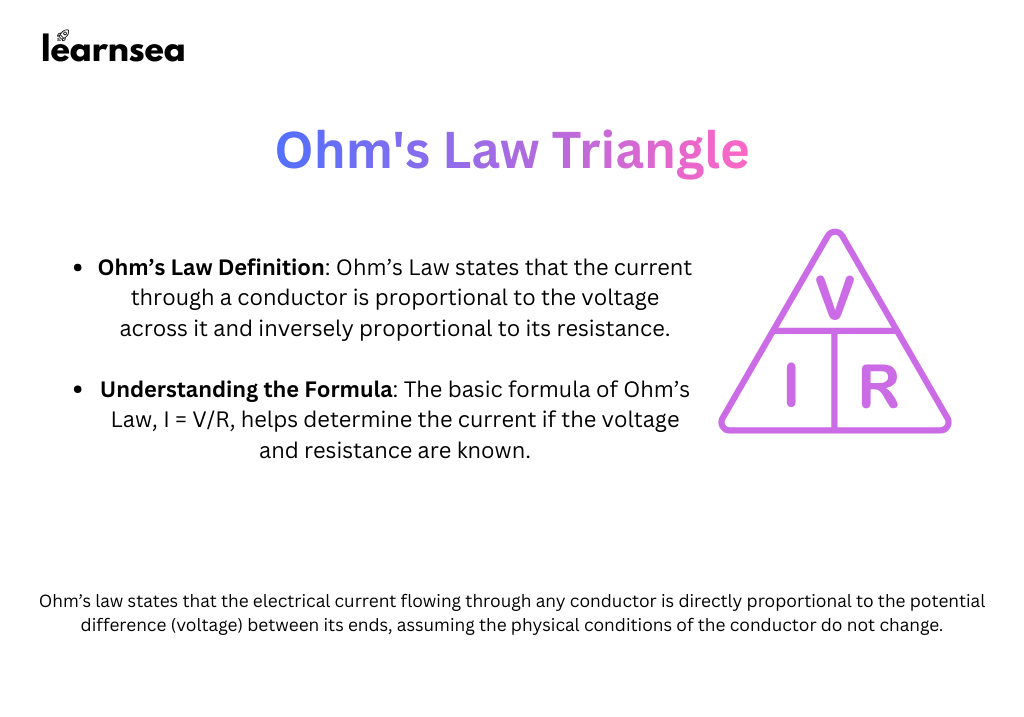
Cover what you want to find:
- Cover V → V = I × R
- Cover I → I = V / R
- Cover R → R = V / I
5. Resistance – Why Wires Oppose Current
Resistance is how much a material opposes the flow of current.
Unit → Ohm (Ω)
1 Ω = 1 V / 1 A
Four things that affect resistance (for a metal wire):
- Longer wire → more resistance (R increases)
- Thicker wire (more area) → less resistance (R decreases)
- Higher temperature → more resistance (for metals)
- Material → Copper < Aluminium < Nichrome (Nichrome has high resistance)
Resistivity (ρ or rho)
It is the “resistance nature” of the material itself (independent of length & thickness).
- Low resistivity → good conductors (copper, aluminium – used in wires)
- High resistivity → good for heating devices (nichrome, constantan)
6. Series and Parallel Connections
Series
- Components connected one after another
- Same current through all
- Total R = R₁ + R₂ + R₃ + …
- If one bulb fuses → whole circuit stops
Parallel
- Components connected side by side
- Same voltage across all
- 1/R_total = 1/R₁ + 1/R₂ + 1/R₃ + …
- If one bulb fuses → others still glow
Quick tip
Series → add resistances directly
Parallel → add their reciprocals (like adding houses in different lanes)
7. Heating Effect of Current (Joule’s Heating)
When current flows through a wire, it gets hot. This is called heating effect.
Joule’s Law formula (most important one):
Heat produced (H) = I² × R × t
(H in joules)
Also written as:
H = V × I × t
H = V² × t / R
Real-life uses:
- Electric heater, iron, toaster, geyser
- Bulb filament (tungsten) becomes white hot → gives light
Electric Fuse – Safety Hero
- Thin wire with low melting point
- If too much current → fuse melts → breaks circuit → saves house from fire
- Always connected in live wire (series)
8. Electric Power & Energy Units
Power = Rate of using electrical energy
P = V × I
P = I² × R
P = V² / R
Unit → Watt (W)
1 W = 1 Volt × 1 Ampere
Memory trick
“Iron men have Super Power”
→ I²R, VI, V²/R
Electrical Energy
Energy = Power × Time
E = P × t = V × I × t = I²Rt
Commercial (bill) unit
1 unit = 1 kilowatt-hour (kWh)
1 kWh = 1000 W used for 1 hour
= 3.6 × 10⁶ Joules
Example for revision
A 100 W bulb used for 10 hours = 100 × 10 / 1000 = 1 unit