
Control and coordination class 10 notes can be helpful for students to prepare well for the board examination. Control and coordination notes class 10 is made by expert teachers. The control and coordination notes can be used for quick revision. According to the latest NCERT and CBSE patterns, the notes are made to help students score high in examinations.
Understanding Movement in Living Organisms
The human body is a complex machine that performs numerous biological functions and processes to maintain and sustain life. Movement in biotic organisms refers to the ability of living organisms to move their bodies.
Control and Coordination in Living Organisms
All living organisms perform various functions to live and respond to the external environment. Many aquatic, aerial, and territorial animals react to the external environment to survive. When any organism responds to the external environment many complex functions and facilitation of hormones take place in the body.
Both plants and animals respond to stimuli differently and perform directional and nondirectional movements. The control and coordination in the vertebrates are controlled by nervous tissues, muscular tissues, and chemical substances called hormones.
The coordination in living organisms takes place due to sensory receptors. The receptors are the organized network of nerves that regulate electrical impulses to various body parts.
Receptors and Sense Organs
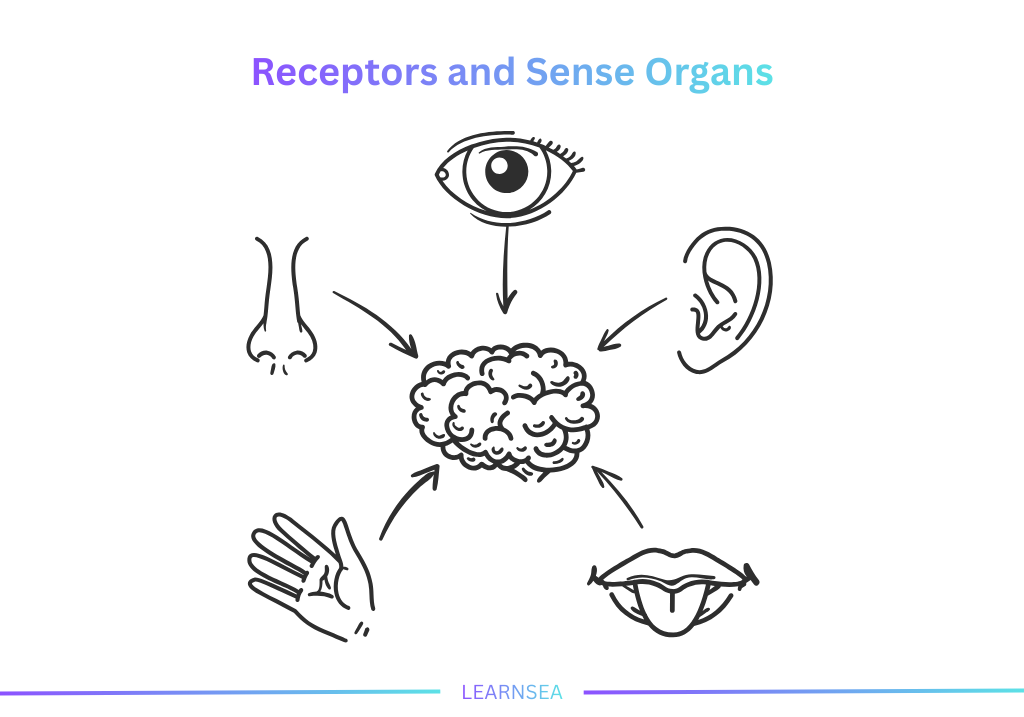
Receptors are located in sensory organs like the skin, ears, eyes, tongue, and nose of the human body. Information from the environment is acquired by specialized tips of nerve cells called receptors. These nerve cells are located in human Sense organs for example:
- Photoreceptors for light (Eye)
- Photoreceptors for sound (Ear)
- Gustatory receptor for taste (Tongue)
- Olfactory receptor for smell (Nose)
- Thigmoreceptor for touch (Skin)
Reflex Action and Reflex Arc
What is Reflex Action?
Reflex action is an autonomic and mechanical response to a stimulus. It acts as an involuntary response that affects glands and muscles and is mediated by the spinal cord. It is the part of the Central nervous system mainly concerned with reflex action.
The action coordinated by reflex requires time to respond. In urgent situations such as touching live electrical wire may cause electric shock, and the body needs a quick reaction to minimize damage.
Ian Pavlov is known as the father of reflex action. He explained that the reflex system is mediated by the spinal cord.
The spinal cord collects electrical impulses from nerves that connect to all body parts. The nerve facilitates the bundle in the spinal cord and transmits impulses to the brain. The spinal cord is the first point where the nerves meet each other and reflex action is mediated by the spinal cord.
After the reaction, the input message collected by the spinal cord through nerves reaches the brain. The brain has no direct role in reflex action.
Examples of Reflex Actions
- Withdrawal of hands when touching hot utensils
- Constriction of the pupil when strong direct light flashed
- Sneezing, coughing, and Yawning
Understanding Reflex Arc
The path followed by reflex action is known as reflex Arc. The reflex arc always moves unidirectional (travels in one direction). The reflex arc follows in the following sequences:
Stimulus → Receptor organs → Sensory nerves → Spinal cord → Motor nerve → Effector → Response
What is the Significance of Reflex Action?
- The reflex action enables the body to mediate quick response to threatening stimuli and thus protect the body
- It also minimizes the overloading of the brain
- The brain is not fast enough to respond in reflex action
- Any lower group of animals has little or lacks a complex neuron network that is needed for thinking
Working of Nervous System in Human
The Working of Neuron
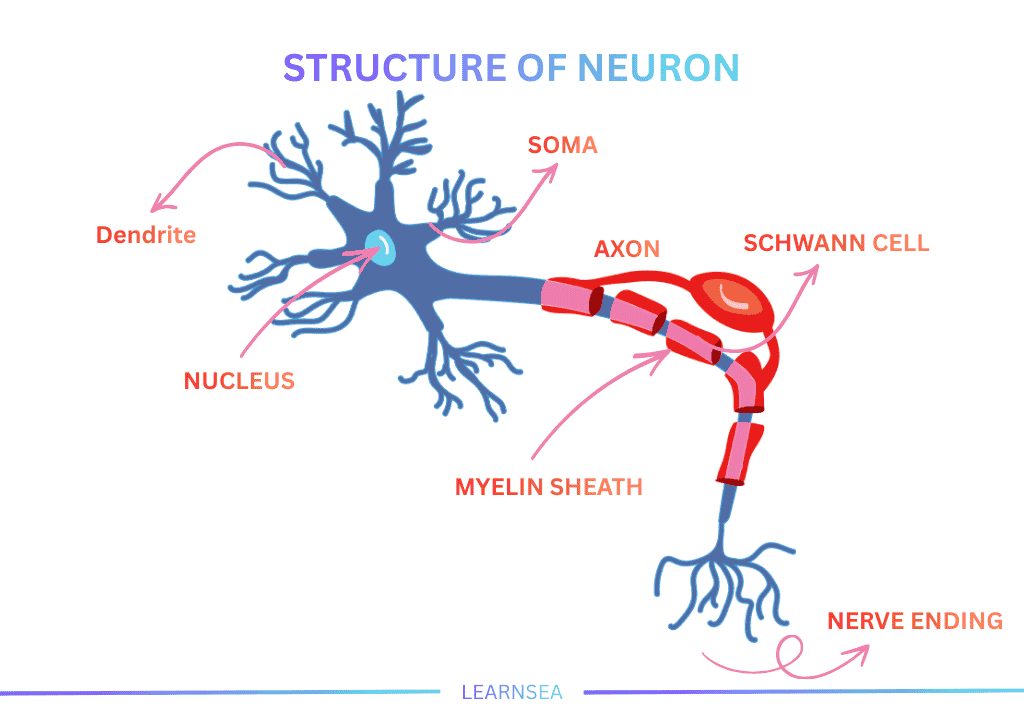
The neuron works based on electrical impulses. The neuron is 10-100 micrometers in size. A neuron is made up of several key parts: dendrites, cytoplasm, a nucleus, an axon, and nerve endings.
- Dendrites: These are hair-like structures that gather electrical impulses from their surroundings. The dendrites collect the electrical impulses and transmit them to the nucleus.
- Nucleus: The nucleus collects the information facilitates the message and transmits the via axon to the nerve ending.
- Axon: Axon has long cylindrical shapes that transmit the electrical impulses from Dendrites to nerve endings. The Axon also supports the flexibility and rigidity of the neuron cell. The Axon is filled with myelin that acts as a protective layer that helps to wrap around the nerve cell.
- Nerve Ending: The nerve ending is the point where the electrical impulses get preserved and transmit impulses to the next consecutive neuron.
- Neurotransmitter: The chemical substance between two neurons is called a neurotransmitter. This chemical helps two neurons to communicate and transmit electrical impulses to the next consecutive neuron.
Types of Nervous System in Animals
The Autonomic Nervous system (ANS) may be further divided into two types Sympathetic and Parasympathetic.
A. Sympathetic Nervous System
Sympathetic plays typical functions that stimulate quick response when needed. It dilates the Pupil and inhibits the flow of saliva via the Salivary gland, It also accelerates heartbeats and relaxes the bladder.
B. Parasympathetic Nervous System
Parasympathetic plays various actions that do not require immediate reactions to respond in an external environment.
The Sympathetic works as an accelerator and the Parasympathetic division works as a brake.
How Does Nervous Tissue Stimulate Action in Muscles?
The nervous issue gets electrical impulses from receptors and sends them to the brain (CNS). The brain is stimulated by the message and responds to make decisions. The Nerve impulses then reach the muscles and the fiber moves by contraction and relaxation of muscle cells.
The muscle cells facilitate contraction and relaxation by a special type of protein called Actin and Myosin. The process is done by neuro-hormones to transmit electrochemical impulses to muscles by ATP and Ca++ ions.
Overall Pathway: Nervous tissue → Collect information → Transfer information → Brain processes information → Interpretation → Action (by Muscle & Glands)
The Working of the Human Brain
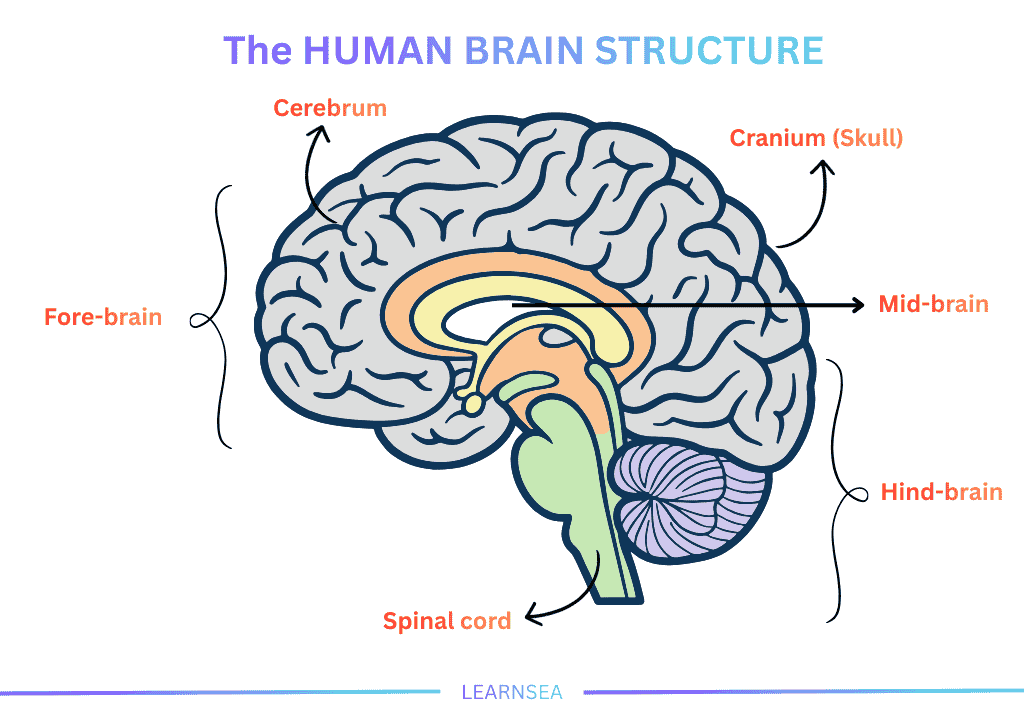
The brain is part of the CNS that regulates and manages important functions. The delicate brain is enclosed in the cranium tissue and covered by cerebrospinal fluid that secures the delicate brain cells and tissues from any kind of mechanical shock.
The Human brain is covered with three layers called meninges such as the Outer Dura-mater, Arachnoids, and Pia mater. The spinal cord gets secured by the meninges fluid and vertebral column.
The human brain consists of three main parts such as the forebrain, midbrain, and hindbrain.
A. The Forebrain (Cerebrum)
The forebrain is the part of the human brain responsible for thinking and higher cognitive functions. The cerebrum is the largest part of the human brain The forebrain also controls voluntary actions and stores information (Memory). The forebrain stimulates when a person is starving. The forebrain receives sensory impulses from various parts of the body in order to respond appropriately.
Four Parts of Cerebrum
1. Frontal Lobe Located in the forebrain that controls Reasoning, Thinking, Language, Emotions, Judgment, motor functions, movement, Short-term memory, inhibition of behavior, Anticipation, Speaking expressive language, Emotional expression, Self-monitoring, motor planning, Personality, Limitations, Sexual behavior, Concentration, Mental flexibility.
2. Temporal Lobe Located in the frontal part of the brain which assists in understanding language, organization and sequencing, Memory, feeling, and music awareness.
3. Parietal Lobe Located behind the hindbrain helps us to understand hearing, Sensation, reading, Smell, Taste, Touch, Academic skills, math calculation, Visual perception, and differentiation of size, shape, and color.
4. Occipital Lobe Controls vision, Colour identification, Reading (Perception and recognition), and Visual identification.
The Diencephalon
The diencephalon is the brain’s smallest component.
Thalamus: A relay station that gets sensory information and passes it on to the cerebral cortex. The Thalamus controls human psychological feelings, sleep cycle, and wakefulness.
Hypothalamus: Called the master gland that regulates and maintains body temperature (37 degrees Celsius) called thermostat. The Hypothalamus also controls desire, food, and water intake, and controls the sleep cycle.
The Midbrain
The midbrain connects the forebrain with the hindbrain. The midbrain facilitates hearing, vision, and motor control, and regulates body temperature.
Brain Stem
The brain stem is the part of the Midbrain and Hindbrain that regulate breathing. The brain stem controls blood pressure, Alertness, Ability to sleep, swallowing, Ability, Sweating, blood vessel control, and the autonomic nervous system.
The Hindbrain
The hindbrain is a crucial part of the brain, comprising the pons, medulla oblongata, and cerebellum. Understanding this structure enhances our appreciation of how our brain governs essential processes for our overall well-being.
Pons: Act as a bridge between different parts of the brain. It also transfers signals between the cerebrum and Cerebellum. It controls involuntary actions in the human body such as breathing, and sleep regulation. Pons has a Pneumotaxic and amnestic center which controls the rhythm of breathing and ensures smooth and regular breathing.
Medulla Oblongata: The medulla Oblongata controls Involuntary actions such as Heartbeats, blood pressure, Digestion, swallowing, and sneezing. The medulla sends electrical impulses to the lung’s diaphragm and chest Cavity to make it contract and relax.
Cerebellum: Located at the back of the brain and controls the coordination of voluntary movement that helps in balancing, balance, Attention, and Vestibular (sense of balance). The cerebellum also controls reflex motor acts.
The Hormones in Human Body
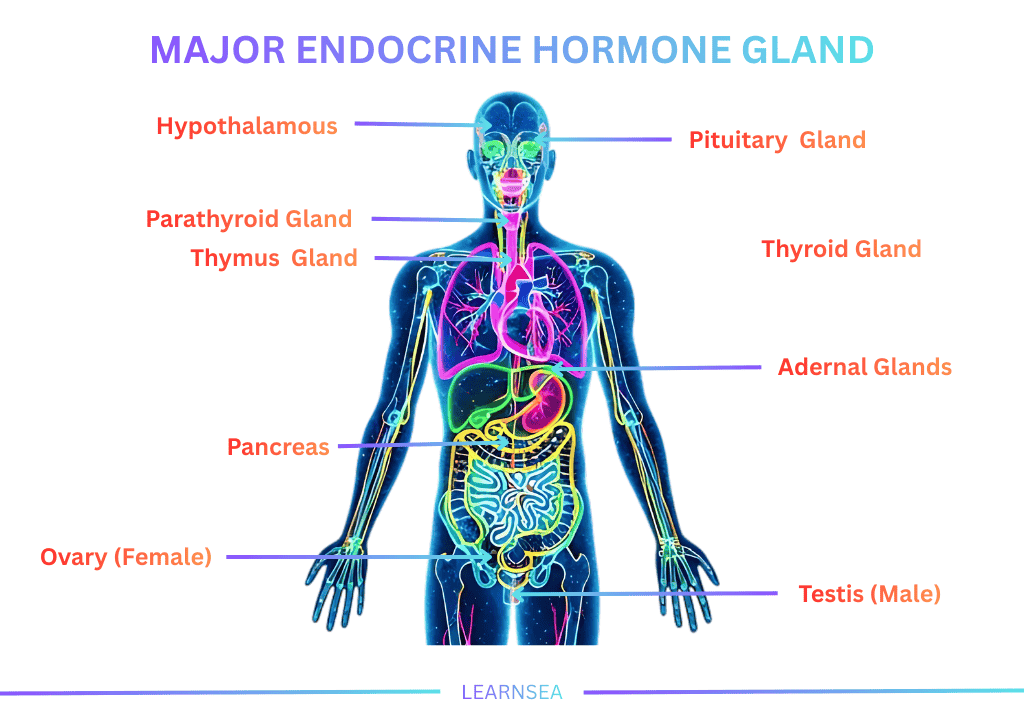
The term “Hormone” was introduced by two great scientists Bayliss and Starling. Hormones are chemically composed of proteins and lipids (fats).
The different types of hormones in the human body. The target site is affected by hormones, which facilitate certain actions in the human body. The endocrine gland directly secrete in blood streams and acts on target sites.
Major Endocrine Glands and Their Hormones
Hypothalamus
Present in the forebrain. It maintains the mechanism and controls the secretion of hormones from the pituitary gland. The hypothalamus acts as the Master gland.
Hormones Secreted:
- ADH (Vasopressin): Regulates water and electrolyte balance in the body
- Oxytocin (Birth hormone): Regulates the ejection of milk during Lactation. The smooth muscles of the uterus contract during childbirth
Pituitary Gland
The pituitary gland, is located near the forebrain and is often referred to as the master gland because it regulates the activity of other endocrine glands.
Hormones Secreted:
- Growth Hormone: Regulate the growth and development of bones and muscles. Excess secretion causes gigantism, and less secretion causes dwarfism
- Prolactin: Regulates the functions of the mammary gland in females
Thyroid Gland
The Thyroid gland is present in the neck on either side of the trachea.
Hormone Secreted:
- Thyroxine: Regulates BMR (Basal Metabolic rate in the body). Iodine mineral is needed to produce thyroxine. It regulates the metabolism of fats, protein, and Carbohydrates for the balanced growth of the body. In Amphibians it regulates metamorphosis in tadpole larvae of frogs
Parathyroid Gland
This gland is embedded in the thyroid gland and there are four in total.
Hormones Secreted:
- Calcitonin and Parathormone: Regulate calcium and phosphate levels in the blood that move calcium from bones to blood. Although it increases calcium levels in the blood
Thymus
Present in the chest cavity.
Hormone Secreted:
- Thymosin: Stimulates immune responses and helps to produce antibodies to fight foreign germs. The thymus gland degenerates when actual maturity attained
Adrenal Gland
The adrenal glands are two in number and located above the kidney. The adrenal gland also known as the suprarenal glands. The Adrenal gland consists of two parts outer cortex and the Inner medulla.
Hormones Secreted:
- Corticosteroids: Regulates carbohydrate metabolism, Mineral balance, and sexual development
- Adrenaline: Secreted in case of stress and sudden emergencies and increases heartbeat. The gland works of three major principles Flight, Fright, and Fight
Pancreas
It is leaf-like structure present below the stomach.
Hormones Secreted:
- Insulin: Lowers the blood glucose and converts sugar into glycogen
- Glucagon: Increases the blood glucose and transforms glycogen into sugar
This gland maintains sugar levels in the human body.
Testes
In males, testes are present in the scrotum producing male sex cells.
Hormone Secreted:
- Testosterone: Develops male accessory organs and secondary sexual characteristics such as armpit hair, genital hair, beard, Voice, and Mustache
Ovaries
In females, the ovaries are located in the lower abdomen and perform two important functions as production of female gamete and female sex hormones.
Hormones Secreted:
- Estrogen and Progesterone: Develops female accessory sex organs and secondary sexual character of females such as breast (Mammary Gland), soft skin, hair pattern, and feminine pitch voice. This gland also controls the menstrual cycle and helps in the maintenance of pregnancy.
Plant Hormones (Phytohormones)
The plant hormones also known as phytohormones responsible for plant growth and development of various plant tissues. The plant hormones are divided into four types they are as follows:
- Auxins: This hormone helps in the growth of plant tissue
- Gibberellins: Helps in the growth of the stem, germination, flowering, cell division, and plant growth
- Cytokinin: It promotes cell division and prevents the aging of plant leaves
- Abscisic Acid: It inhibits or stops the growth of the plant leaves and helps in the dormancy of buds and seeds
Plant Movements
The plant responded to various stimuli in nature. The plant movement can be divided into two main types. The directional movement in plants is known as trophic movement and nondirectional movement in plants known as the Nastic movement. Trophic movement or Tropism in plants is divided into five major types:
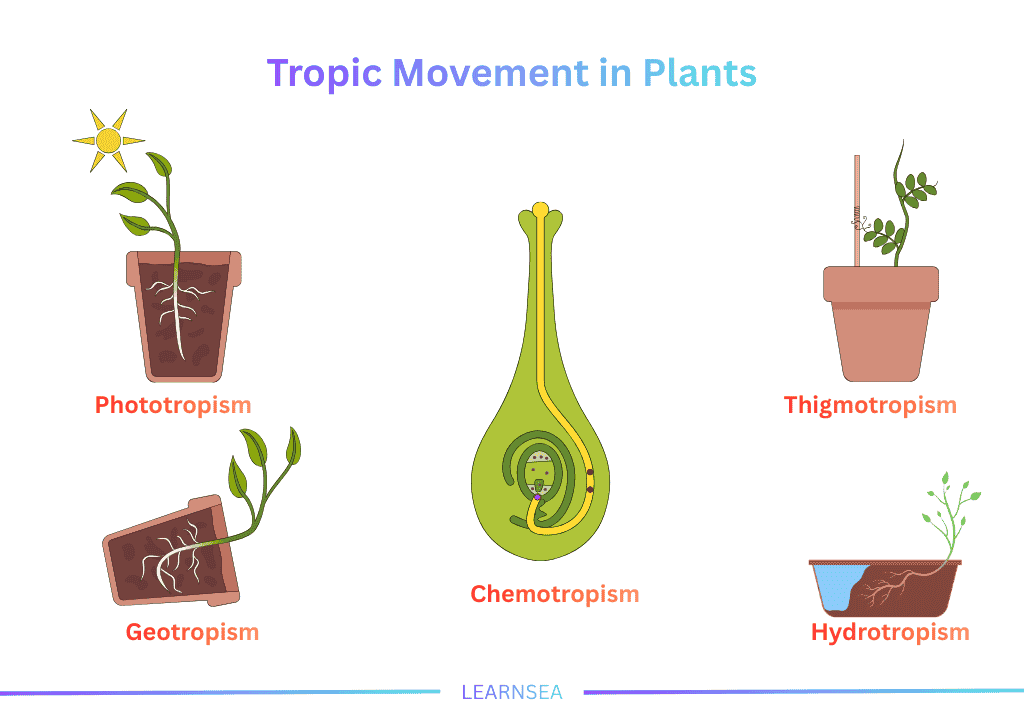
1. Phototropism (Stimuli – Light)
The phototropism The plant shoots and apical tissues of the plant respond to light. In the experiment, we placed the plants in a dark room and opened a space in the window in which light entered the room. In a few days, the plants shoot and start moving towards sunlight. The movement of plants towards sunlight shows that plants can be moved towards sunlight.
2. Hydrotropism (Stimuli – Water)
The plant roots move in the direction of the water in the ground. The hydro (Water) + Tropism (Direction). The plant roots move towards water in the ground termed directional movement towards water. In the experiment, we place a plant in the ground then its roots automatically start moving toward the source of water to retain water for growth. As we know, Water is essential for plant growth, the movement is directional towards the source of water.
3. Geotropism (Stimuli – Earth)
When the plant’s roots move downwards due to gravity. The plant shoot always moves in an upward direction due to sunlight and the roots always move downwards. The movement of roots is caused by the earth’s gravity.
4. Chemotropism (Stimuli – Chemical)
Chemotropism is the directional movement of pollen grains towards the carpel in the plant to form seeds in the plant. In reproduction in plants, the stamen contains anther and filaments. In the anther, the micron particles known as pollen grains fall on the stigma and start moving downwards by the narrow passage towards the ovary. After that, it enters in ovary of the plant and facilitates reproduction in the plant to form offspring known as seeds.
5. Thigmotropism (Stimuli – Touch)
Thigmotropism is a directional movement of the tiny tendrils of a pea plant coil around a support (like a stick or wood) in response to touch. This is thigmotropism, a directional growth movement.
Nastic Movement
Nasty movement is non-directional. The plant parts move but in the specified directions for example the plant known as Dandelions may blossom in the day and Moonflower (Ipomoea alba) blossom only at night. Note that these flowers burst in response to light but the direction is not specified.
On one hand, the leaves also move in response to touch. When the water content in the leaves pulvinus fills up, it swells. When we touch it, due to electrical conductivity, it starts shrinking by losing extra water.
Thigmonasty
The Mimosa Pudica plant’s leaves fold inwards due to the response of touch. Experimentally, if we touch “Mimosa Pudica” folds inwards due to electrical impulses generated by our body that stimulate plants’ movement of leaves.
Differences Between Tropic Movement and Nastic Movement
| Direction of Stimulus | Depends on the direction of the stimulus (e.g., light, gravity) | Independent of the direction of the stimulus |
| Type of Response | Directional growth movement (e.g., roots growing towards gravity) | Non-directional movement (e.g., folding of Mimosa leaves when touched) |
| Cause | Caused by external stimuli like light, gravity, or water | Caused by internal stimuli or external factors like temperature, touch, or light intensity |
| Type of Plant Part Involved | Involves growing parts like roots and shoots of the plant | Usually involves non-growing parts like leaves or petals |
| Examples | Phototropism (plant bends toward light), Geotropism (roots grow downward) | Thigmonasty (touch response in Mimosa), Photonasty (flower opening/closing due to light) |
FAQs: Control and Coordination Class 10 Notes
Q1. What is Control and Coordination in Class 10 Biology?
Control and coordination is the biological process where organisms respond to stimuli in the external environment.
Q2. Are these notes helpful for board exams?
Yes, These notes are prepared by experts and majorly focused on board examination PYQs and CBSE question patterns. These notes can be used by students to score high in board examinations.
Q3. How can I use these notes for revision?
You can read NCERT book chapter 7 Control and Coordination chapter to understand the overall concepts. One can use our notes to revise important key points and quickly recall tables and diagrams.
Q4. Are the notes based on the NCERT textbook?
Yes, The notes are based on the NCERT textbook and we have followed CBSE guidelines to prepare the best notes possible.
Q5. Do I need additional study material after using these notes?
No, The control and coordination notes are more than sufficient to prepare for the board examination. However, one can revise the previous year’s question papers for revision.
Conclusion
We hope the Control and coordination notes helped you to understand concepts easily. If you have any queries then let us know below the comment section we will reply at the earliest. Control and Coordination Class 10, CBSE Class 10 Biology Notes, Reflex Action, Nervous System, Human Brain, Hormones, Plant Movements, Tropism, Nastic Movement, NCERT Chapter 10 Notes