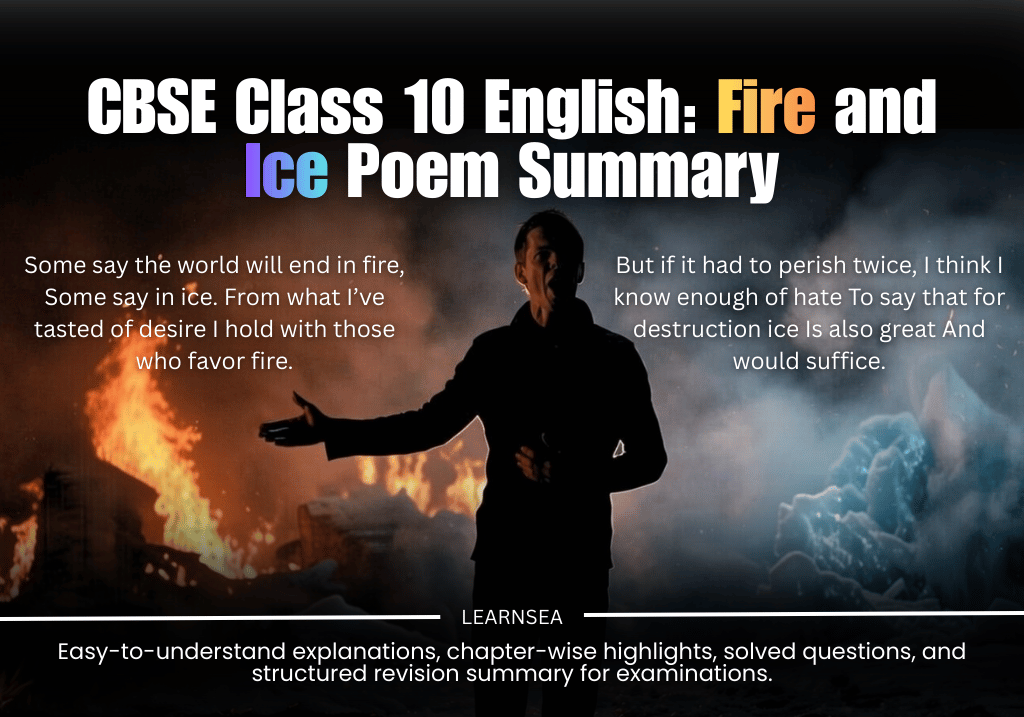

Chapter 1 of the Class 10 English textbook First Flight features two poems, and the second one is “Fire and Ice” by Robert Frost. This short poem shows how a brief reflection on human emotions can reveal the powerful destructive forces within us and offer a profound understanding of our own nature.
The summary provided here are designed to help students understand the poet’s viewpoint and the message he conveys through simple yet striking imagery and symbolism. By going through this summary, students can revise important ideas effectively before exams.
They can also explore additional CBSE English summary and essay materials to improve their writing and preparation for the language paper.
Robert Frost Fire and Ice Class 10 – Short Summary in English
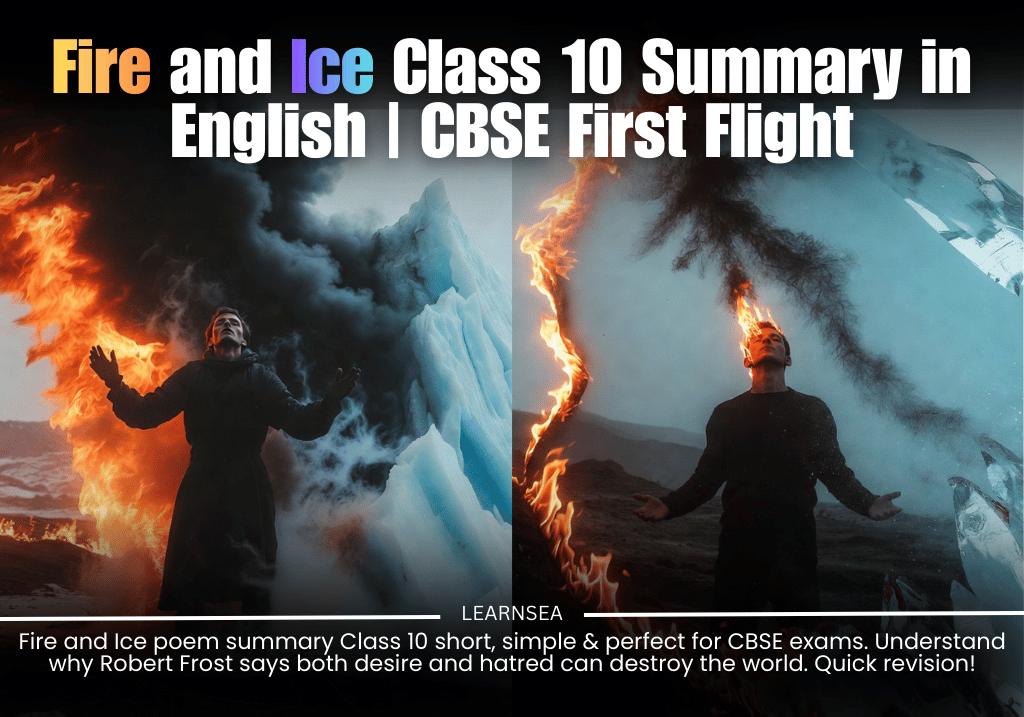
“Fire and Ice” by Robert Frost is a short poem that explores how the world might end. The poet discusses two possible ways: through fire or through ice. Fire symbolizes desire, passion, and uncontrolled emotions, while ice represents hatred, coldness, and indifference. Frost reflects on human feelings and suggests that either strong desire or intense hatred can destroy the world.
The poem is inspired by Frost’s observations of human nature. He uses fire and ice as metaphors to explain how emotions can have powerful and destructive effects. The poet also shares his personal opinion, saying he finds both possibilities believable, though he slightly prefers fire as the more likely cause.
In short, the poem teaches that emotions, whether burning desire or freezing hate, can have serious consequences. It is a reflection on human behavior and the power of feelings.
Fire and Ice Stanza wise Summary with Lines
Stanza 1 (Lines 1–4)
Lines:
“Some say the world will end in fire,
Some say in ice.
From what I’ve tasted of desire
I hold with those who favor fire.”
Summary:
In these lines, the poet talks about two opinions regarding the end of the world. Some people believe it will end in fire, while others believe it will end in ice. From his own experience of desire, the poet agrees with those who think fire will destroy the world. Here, fire symbolizes human desire, greed, and uncontrolled passion.
Stanza 1 (Lines 5–9)
Lines:
“But if it had to perish twice,
I think I know enough of hate
To say that for destruction ice
Is also great
And would suffice.”
Summary:
In these lines, the poet reflects on hatred, which is symbolized by ice. He says that if the world had to end again, hatred would be enough to destroy it. Ice represents coldness, hatred, and lack of emotions. The poet concludes that ice is as destructive as fire and would be sufficient to end the world.
Fire and Ice – Figures of Speech
- Metaphor
- Fire is a metaphor for desire, greed, and uncontrolled passion.
- Ice is a metaphor for hatred, coldness, and lack of emotions.
- The end of the world is a metaphor for self-destruction of humanity.
- Symbolism
- Fire symbolizes intense human desires.
- Ice symbolizes hatred and emotional coldness.
- Both symbolize forces that can destroy society.
- Alliteration
- “Some say the world will end in fire”
- Repetition of the ‘s’ sound.
- Antithesis
- Fire and ice are opposite elements, used together to highlight contrasting human emotions.
- Irony
- Fire and ice are opposites, yet both lead to the same result: destruction.
- Personification
- “From what I’ve tasted of desire”
- Desire is treated as something that can be tasted.
FAQ: Fire and Ice by Robert Frost
1. Who is the poet of the poem Fire and Ice?
The poem Fire and Ice is written by Robert Frost, a famous American poet.
2. What is the central theme of the poem (Fire and Ice)?
The poem talks about how the world might end, either because of fire (desire) or ice (hatred). Both emotions are dangerous.
3. What does “fire” symbolize in the poem?
“Fire” symbolizes desire, greed, passion, and uncontrolled wants that can destroy humanity.
4. What does “ice” symbolize in the poem?
“Ice” symbolizes hatred, coldness, indifference, and cruelty among people.
5. Which does the poet prefer as the cause of the world’s end and why?
The poet first supports fire because he has experienced desire and knows its destructive power.