

Poetry in Class 9 English introduces students to deep emotions and meaningful ideas. I Cannot Remember My Mother by Rabindranath Tagore is a touching poem that shows how a child feels the presence of his mother through memories and nature. The poem highlights the everlasting bond between a mother and her child.
This article provides a simple summary of “I Cannot Remember My Mother” along with explanations helpful for NCERT solutions, Kaveri English textbook preparation, and English Literature understanding. It will help students grasp the poem’s main ideas quickly and prepare effectively for exams.
I Cannot Remember My Mother Summary and Explanation
What the Poem is About?
This is one of Tagore’s most touching short poems from his collection The Crescent Moon (about childhood). It celebrates motherly love in a soft, spiritual way. The little child (or the speaker) says he cannot clearly remember his mother’s face or voice because she is gone (probably she passed away when he was very young). But even without clear memories, her love and presence come back to him in small, beautiful everyday things. These moments make him feel his mother is still near him, like a soft, loving feeling all around.
Even if we cannot remember someone we lost (like a mother who died early), their love never really goes away. It lives on in small, beautiful things around us – a song, a flower smell, the sky. Mother’s presence becomes part of nature and our feelings forever. The poem shows how deep a mother’s love is – it stays even when memories fade.
I Cannot Remember My Mother Stanza – I

The child cannot remember his mother’s face, but when he is playing happily, a sweet tune suddenly comes into his mind. It is the lullaby (soft song) his mother used to sing while gently rocking his cradle when he was a baby. That music makes him feel his mother is close again.
I Cannot Remember My Mother Stanza – II
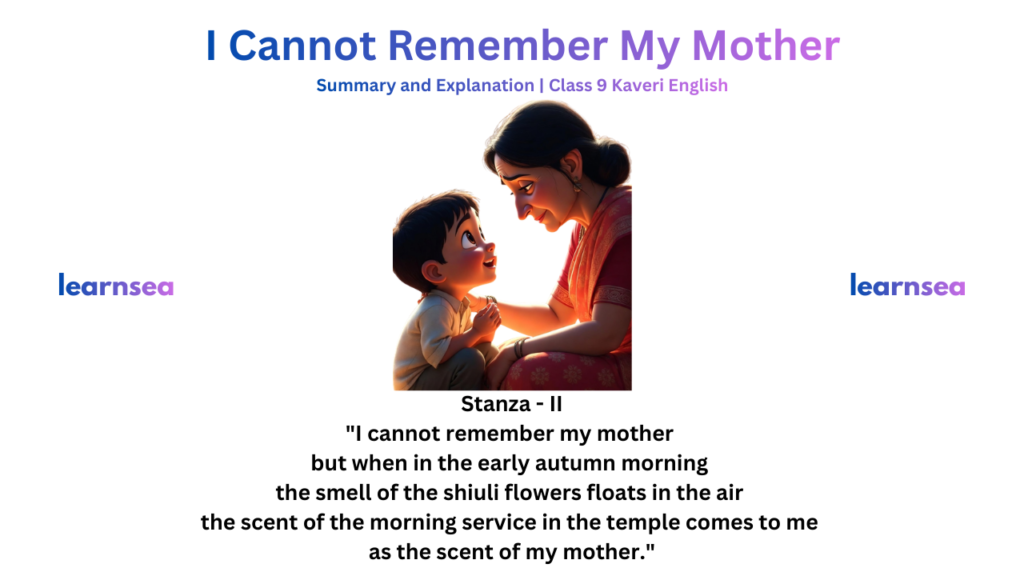
He still cannot picture his mother, but in the early morning of autumn, when the sweet smell of shiuli flowers (a white, fragrant flower common in Bengal during autumn) spreads in the air, he remembers the smell of the morning prayers (puja) in the temple. To him, that beautiful temple scent feels exactly like his mother’s loving presence – pure, peaceful, and comforting.
I Cannot Remember My Mother Stanza – III
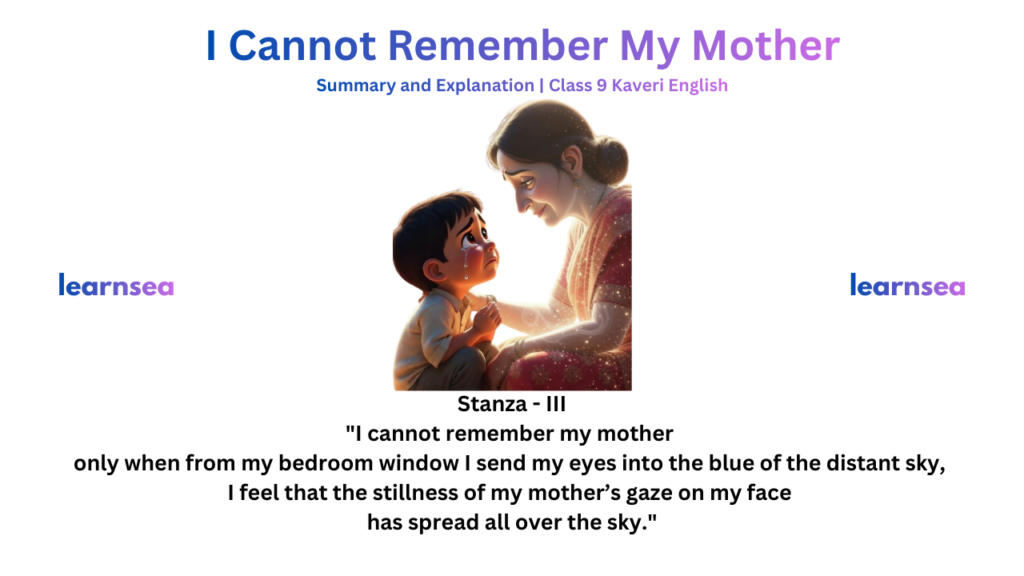
He cannot recall his mother clearly, but when he looks out from his bedroom window into the vast blue sky far away, he feels something special. The calm, loving way his mother used to look at him (her gentle gaze) now seems to fill the entire sky. The quiet, endless blue sky feels like his mother’s peaceful eyes watching over him with love.
Poetic Devices – I Cannot Remember My Mother
- Repetition — “I cannot remember my mother” appears at the beginning of each stanza. It first shows the poet’s sadness but later suggests that even without clear memories, his mother’s presence remains everywhere.
- Imagery — The poem creates vivid sensory pictures: the soft sound of a lullaby, the fragrance of shiuli flowers and temple incense, and the calm blue sky. These details make the emotions gentle and vivid.
- Personification — The tune “hovers” over playthings and the mother’s gaze seems to spread across the sky, giving human qualities to memories and feelings.
- Symbolism — Shiuli flowers and temple fragrance represent purity and devotion; the cradle song represents a mother’s care in childhood; the vast blue sky suggests the mother’s endless love watching from above.
- Sensory Appeal — The poem appeals to different senses: sound (lullaby), smell (flowers and incense), and sight (blue sky), connecting the mother’s love with nature.
- Tone — The tone is gentle, tender, and nostalgic, expressing quiet love rather than deep sorrow.
Read More
Winds of Change Class 9 Kaveri English Chapter Summary
Gifts of Grace Honouring Our Vocations Summary Class 9
In a Nutshell
I Cannot Remember My Mother by Rabindranath Tagore beautifully shows that a mother’s love never fades. This Class 9 poem summary and explanation highlight how the poet feels his mother’s presence through nature, memories, and emotions. The poem reminds readers that a mother’s love is eternal and continues to live in a child’s heart.