
Reported Speech Speech is an important topic for Class 10 English. Learnsea explains the rules in a simple way with clear examples. Students can easily understand how to change sentences from direct to indirect speech and score better in exams with these easy notes.
What is Direct and Indirect Speech?
Imagine your friend tells you something, and you want to tell someone else what your friend said. You have two ways to do this! When you repeat exactly what someone said, using their same words, that’s called Direct Speech.
Example:
- Tejash said, “I am hungry.”
- Mother said, “Clean your room now.”
How to Write Direct Speech:
- Put the spoken words inside quotation marks (” “)
- Add a comma before the quotation marks
- The first word inside quotes starts with a capital letter
Indirect Speech (Reporting Speech)
When you tell someone what another person said without using their exact words, that’s called Indirect Speech or Reported Speech.
Example:
- Nitin said that he was hungry.
- Mother told me to clean my room.
How to Write Indirect Speech:
- No quotation marks needed
- No comma after ‘said’
- The word ‘that’ can be used (but it’s optional)
Why Do We Need Both?
- Direct Speech: Used in stories, dialogues, plays, and when quoting someone
- Indirect Speech: Used when reporting conversations, writing essays, or telling someone about a discussion
Basic Rules for Converting Direct to Indirect Speech
When we change Direct Speech into Indirect Speech, we need to make some important changes. Let’s learn them step by step!
Rule 1: Change the Pronouns
The words I, me, my, we, us, our usually change to he, she, him, her, his, they, them, their.
Examples:
| She said, “I am tired.” | She said that she was tired. |
| He said, “My book is lost.” | He said that his book was lost. |
| They said, “We are ready.” | They said that they were ready. |
Easy Tip: Think about WHO is speaking and WHO they’re talking about!
Rule 2: Change Time Words
When reporting what someone said earlier, time words need to change because we’re talking about a different time now.
| today | that day |
| yesterday | the day before |
| tomorrow | the next day / the following day |
| tonight | that night |
| last week | the previous week |
| next month | the following month |
| now | then |
| ago | before |
Examples:
| Ram said, “I will go tomorrow.” | Ram said that he would go the next day. |
| She said, “I saw him yesterday.” | She said that she had seen him the day before. |
| He said, “I am busy today.” | He said that he was busy that day. |
Important Note: If you’re reporting on the same day, you don’t need to change time words!
Example: This morning he said, “I am busy today” → This morning he said that he was busy today.
Rule 3: Change Place Words
| here | there |
| this | that / the |
| these | those / the |
Examples:
- She said, “Come here” → She told me to go there.
- He said, “I like this book” → He said that he liked that book.
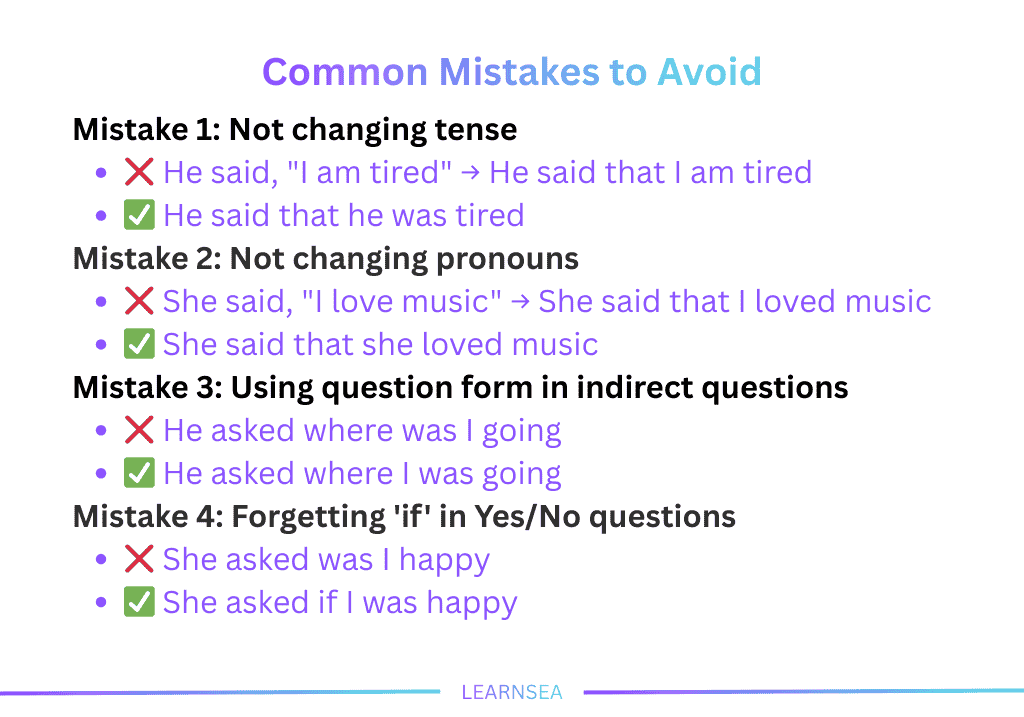
Rule 4: Change the Verb Tenses
This is the MOST IMPORTANT rule! When the reporting verb (like ‘said’) is in past tense, we move the tense of the sentence one step back.
Here’s the easy formula:
| Simple Present | Simple Past | “I play” → he played |
| Present Continuous | Past Continuous | “I am playing” → he was playing |
| Present Perfect | Past Perfect | “I have played” → he had played |
| Simple Past | Past Perfect | “I played” → he had played |
| Will | Would | “I will play” → he would play |
| Can | Could | “I can play” → he could play |
| May | Might | “I may play” → he might play |
Detailed Examples:
1. Simple Present → Simple Past
- Direct: She said, “I eat rice.”
- Indirect: She said that she ate rice.
2. Present Continuous → Past Continuous
- Direct: He said, “I am watching TV.”
- Indirect: He said that he was watching TV.
3. Present Perfect → Past Perfect
- Direct: They said, “We have finished the work.”
- Indirect: They said that they had finished the work.
4. Simple Past → Past Perfect
- Direct: She said, “I went to Delhi.”
- Indirect: She said that she had gone to Delhi.
5. Future (will/shall) → Conditional (would)
- Direct: He said, “I will help you.”
- Indirect: He said that he would help me.
Converting Different Types of Sentences
Type 1: Statements (Telling Something)
Formula: Subject + said (that) + changed sentence
Examples:
- Direct: John said, “I love chocolate.”
- Indirect: John said that he loved chocolate.
- Direct: She said, “My sister is a doctor.”
- Indirect: She said that her sister was a doctor.
- Direct: They said, “We have completed our homework.”
- Indirect: They said that they had completed their homework.
Type 2: Questions (Asking Something)
When converting questions, we need to make THREE main changes:
- Change ‘said’ to ‘asked’
- Remove the question mark (?)
- Change question form to statement form (no helping verb before subject)
A. Questions with Question Words (What, Where, When, Why, Who, How)
Formula: Subject + asked + question word + statement form
Examples:
- Direct: He said, “Where are you going?”
- Indirect: He asked where I was going.
- Direct: She said, “What is your name?”
- Indirect: She asked what my name was.
- Direct: They said, “Why are you late?”
- Indirect: They asked why I was late.
Notice: “are you” becomes “I was” (statement form, not question form)
B. Questions without Question Words (Yes/No Questions)
Formula: Subject + asked + if/whether + statement form
Examples:
- Direct: He said, “Are you coming to the party?”
- Indirect: He asked if/whether I was coming to the party.
- Direct: She said, “Do you like pizza?”
- Indirect: She asked if/whether I liked pizza.
- Direct: Teacher said, “Have you finished your homework?”
- Indirect: Teacher asked if/whether we had finished our homework.
Easy Trick: If the question can be answered with Yes or No, use if or whether!
Type 3: Commands (Ordering or Requesting)
Commands tell someone to do something. When converting commands:
Formula: Subject + told/ordered/requested + object + to + verb
Examples:
- Direct: Mother said to me, “Close the door.”
- Indirect: Mother told me to close the door.
- Direct: Teacher said to students, “Open your books.”
- Indirect: Teacher told students to open their books.
- Direct: He said to me, “Please help me.”
- Indirect: He requested me to help him.
Negative Commands (Don’t…)
Formula: Subject + told/warned + object + not to + verb
Examples:
- Direct: Father said to me, “Don’t waste time.”
- Indirect: Father told me not to waste time.
- Direct: She said to him, “Don’t be late.”
- Indirect: She told him not to be late.
Type 4: Exclamations (Expressing Emotions)
Exclamations express strong feelings like happiness, sadness, surprise, etc.
Formula: Subject + exclaimed with joy/sorrow/surprise + that + statement
Examples:
- Direct: He said, “What a beautiful flower!”
- Indirect: He exclaimed with joy that it was a very beautiful flower.
- Direct: She said, “How sad!”
- Indirect: She exclaimed with sorrow that it was very sad.
- Direct: They said, “Hurrah! We won the match!”
- Indirect: They exclaimed with joy that they had won the match.
Special Words and How to Change Them
Words That Express Emotions
| “Thank you!” | He thanked me. |
| “Sorry!” | He apologized. |
| “Congratulations!” | He congratulated me. |
| “Good luck!” | He wished me luck. |
| “Happy Birthday!” | He wished me a happy birthday. |
| “Welcome!” | He welcomed me. |
Special Cases: Words That DON’T Change
1. Modal Verbs (Sometimes)
Some modal verbs stay the same:
- could, might, would, should, ought to → stay the same
Examples:
- Direct: He said, “I could do it.”
- Indirect: He said that he could do it.
2. Universal Truths
Facts that are always true don’t change tense:
Examples:
- Direct: Teacher said, “The Earth revolves around the Sun.”
- Indirect: Teacher said that the Earth revolves around the Sun.
3. Historical Facts
- Direct: He said, “Gandhiji led the freedom movement.”
- Indirect: He said that Gandhiji led the freedom movement.
Common Reporting Verbs
Instead of always using ‘said’, you can use these verbs to make your writing interesting:
| Giving information | told, informed, mentioned |
| Asking questions | asked, inquired, questioned |
| Giving orders | ordered, commanded, instructed |
| Making requests | requested, begged, pleaded |
| Giving advice | advised, suggested, recommended |
| Making promises | promised, assured, guaranteed |
| Giving warnings | warned, cautioned, alerted |
| Making complaints | complained, protested, objected |
| Refusing | refused, denied, rejected |
| Agreeing | agreed, accepted, consented |
Step-by-Step Conversion Process
Follow these steps every time you convert Direct to Indirect Speech:
Step 1: Remove the quotation marks
Step 2: Check the reporting verb (said/told) and change if needed
Step 3: Add ‘that’ after the reporting verb (optional)
Step 4: Change pronouns (I→he/she, my→his/her, etc.)
Step 5: Change time and place words (today→that day, here→there)
Step 6: Change the verb tense (one step backward)
Step 7: For questions: add if/whether or keep question word, and change to statement form
Step 8: For commands: use ‘to’ + verb
Change the following sentences from Direct Speech to Indirect Speech
Q1. She said, “I am very busy today.”
Answer: She said that she was very busy that day.
Q2. Ravi said, “I have completed my project.”
Answer: Ravi said that he had completed his project.
Q3. My mother said to me, “I will help you with your homework tomorrow.”
Answer: My mother told me that she would help me with my homework the next day.
Q4. She said to me, “What is your name?”
Answer: She asked me what my name was.
Q5. Mother said to me, “Have you finished your homework?”
Answer: Mother asked me if/whether I had finished my homework.
Q6. The teacher said to the students, “Keep quiet.”
Answer: The teacher ordered/told the students to keep quiet.
Q7. Father said to me, “Don’t waste your time on video games.”
Answer: Father advised/told me not to waste my time on video games.
Q8. He said to me, “Where do you live?”
Answer: He asked me where I lived.
Q9. She said, “Alas! I have lost my pen.”
Answer: She exclaimed with sorrow that she had lost her pen.
Q10. He said, “I went to Delhi last week.”
Answer: He said that he had gone to Delhi the previous week.
Conclusion
Direct and Indirect Speech becomes easy when you understand the basic rules of reporting verbs, pronoun changes, and time expressions. With regular practice, Class 10 students can quickly learn how to convert any sentence correctly. These exercises help build confidence and improve grammar for exams.