

Looking for a clear and reliable The Pot Maker Class 9 Summary in English? This complete summary to the English Literature chapter from the Kaveri textbook explains the story in simple language, making it easy for students to understand and revise.
In this post, you will find a well structured The Pot Maker summary for Class 9, along with its theme, message, and important points for exam preparation. The story highlights the dignity of labour and the impact of modernization on traditional artisans. This explanation is designed especially for Class 9 students who want quick revision summary and better performance in English exams.
The Pot Maker – Part I
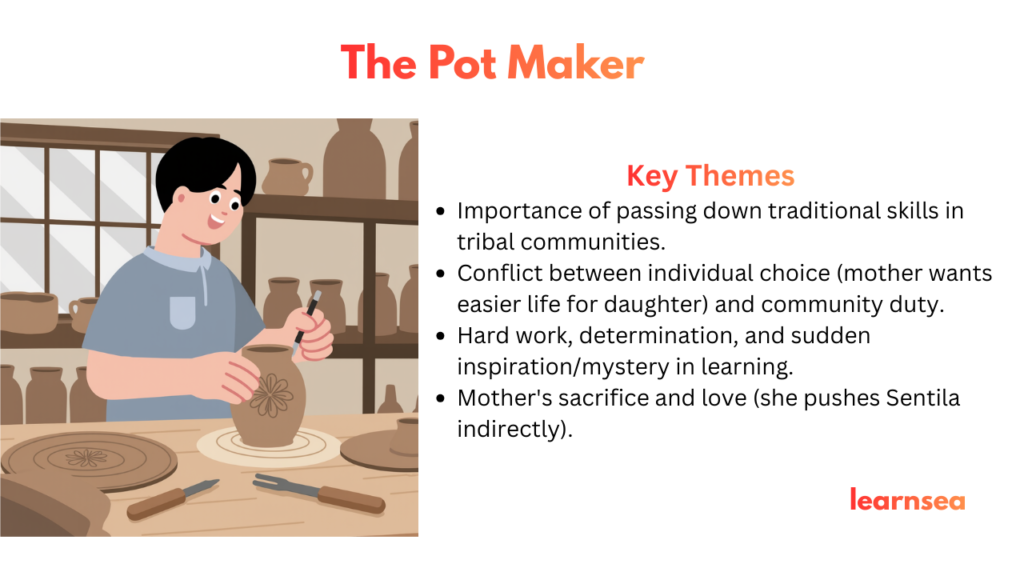
Sentila, a young girl from a tribal village (likely Naga community), dreams of becoming a pot maker like her mother Arenla and grandmother. But her mother, Arenla, does not want to teach her. Arenla prefers Sentila to learn weaving instead because pot making is very hard, tiring work: fetching heavy clay from the riverbank 16 km away (climbing down and up steep paths), pounding stubborn clay in bamboo cylinders, shaping pots carefully, drying them, and firing in a kiln – all for very little money.
Weaving is easier, done indoors, faster, and earns more money plus cloth for the family. Sentila secretly watches expert potters in the village to learn. She loves the process: mixing clay with water, pounding it, shaping the lump on the wheel with left hand inside and spatula in right hand (tap-tap sound like music), drying in sun, and careful firing to avoid ruining the batch. She hides her interest at home after overhearing her mother’s complaints.
Arenla knows about Sentila’s visits but ignores it at first. Soon, the village gossips about why Arenla refuses to teach her daughter. The village council calls Sentila’s father, Mesoba, and questions him. He humbly explains they want Sentila to recover from illness first, but promises she will soon make the best pots. The elders warn that pot making is a traditional skill passed down generations – it belongs to the community, not individuals.
Experts must teach anyone interested, especially their children, because it meets people’s needs and symbolizes the tribe’s history and tradition. Mesoba tells Arenla, and the pressure from the village makes her think again.
The Pot Maker – Part II
The next year, Arenla finally takes Sentila to the riverbank to dig grey and red clay. She teaches her how to load it, soak it, stuff into bamboo cylinders, and pound it into soft dough. Sentila learns quickly but struggles badly with shaping the pot – she can’t even hold the lump properly. Arenla watches silently as Sentila fails again and again, then shows her by making a perfect pot herself.
This continues for a year with no real progress – Sentila feels ashamed and frustrated. Later, as per custom, Sentila stays in the girls’ dormitory run by kind widow Onula (Aunty). Onula hears about the family problem and wants to help. One evening, when others are away, she sees Sentila secretly trying to make pots but failing because she is too tense. Onula calms her, teaches her gently, and Sentila makes a beautiful pot! But the mouth/rim is wrong.
Onula advises her to watch her mother carefully next time, especially how she shapes the rim slowly. In the next session with Arenla, Sentila observes closely. One sunny day, Arenla says they must make many pots before rain comes.
The Pot Maker – Continued Story
She finishes her batch fast, complains of headache and backache, and leaves Sentila alone to continue. Surprisingly, Sentila suddenly succeeds – her hands move perfectly, she makes pot after pot with speed and skill like her mother. She makes almost as many as Arenla. Tired, she goes inside for lunch and finds her mother dead on the floor (not breathing). Shocked, Sentila calls villagers for help.
During the funeral next day, Sentila runs after her mother’s body crying, “Mother, I did not wish it to happen this way; it simply came to me. Please forgive me.” Only Onula understands something big has happened. Later, Onula sees the work shed: two neat rows of identical pots – impossible to tell which are Arenla’s and which are Sentila’s.
She realizes a new pot maker has been born in the most mysterious way. The story shows how tradition, community duty, and a mother’s hidden love pass on skills – even through hardship and loss.
In a Nutshell
For exam preparation, this The Pot Maker Class 9 English NCERT Summary helps students quickly revise the theme, message, and key points. Understanding this chapter strengthens concept clarity and improves performance in Class 9 English Literature exams.