
As per the newly released NCERT Class 9 Exploration textbook of Science 2026-27 textbook under the National Education Policy (NEP) 2020, Cell: The Building Block of Life Class 9 students are now learning Science with greater focus on conceptual understanding and real-life connections rather than just memorizing facts.
The Most important chapter in Biology, Cell: The Building Block of Life, takes you into the fascinating microscopic world of the cell – the smallest unit of life. Starting from Robert Hooke’s discovery of cells in a thin slice of cork to the development of modern Cell Theory, this chapter beautifully explains how millions of tiny cells come together to form complex living organisms like plants, animals, and even us humans.
These notes have been prepared in simple and easy language, strictly following the latest NCERT 2026-27 syllabus. You will find clear explanations, helpful tables, important differences between plant and animal cells, functions of cell organelles, and all key points that will make learning enjoyable and exam preparation much easier
Cell: Building Block of Life Class 9 Science Notes
What is a Cell?
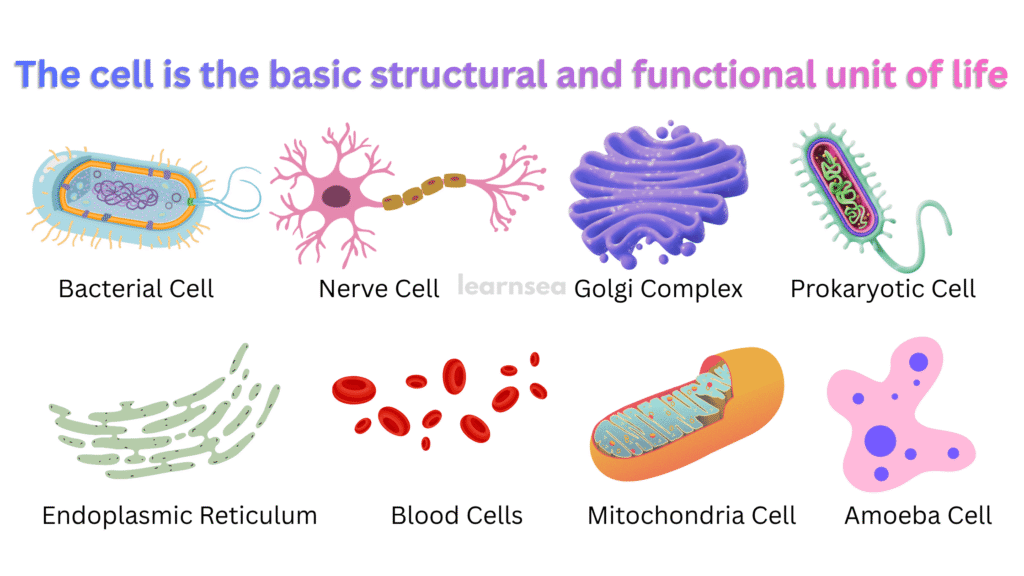
The cell is the fundamental structural and functional unit of all living beings. It is the smallest part of the body of an organism that is capable of independent existence and of performing the essential functions of life.
Every organ in our body — the skin, the brain, the muscle or even the bone — is composed of hundreds of thousands of such cells. Similarly, every part of a plant — the leaf, the flower, the root and even the wood — is composed of an exceedingly large number of cells.
Every cell has its own life. Old and weak cells in the body continually die and are replaced by new cells. All organisms including ourselves, start life as a single cell called the egg.
Cells are so small (microscopic) that they cannot be seen with the naked eye. It was, therefore, natural that their existence could not be detected by man until he invented magnifying aids in the form of microscopes.
The Invention of the Microscope and the Discovery of Cell
The first microscope was constructed by Dutch scientist Antony van Leeuwenhoek (1632-1723). He was an ordinary public official who ground lenses and made microscopic observations as a hobby. He is said to have constructed 400 microscopes. Basically, all his microscopes consisted of a single biconvex lens and were called simple microscopes. Some of these microscopes had a considerable magnifying power up to 200 times.
Robert Hooke (1635-1703), an English scientist, developed a microscope by using two lenses for achieving greater magnification. Such microscopes were later known as compound microscopes. In Hooke’s microscope the object to be seen was placed on the stage below and light from an oil flame was thrown on it by means of a concave mirror.
Hooke examined a thin slice of cork under his microscope and observed that it was made of tiny “boxlike” compartments piled up together. This reminded him of the rooms, or cells, or monks in a monastery and so he said that the cork was made up of cells. The cells which Hooke saw were all dead cells and they had only the empty “boxes” or the walls.
The ordinary compound microscope of today is a greatly improved design of the original Hooke’s microscope.
Cell: The Building Block of Life NCERT Class 9 Notes
Cell Theory
In 1838, Matthias Schleiden, a German Botanist, announced that every plant is made up of a large number of cells. He added that each of these cells performed various life processes. A year later, Theodor Schwann, a German zoologist, made similar observations in animals. He said that all animals and plants are composed of cells, which serve as the units of structure and function. In short, this is called the Cell Theory.
In 1855, Rudolf Virchow made an addition to the cell theory by saying that all cells arise from pre-existing cells.
The Cell Theory states three major points:
- The cell is the smallest unit of structure of all living things.
- The cell is the unit of function of all living things.
- All cells arise from pre-existing cells.
What does the cell theory mean?
Take two examples, a plant such as mango and an animal such as a frog.
- Structural Unit: If we take any part of the body of a frog or any part of a mango plant and examine it under a microscope, it will show a cellular structure.
- Functional Unit: Any function in the body of the frog or in the mango plant is due to the activity in its cells. For example, movement of the frog is due to the contractions of muscle cells, food is digested by the enzymes which the cells of the gut secrete, digested food is used up in cells for various metabolic activities. In a mango plant, photosynthesis occurs in the cells of leaves, the root cells absorb water from the soil.
Cells Die and Are Replaced
The body of the frog, or of the mango tree, is composed of millions and millions of cells. Many of these cells continuously die and are replaced by new ones which are formed by the division of younger cells. Formation of cells from pre-existing cells is a never-ending chain.
All life starts as a single cell. The life of the frog and the life of the mango tree started as an egg and as a seed respectively. The egg was a single cell produced by the cells of the ovary of the mother frog. The mango seed had an embryo which also started as a single cell in the ovary of the flowers of the parent mango tree.
Understanding Cell: The Building Block of Life NCERT Class 9 Science Notes
Cells – How Numerous?
Larger an organism, greater the number of cells in its body.
- Single-celled: Many small plants and animals are made up of just one single cell.
Examples: Bacteria, yeast, amoeba. - Few-celled: Some very small plants and animals are made up of relatively few cells — just a few hundred or a few thousand cells.
Examples: Spirogyra, Volvox. - Multi-celled: Most plants and animals we see around us including ourselves, are made up of millions and billions of cells.
Examples: Human beings, Mango.
An average-sized adult human constitutes approximately:
- 1000 million million cells in the whole body.
- 10,000 million nerve cells in the brain cortex.
- 5-6 million red blood cells and 7 thousand white blood cells per cubic millimetre of blood.
Cells – How Small?
Many cells are very small and are seen only with a microscope.
- Smallest cells are the bacteria (0.3-5.0 micrometre), red blood cells (about 7 micrometre) in the human body, etc.
- Longest cells are the nerve cells. Imagine a nerve cell extending from your finger tip up to the spinal cord within your backbone.
- Largest cells are the bird’s eggs (actually the central yellow sphere). Ostrich egg (before development begins in it) is the largest single cell of the living world today. The white (albumen) of the egg and the egg-shell are extra parts added on to the actual egg as it passes down the reproductive tract.
Smallness of Cells: A Greater Efficiency
Cells generally remain small in size and this is so for two main reasons:
(i) Different regions of a cell can communicate with each other rapidly for the cell to function effectively.
(ii) Cells have a large surface area / volume ratio for greater diffusion of substances in and out of the cell.
To understand the second advantage about surface area/volume ratio imagine a cube with each of its sides measuring 2 mm. The total surface area of this cube will be 2 mm × 2 mm × 6 (surfaces) = 24 sq. mm.
Suppose we cut this cube into 8 equal smaller cubes by reducing each side by half its length, then the total surface area of these 8 smaller cubes will be 1 mm × 1 mm × 6 (surfaces) × 8 pieces = 48 sq. mm, which is double that of the original larger cube. The total volume in both cases still remains the same.
Small size of cell presents a larger surface area / volume ratio.
This larger surface area relative to volume of the cell ensures greater diffusion of:
- Nutrients into the cell,
- Metabolic wastes from the interior to the outside of the cell,
- Respiratory gases i.e. oxygen into the cell and carbon dioxide out of the cell,
- Any damage to the cell, can be easily repaired.
Cell: The Building Block of All Living Things NCERT Class 9 Science Notes
Cell Shapes – To Suit Functional Requirement
Cells vary greatly in shape. These may be disc-like, polygonal, rectangular, cuboid, thread-like, branched or even irregular. These shapes of cells are often related to the different functions they perform.
Examples of different cell shapes:
- Epithelial cells: Flat, polygonal or cuboidal – cover surfaces and line cavities.
- Human blood cells: Red blood cells are circular and biconcave; White blood cells are amoeboid.
- Nerve cells: Long with branches (dendrites and axon) – to conduct impulses.
- Muscle cells: Long and contractile – to pull or squeeze the parts.
- Guard cells of stomatal pore in the leaves are bean-shaped – to open and close the pore.
Structure of a Cell
Various kinds of cells show special differences, yet they all show some basic structural plan which may be expressed in the term “generalised cell”.
A generalised cell consists of three essential parts:
(1) Cell membrane (plasma membrane),
(2) Nucleus,
(3) Cytoplasm.
Cell organelles (the “little organs”): Most parts of a cell have a definite shape, a definite structure and a definite function. Such parts are called organelles. The organelles have the same status in a cell as the organs have in the entire body of an animal or a plant performing specific functions. Cell organelles are living parts.
Cell Membrane and Cell Wall
Each cell is surrounded by a cell membrane or plasma membrane.
- The cell membrane has fine pores through which substances may enter or leave the cell.
- The permeability of the cell membrane is selective, i.e. it allows only certain substances to pass through while it prevents others.
Plant cells have a cell wall surrounding the cell membrane. The cell wall is made of cellulose, a non-living substance.
- The cell wall gives shape and a certain degree of rigidity to the cell without interfering with the functions of the cell membrane.
- The cell wall is freely permeable allowing the substances in solution to enter and leave the cell without hindrance.
The plant cell also shows portions of the cell walls of six surrounding cells. A thin middle lamella (shown as a thick dark line) holds the two adjacent cells together.
Note: Cotton, jute and coconut fibres are the cell walls of their dead cells.
Cytoplasm
Cytoplasm is a semi-liquid substance. It occupies most part of the cell within the cell membrane. Under a compound microscope, it appears to be colourless, partly transparent and somewhat watery.
- Many chemical reactions take place in the cytoplasm.
- Living cytoplasm is always in a state of some movement.
Cell organelles embedded in the cytoplasm:
Endoplasmic reticulum
- It is so fine in structure that its existence is revealed only through an electron microscope.
- It is an irregular network of double membranes distributed over the entire cytoplasm in a cell.
- At its outer end endoplasmic reticulum is connected with the cell membrane.
- At its inner end it is connected with the nuclear membrane.
- It appears rough when the particle-like ribosomes are attached to it and appears smooth without them.
- It forms the supporting framework of the cell and also serves as a pathway for the distribution of the materials from one part of the cell to the other.
Ribosomes
- The sites of protein synthesis
- Ribosomes are numerous small granules either scattered freely in the cytoplasm or attached to the membranes of the endoplasmic reticulum.
- These are the “factories” for the synthesis of proteins.
Mitochondria
- The sites of energy producers
- Mitochondria are spherical, rod-shaped or thread-like (mitos = thread) bodies.
- These are minute double-walled bags with their inner walls produced into finger-like processes projecting inwards (called cristae).
- Mitochondria are the sites where cell respiration occurs to release energy.
- This energy is stored in the form of an energy-rich compound ATP (adenosine triphosphate) and is used in various metabolic functions of the cell.
- Some people call the mitochondria as “power houses of the cell”.
Golgi apparatus
- The delivery system of the cell
- The Golgi apparatus occurs in the form of granules, filaments or rods which are supposed to be originated from endoplasmic reticulum.
- These are very small vesicles of different shapes, and are generally located near the nucleus.
- The Golgi complex consists of many groups of hollow tubular structures with membranous walls and is associated with some minute vesicles and vacuoles.
- It is concerned with the secretions of the cell including enzymes, hormones, etc.
Lysosomes
- The intracellular digestive centres
- Lysosomes are small vesicles of different shapes containing some digestive enzymes.
- Their enzymes destroy and digest foreign substances around them.
- They digest the stored food during starvation of the cell.
- Many damaged cells are rapidly destroyed or dissolved by their own lysosomes and hence these are also called the “suicide bags”.
Cell: The Building Block of Life – Class 9 Science Notes
Centrosome
- A centrosome is found only in an animal cell. It is a clear area of cytoplasm close to nucleus, (from which spindle fibres develop during cell division both in mitosis and meiosis).
- The centrosome contains two centrioles which are short bundles of microfilaments arranged at right angles to each other (that is why they always appear in this shape) in the microscopic view of cell.
- There is no centrosome and centrioles in plant cells.
Plastids
- Plastids are found only in plant cells.
- These are special organelles in different shapes—oval, spherical and disc-shaped.
- Depending upon the colour they impart plastids are classified as leucoplasts, chromoplasts and chloroplasts.
- (a) Leucoplasts (leuco = white) are colourless plastids. They have no pigment. They store starch. Cells of a potato have lots of leucoplasts in them.
(b) Chromoplasts (chromo = colour) are variously coloured plastids—yellow, orange and red. They are mostly present in petals of flowers and in fruits, and the colouring substances (pigments) associated with them are xanthophyll (yellow) and carotene (orange-red).
(c) Chloroplasts (chloro = green). These are green coloured plastids. They have green coloured pigment called chlorophyll. Chloroplasts are abundant in parts exposed to light, e.g. leaves. They also have other pigments such as orange and yellow, but these pigments are masked by large quantities of chlorophyll. Their function is to trap solar energy and absorb carbon dioxide for the manufacture of starch and sugar during photosynthesis. Chloroplasts contain DNA and have the capacity to divide.
Nucleus – Cell: The Building Block of Life
Nucleus is the most important part of the cell.
- It regulates and coordinates various life processes of the cell.
- It plays an important part in cell division.
- It contains factors (genes) which determine heredity.
Nucleus is a small spherical mass located somewhat in the centre of the cytoplasm. It has a delicate nuclear membrane which is filled with a relatively dense nucleoplasm. In the nucleoplasm there are certain threadlike structures called chromatin fibres.
During cell division the chromatin fibres become thick and ribbon-like. These fibres are then called chromosomes. Cells in which nuclear membrane is absent are called Prokaryotic cells (pro-primitive; karyon-nucleus). They have nuclear material called chromatin fibres which occur freely in the cytoplasm e.g. bacteria.
Cells in which double nuclear membrane is present are called Eukaryotic cells (eu: true; karyon: nucleus), e.g. all organism other than bacteria.
An early stage of cell division showing two pairs of chromosomes (that have condensed from the chromatin network, inside the nucleus. Chromosome number varies from one organism to another.
Each nucleus also has, at least, one nucleolus. It. Some cells may have more than one nucleolus. The number of nucleoli in a cell is fixed. The nucleolus participates in protein synthesis.
The number of chromosomes in various Oragnism
The number of chromosomes is definite in each species. Every human body cell has 46 (23 pairs) chromosomes. Chromosome numbers of some other common animals and plants are as follows:
| Organism | Number of Chromosomes |
| Honey-bee | 32 |
| Lion | 38 |
| Mouse | 40 |
| Wheat | 42 |
| Potato | 48 |
| Chimpanzee | 48 |
| Monkey | 54 |
| Chicken | 78 |
| Dog | 78 |
| Sugarcane | 80 |
| Crayfish | 200 |
| Some insects | More than 1000 |
The chromosomes carry the genetic characters from the parents to the offspring through the union of the egg of the female and the sperm of the male.
Chromosomes are made of chromatin, which is composed of hereditary units called genes. Genes are made of a complex chemical substance DNA (deoxyribonucleic acid).
Parts of Cell, Their Main Characteristics and Functions
| Part of Cell | Main Characteristics | Function(s) |
| Plasma Membrane (also called Cell Membrane) | 1. Outermost in animal cells 2. Lies next to cell wall in plant cells 3. Very thin, flexible, living membrane 4. Possesses fine pores 5. Semi-permeable 6. Made up of lipoproteins | 1. Separates contents of cell from its surroundings 2. Allows the entry of certain solutes and ions 3. Maintains shape of the cell (in animal cells) |
| Cell Wall (Plant cells only) | 1. Non-living rigid layer surrounding plasma membrane 2. Mainly composed of cellulose 3. Freely permeable | 1. Gives rigidity and shape to the plant cell 2. Allows substances in solution to enter and leave the cell without hindrance 3. Provides protection |
| Cytoplasm | 1. All the parts together inside the plasma membrane excluding nucleus 2. Contains a mixture of water and soluble inorganic and organic compounds, and various organelles | 1. Different organelles contained in it perform different functions 2. All metabolic activities occur in it 3. Seat of earlier steps of respiration (production of pyruvic acid) (anaerobic respiration) |
| Endoplasmic Reticulum (ER) | 1. Irregular network of tubular double membrane 2. It is continuous with the plasma membrane on the outside and the nuclear membrane on the inside 3. May be smooth or rough (attached ribosomes) | 1. Supportive framework for the cell 2. Synthesis and transport of proteins and fats |
| Mitochondria | 1. Various shapes but usually sausage-like 2. Double-walled; inner wall thrown into folds (cristae) 3. Have their own DNA containing several genes 4. Also contain their own ribosomes | 1. Release of energy from pyruvic acid produced in cytoplasm, in the form of ATP (Seat of cellular respiration & stores energy) 2. Synthesis of respiratory enzymes |
Parts of Cell, Their Main Characteristics and Functions
| Part of Cell | Main Characteristics | Function(s) |
| Golgi Apparatus (called dictyosomes in plant cells) | 1. Stacks of flattened membrane sacs 2. Consists of tubules, vesicles and vacuoles | 1. Synthesis and secretion of enzymes, hormones, etc. 2. Formation of acrosome of sperm |
| Ribosomes | 1. Small granules either scattered in the cytoplasm or attached to the outside of endoplasmic reticulum 2. Single walled, dense, spherical bodies composed mainly of RNA | 1. Protein synthesis |
| Lysosomes | 1. Membranous sacs budded off from Golgi bodies 2. Contain 40 different types of enzymes | 1. Intracellular digestion 2. Destroy foreign substances 3. When cell is old or injured, these rapidly destroy organelles (hence called “suicide bags”) 4. Formation of bones by digesting cartilages |
| Centrosome (Animal cells only) | 1. A region surrounding the centrioles, located near nucleus 2. Contains one or two centrioles 3. Centrioles are surrounded by radiating microtubules to form a “star” (aster) during cell division | 1. Initiates and regulates cell division 2. Forms spindle fibres, with the help of asters |
| Plastids (Plant cells only) | 1. Several kinds, most common ones are chloroplasts containing the green pigment chlorophyll 2. Double membrane, proteinaceous matrix, contain DNA 3. Disc-like structures called thylakoids contain chlorophyll | 1. Chromoplasts impart colour to flowers and fruits (Xanthophyll: yellow, Carotene: orange, red) 2. Chloroplasts (green) trap solar energy for photosynthesis 3. Leucoplasts – stores starch 4. Anthocyanin pigment is dissolved in cell sap and responsible for blue-violet colour in plants |
| Nucleus | 1. Largest cell organelle 2. Mostly spherical and dense 3. Nuclear membrane with pores to allow substances to enter and leave 4. Contains network of thread-like structures called chromatin fibres which contain DNA | 1. Regulates cell functions 2. If removed, the cell dies 3. Contains chromosomes (bearers of genes that control hereditary characters) |
| Nucleolus | 1. One or more round-shaped nucleoli inside the nucleus | 1. Produces ribosomes 2. Participates in protein synthesis by forming and storing RNA 3. Dictates ribosomes to synthesise proteins |
| Chromatin Fibres | 1. The network in resting stage of the nucleus condenses into chromosomes during cell division 2. Made up of DNA threads | 1. Chromosomes carry hereditary information or the genes |
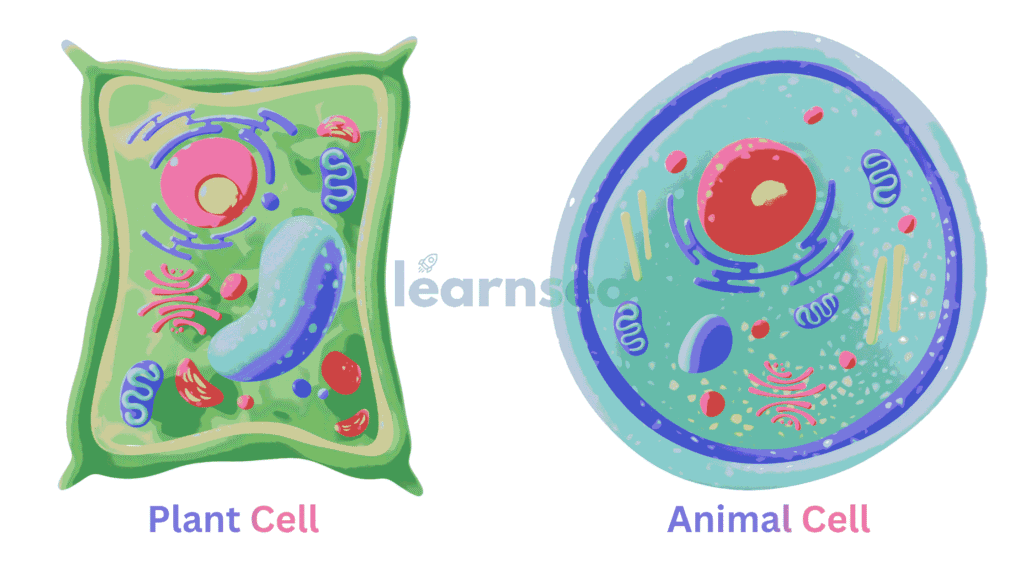
Difference Between Plant Cells and Animal Cells
| Feature | Plant Cells | Animal Cells |
| Cell wall | A definite cell wall, made up of cellulose | No cell wall |
| Centrosome | Centrosome is not present | Centrosome is present |
| Vacuoles | Vacuoles prominent, one or more, concerned with excretion or secretion | Vacuoles, if any, are small and temporary |
| Plastids | Usually contain plastids (chloroplasts, chromoplasts, leucoplasts) | Do not contain plastids |
| Size | Usually larger, with distinct outlines | Smaller, with less distinct boundaries |
| Cytoplasm | Cytoplasm not so dense. Only a thin lining of cytoplasm, mostly pushed to the periphery | Cytoplasm denser and more granular. Cytoplasm fills almost the entire cell |
| Arrangement of cytoplasm | Only a thin lining of cytoplasm, mostly pushed to the periphery | Cytoplasm fills almost the entire cell |
Protoplasm
Protoplasm is the living substance of a cell.
Biologists use the term “protoplasm” to mean all the living material inside an organism.
- It is present only in the cells.
- It looks like a translucent, jelly-like fluid that is colourless, greyish or brownish.
- It contains water, proteins, carbohydrates, fats, minerals and salts.
- Chemical composition is complex and slightly different in every cell.
Protoplasm = The living matter of a cell = Cytoplasm + Nucleus
Note: Once protoplasm is taken out of the cell, it stops being living. It becomes dead matter.
Prokaryotic and Eukaryotic Cells
| Feature | Prokaryotic Cell | Eukaryotic Cell |
| Nucleus | No well-defined nucleus (only DNA floating in cytoplasm) | Well-defined nucleus with nuclear membrane |
| Genetic Material | Single circular DNA | Several chromosomes (DNA + proteins) |
| Ribosomes | Small ribosomes | Larger ribosomes |
| Other Organelles | No mitochondria, ER, Golgi, etc. | Has mitochondria, ER, Golgi, chloroplasts (in plants), etc. |
| Examples | Bacteria, Blue-green algae (Cyanobacteria) | Amoeba, Euglena, all plants and animals |
Easy Way to Remember:
- Prokaryotic = “Primitive” → Simple cells (like bacteria)
- Eukaryotic = “True nucleus” → Advanced cells (plants, animals, humans)
Every Activity of a Living Organism is the Outcome of Cellular Activity
All functions in our body or in a plant are actually done by cells.
Examples of Cellular Activities:
- Growth → Cells increase in size and divide to make more cells.
- Repair and healing → New cells are formed to replace damaged or lost parts (e.g., lizard growing back its tail).
- Movement → Muscle cells contract and relax (walking, running, heart beating).
- Digestion → Cells in stomach and intestine produce enzymes to digest food.
- Absorption → Root cells absorb water and minerals.
- Photosynthesis → Chloroplasts in leaf cells trap sunlight to make food.
- Respiration → Mitochondria release energy from food.
- Transportation → Blood cells carry oxygen, nutrients and waste.
- Reproduction → Egg and sperm cells carry hereditary traits.
- Protection → White blood cells fight germs and diseases.
- Colour and attraction → Cells in flowers make colourful pigments to attract insects.
Frequently Asked Questions (FAQs) on Cell: The Building Block of Life
Q1. What is a cell and why is it called the building block of life?
A cell is the smallest structural and functional unit of all living organisms. It is called the building block of life because every plant, animal, and human body is made up of millions of cells.
Q2. Who discovered the cell and in which year?
Robert Hooke discovered the cell in 1665 while observing a thin slice of cork under his self-made microscope.
Q3. What did Robert Hooke see in the cork?
He saw tiny box-like structures that looked like the rooms of a monastery and named them “cells”.
Q4. What is the difference between a simple microscope and a compound microscope?
A simple microscope has only one lens (used by Leeuwenhoek), while a compound microscope has two or more lenses for higher magnification (used by Hooke).
Q5. Who first observed living cells?
Antony van Leeuwenhoek first observed living cells (bacteria, protozoa, etc.) using his simple microscope.
Q6. What are the three main postulates of Cell Theory?
- All living organisms are made up of cells.
- The cell is the basic unit of structure and function.
- All cells arise from pre-existing cells.
Q7. Who gave the Cell Theory?
Matthias Schleiden, Theodor Schwann, and Rudolf Virchow together proposed the Cell Theory.
Q8. What is protoplasm?
Protoplasm is the living substance of a cell. It includes both cytoplasm and nucleus.
Q9. What is the difference between prokaryotic and eukaryotic cells? Prokaryotic cells have no well-defined nucleus (e.g., bacteria), while eukaryotic cells have a well-defined nucleus with a nuclear membrane (e.g., plants and animals).
Q10. Give two examples of prokaryotic cells. Bacteria and blue-green algae (Cyanobacteria).
Read more
Conclusion
Cell: The Building Block of Life is one of the most important chapters in Class 9 Science. From Robert Hooke’s discovery to the modern Cell Theory, this chapter explains how millions of microscopic cells form complex living organisms. With clear concepts of cell organelles, plant vs animal cell differences, and protoplasm, these notes follow the latest NCERT Exploration of Science 2026-27 syllabus under NEP 2020.