
Acids, bases and salts class 10 notes can be helpful for students to prepare effectively for board examinations. These notes are prepared by expert teachers to ensure clarity of concepts and easy understanding. The acids, bases, and salts notes are useful for quick revision and last minute preparation. Based on the latest NCERT Notes and CBSE guidelines, these notes are designed to help students improve their performance and score high in exams.
These notes also include important formulas, reactions, and key points to enhance conceptual understanding. Students can use them to strengthen their basics and perform better in both school tests and competitive exams. The content is structured in a simple and concise manner for easy learning.
1. Understanding Acids Class 10 Chemistry Notes
1.1 What is Acid?
An acid is a substance that produces H⁺ (hydrogen ions) in an aqueous solution or forms H₃O⁺ (hydronium ions) when dissolved in water. Acids are typically characterized by a sour taste, although tasting chemicals is strictly unsafe and should never be done. One of the key identifying properties of acids is that they turn blue litmus paper red, which is commonly used as a simple test to detect acidic nature.
1.2 Indicators Table – Acid
| Indicator | Acid Colour | Base Colour | Neutral |
| Litmus | Red | Blue | Purple |
| Phenolphthalein | Colourless | Pink | Colourless |
| Methyl orange | Red | Yellow | Orange |
| Universal indicator | Red/Orange (pH 1–6) | Blue/Violet (pH 8–14) | Green (pH 7) |
1.3 Types & Sources
Organic Acids (These are weak acids that come from plants, fruits, animals, food) They are gentle, mostly found in nature.
| Acid Name | Where We Find It | Easy Example |
|---|---|---|
| Citric acid | Lemon, orange | Makes things sour like lemon |
| Acetic acid | Vinegar (4–6%) | In your kitchen vinegar |
| Lactic acid | Curd, milk, yoghurt | Makes curd sour |
| Tartaric acid | Tamarind, grapes | In imli and grapes |
| Ascorbic acid | Amla (Indian gooseberry) | This is Vitamin C! |
| Oxalic acid | Tomato, spinach | In palak and tamatar |
| Formic acid | Ant bite, bee sting, nettle | Makes ant bite painful |
Mineral Acids (These are strong acids → made in lab/chemical factories) They are very powerful, used in science and industry (handle with care!).
| Acid Name | Short Name | Special Name / Fact |
|---|---|---|
| Hydrochloric acid | HCl | Very strong, found in our stomach too |
| Sulphuric acid | H₂SO₄ | King of Chemicals |
| Nitric acid | HNO₃ | Strong, used to make fertilizers |
1.4 Physical Properties of Acid
- Sour taste
- Blue litmus → red
- Corrosive (damage skin, paper, cloth)
- Good conductors of electricity in water (due to free H⁺ ions)
- Dilution is highly exothermic → Always add acid to water slowly (not water to acid) to avoid splashing.
1.5 Chemical Properties – All Important Reactions
A. Reaction with Metals (Produces salt + Hydrogen gas)
General: Acid + Metal → Salt + H₂↑
- Only metals above hydrogen in reactivity series react (Zn, Mg, Fe, Al etc.).
- Cu, Ag, Au, Pt do not react with dilute acids.
Examples:
- Zinc + Sulphuric acid → Zinc sulphate + Hydrogen
Zn(s) + H₂SO₄(aq) → ZnSO₄(aq) + H₂(g)↑ - Magnesium + Hydrochloric acid → Magnesium chloride + Hydrogen
Mg(s) + 2HCl(aq) → MgCl₂(aq) + H₂(g)↑ - Iron + Sulphuric acid → Iron sulphate + Hydrogen
Fe(s) + H₂SO₄(aq) → FeSO₄(aq) + H₂(g)↑
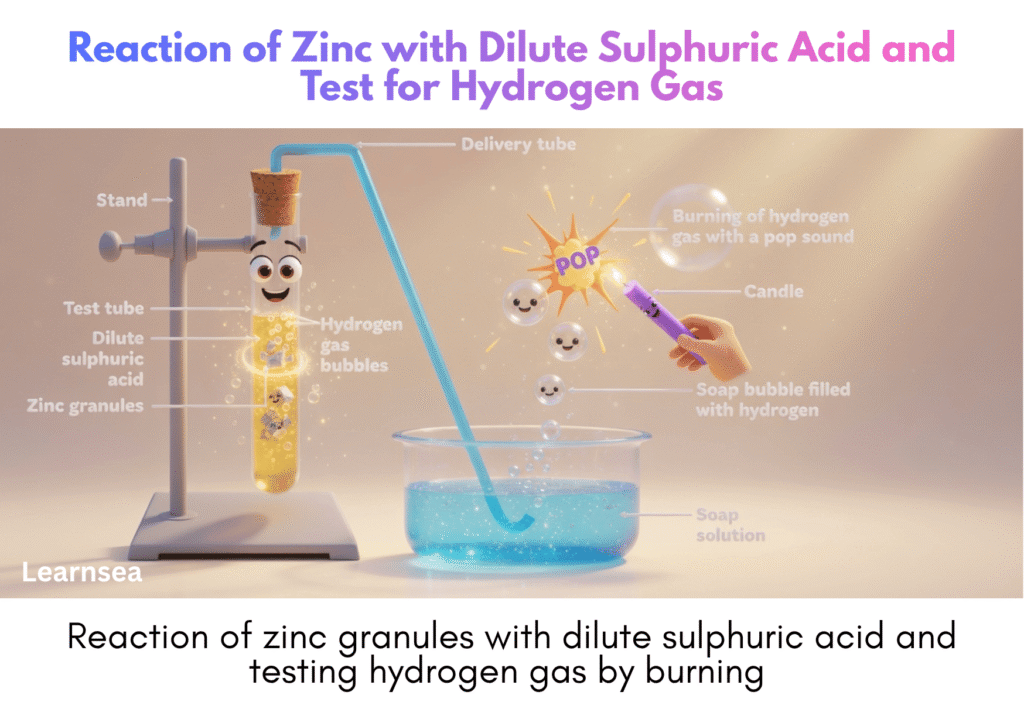
- Test for H₂ gas: Burns with a pop sound (light a match near mouth of test tube).
- Bubbles of gas evolve on metal surface.
B. Reaction with Metal Carbonates & Metal Hydrogen Carbonates
General: Acid + Carbonate → Salt + Water + CO₂↑
Acid + Hydrogen carbonate → Salt + Water + CO₂↑
Examples:
- Sodium carbonate + Hydrochloric acid
Na₂CO₃(s) + 2HCl(aq) → 2NaCl(aq) + H₂O(l) + CO₂(g)↑ - Calcium carbonate + Sulphuric acid
CaCO₃(s) + H₂SO₄(aq) → CaSO₄(aq) + H₂O(l) + CO₂(g)↑ - Sodium hydrogen carbonate + Acetic acid
NaHCO₃(s) + CH₃COOH(aq) → CH₃COONa(aq) + H₂O(l) + CO₂(g)↑
- Observation: Effervescence (brisk bubbling of CO₂).
- Test for CO₂: Pass gas through lime water → turns milky due to CaCO₃ formation.
Ca(OH)₂(aq) + CO₂(g) → CaCO₃(s)↓ (white ppt) + H₂O(l)
(Excess CO₂ makes it clear again – Ca(HCO₃)₂ soluble)
C. Reaction with Metal Oxides (Basic oxides)
General: Acid + Metal oxide → Salt + Water
(Neutralisation between acid and basic oxide)
Examples:
- Copper oxide + Hydrochloric acid
CuO(s) (black) + 2HCl(aq) → CuCl₂(aq) (blue-green) + H₂O(l) - Calcium oxide + Hydrochloric acid
CaO(s) + 2HCl(aq) → CaCl₂(aq) + H₂O(l) - Zinc oxide + Sulphuric acid
ZnO(s) + H₂SO₄(aq) → ZnSO₄(aq) + H₂O(l)
- Observation: Insoluble black/basic oxide dissolves to form coloured solution.
D. Neutralisation Reaction (with Bases/Alkalis)
General: Acid + Base → Salt + Water
Examples:
- Hydrochloric acid + Sodium hydroxide
HCl(aq) + NaOH(aq) → NaCl(aq) + H₂O(l) - Sulphuric acid + Potassium hydroxide
H₂SO₄(aq) + 2KOH(aq) → K₂SO₄(aq) + 2H₂O(l)
- Heat is evolved (exothermic).
- Used in treatment of acidity (antacids like Mg(OH)₂ neutralise HCl in stomach).
1.6 Strength of Acids (Very Important for Exams)
- Strong acids — Completely ionise in water → High H⁺ concentration
HCl → H⁺ + Cl⁻ (100%)
H₂SO₄ → 2H⁺ + SO₄²⁻
HNO₃ → H⁺ + NO₃⁻ - Weak acids — Partially ionise → Low H⁺ concentration
CH₃COOH ⇌ CH₃COO⁻ + H⁺ (only ~1%)
Citric, tartaric, carbonic acids are weak.
1.7 The Nature of Acid in Everyday Life
- pH of strong acid solutions: Very low (e.g., HCl pH ≈ 1)
- Ant sting pain → Formic acid → Apply baking soda (neutralises).
- Tooth decay → Acid from bacteria (lactic) → Use basic toothpaste.
- Never store pickles/lemon in copper/brass → Acid reacts → poisonous salts.
- Acid rain (H₂SO₄ + HNO₃) → pH < 5.6 → Harms soil, buildings, aquatic life.
2. Understanding Acids Class 10 Chemistry Notes
Bases are substances that produce hydroxide ions (OH⁻) when dissolved in water. They taste bitter and feel soapy/slippery to touch (like soap). Bases turn red litmus blue and are the opposite of acids. In daily life, we see bases in soap, toothpaste, baking soda, and drain cleaners. Bases help neutralise acids and are very useful in cleaning and medicine.
2.1 Sources of Bases
- Common Bases (Alkalis when soluble in water):
- Sodium hydroxide (NaOH) — Caustic soda (used in soap making)
- Potassium hydroxide (KOH) — Caustic potash
- Calcium hydroxide (Ca(OH)₂) — Slaked lime (whitewash)
- Ammonium hydroxide (NH₄OH) — Ammonia solution (used in cleaners)
- Magnesium hydroxide (Mg(OH)₂) — Milk of magnesia (antacid)
- Aluminium hydroxide (Al(OH)₃) — Used in antacids
Bases that dissolve in water are called alkalis (e.g., NaOH, KOH). Not all bases are alkalis (e.g., Ca(OH)₂ is sparingly soluble).
2.2 Physical Properties of Bases
Bases have characteristic features that help identify them.
- Bitter taste (never taste lab chemicals!).
- Turn red litmus paper blue.
- Feel soapy/slippery on skin (due to reaction with skin oils).
- Conduct electricity in solution (due to free OH⁻ ions).
- Strong bases are caustic — can burn skin (handle with care).
2.3 Reaction with Metals (Amphoteric Metals Only)
Some bases react with certain metals (like Al, Zn) to produce salt + hydrogen gas.
General Equation: Base + Metal → Salt + Hydrogen gas (H₂↑)
Examples:
- 2NaOH + Zn → Na₂ZnO₂ (sodium zincate) + H₂↑
- 2NaOH + 2Al + 2H₂O → 2NaAlO₂ (sodium aluminate) + 3H₂↑
- Ca(OH)₂ does not react easily, but NaOH/KOH do with Zn/Al.
Test for H₂: Gas burns with pop sound.
2.4 Indicators Table – Base
| Indicator | In Acid | In Base | In Neutral |
|---|---|---|---|
| Litmus | Red | Blue | Purple |
| Phenolphthalein | Colourless | Pink | Colourless |
| Methyl orange | Red | Yellow | Orange |
| Universal indicator | Red/Orange | Blue/Violet | Green |
2.5 Neutralisation Reaction
Bases react with acids to form salt and water. This is an exothermic reaction (heat released). Lakhmir Singh stresses this as the fundamental property of bases.
General Equation:
Base + Acid → Salt + Water
Key Examples (common in exercises):
- Sodium hydroxide + Hydrochloric acid NaOH(aq) + HCl(aq) → NaCl(aq) + H₂O(l) (Sodium chloride + Water)
- Potassium hydroxide + Sulphuric acid 2KOH(aq) + H₂SO₄(aq) → K₂SO₄(aq) + 2H₂O(l)
- Calcium hydroxide + Hydrochloric acid Ca(OH)₂(aq) + 2HCl(aq) → CaCl₂(aq) + 2H₂O(l)
- Magnesium hydroxide (milk of magnesia – antacid) + HCl Mg(OH)₂(aq) + 2HCl(aq) → MgCl₂(aq) + 2H₂O(l)
Observation: Heat evolved; no gas usually.
Use: Antacids neutralise excess stomach acid (HCl).
2.6 Reaction of Bases with Amphoteric Metals (Zn, Al) – Produces Hydrogen Gas
Strong bases like NaOH/KOH react with metals like zinc and aluminium (amphoteric) to form salt (zincate/aluminate) + hydrogen gas. This is a very important Lakhmir Singh reaction (often with equation balancing).
General Equation:
Base + Metal → Salt + Hydrogen gas (H₂↑)
Examples:
- Sodium hydroxide + Zinc 2NaOH(aq) + Zn(s) → Na₂ZnO₂(aq) + H₂(g)↑ (Sodium zincate + Hydrogen)
- Sodium hydroxide + Aluminium (with water) 2NaOH(aq) + 2Al(s) + 2H₂O(l) → 2NaAlO₂(aq) + 3H₂(g)↑ (Sodium aluminate + Hydrogen)
Observation: Bubbles of H₂ gas; pop sound test.
Note: Ordinary metals like Fe, Cu do not react with bases.
2.7 Reaction of Bases with Non-metallic / Acidic Oxides
Bases neutralise acidic gases/oxides to form salt + water. Very common in Lakhmir Singh for environmental/everyday applications.
Examples:
- Sodium hydroxide + Carbon dioxide (acidic gas) 2NaOH(aq) + CO₂(g) → Na₂CO₃(aq) + H₂O(l) (Sodium carbonate + Water) → Used to absorb CO₂ in labs.
- Calcium hydroxide + Carbon dioxide (Lime water test – reverse of CO₂ test) Ca(OH)₂(aq) + CO₂(g) → CaCO₃(s)↓ + H₂O(l) (Calcium carbonate – white ppt; turns milky)
- Sodium hydroxide + Sulphur dioxide 2NaOH(aq) + SO₂(g) → Na₂SO₃(aq) + H₂O(l)
Observation: In lime water – milky precipitate.
2.8 Reaction of Bases with Ammonium Salts – Liberation of Ammonia Gas
Bases liberate ammonia from ammonium salts. This is asked in Lakhmir Singh exercises.
General Equation:
Base + Ammonium salt → Salt + Water + Ammonia gas (NH₃↑)
Examples:
- Calcium hydroxide + Ammonium chloride Ca(OH)₂(aq) + 2NH₄Cl(s) → CaCl₂(aq) + 2H₂O(l) + 2NH₃(g)↑
- Sodium hydroxide + Ammonium sulphate 2NaOH(aq) + (NH₄)₂SO₄(aq) → Na₂SO₄(aq) + 2H₂O(l) + 2NH₃(g)↑
Observation: Pungent smell of NH₃; turns red litmus blue.
2.9 Strength & Ionisation Reactions
- Strong base (complete dissociation): NaOH(aq) → Na⁺(aq) + OH⁻(aq) KOH(aq) → K⁺(aq) + OH⁻(aq)
- Weak base (partial): NH₄OH(aq) ⇌ NH₄⁺(aq) + OH⁻(aq)
2.10 Reaction with Non-metallic Oxides (Acidic Oxides)
Base + Acidic oxide → Salt + Water
(This is how bases neutralise acidic gases.)
Examples:
- 2NaOH + CO₂ → Na₂CO₃ + H₂O (removes CO₂ from air)
- Ca(OH)₂ + CO₂ → CaCO₃↓ (white ppt) + H₂O (lime water test for CO₂ — turns milky)
- 2NaOH + SO₂ → Na₂SO₃ + H₂O
2.11 Neutralisation Reaction (with Acids)
Base + Acid → Salt + Water (exothermic — heat released)
Examples:
- NaOH + HCl → NaCl + H₂O
- 2KOH + H₂SO₄ → K₂SO₄ + 2H₂O
- Mg(OH)₂ + 2HCl → MgCl₂ + 2H₂O
This reaction is used in antacids (neutralise excess stomach acid) and soil treatment (lime neutralises acidic soil).
2.12 Strength of Bases
Bases are classified by how much they ionise in water.
- Strong Bases — Completely dissociate → Produce many OH⁻ ions (highly basic). Examples: NaOH → Na⁺ + OH⁻ (100%) KOH → K⁺ + OH⁻
- Weak Bases — Partially dissociate → Produce fewer OH⁻ ions. Examples: NH₄OH ⇌ NH₄⁺ + OH⁻ (partial) Mg(OH)₂, Ca(OH)₂ (sparingly soluble, weak in effect)
2.13 pH Scale and Indicators
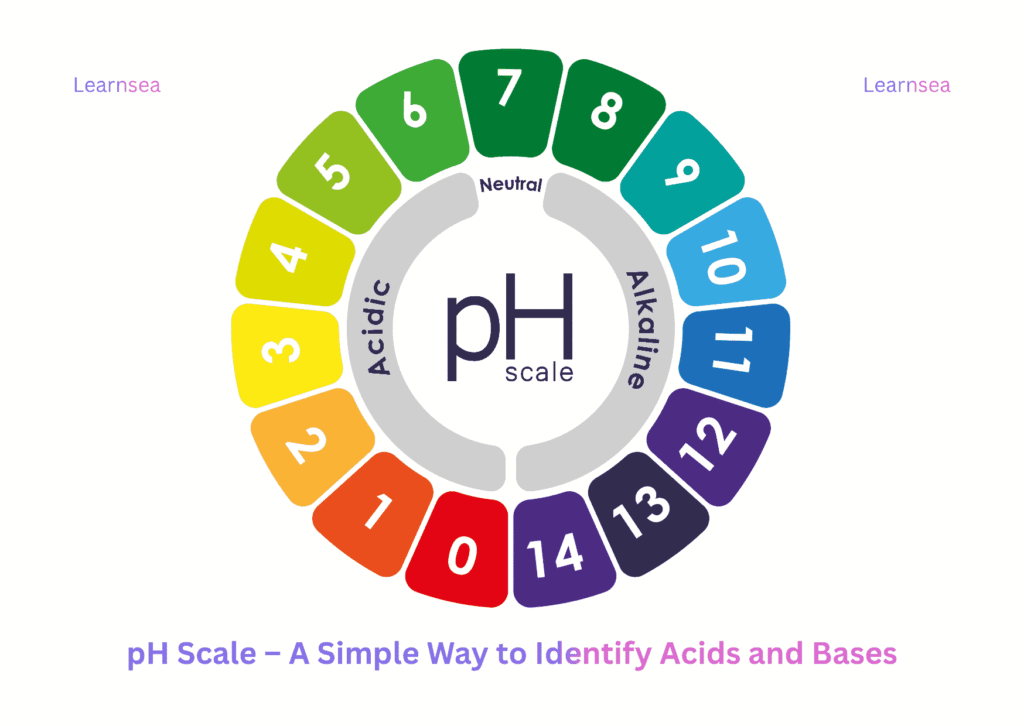
pH scale: pH > 7 = basic, pH = 7 = neutral, pH < 7 = acidic. Higher pH means stronger base.
| pH Value | Type | Common Examples | Approximate pH |
|---|---|---|---|
| 0 | Very strong acid | Battery acid (sulphuric acid), HCl (concentrated) | 0–1 |
| 1 | Strong acid | Stomach acid (hydrochloric acid in our tummy) | 1–2 |
| 2 | Acidic | Lemon juice, lime juice | 2 |
| 3 | Acidic | Vinegar, cola/soft drinks, oranges | 2.5–3.5 |
| 4 | Acidic | Tomato, tomato juice, black coffee, beer/wine | 4–5 |
| 5 | Mildly acidic | Black coffee, bananas, rainwater (normal) | 5 |
| 6 | Slightly acidic | Milk, saliva, urine | 6–6.5 |
| 7 | Neutral | Pure water, blood (close to neutral) | 7 |
| 8 | Mildly basic | Baking soda solution, sea water | 8 |
| 9 | Basic | Soap, toothpaste | 9 |
| 10 | Basic | Milk of magnesia (antacid) | 10 |
| 11 | Strong base | Ammonia solution, household cleaners | 11 |
| 12 | Very strong base | Bleach (sodium hypochlorite) | 12–13 |
| 13–14 | Very strong base | Drain cleaner, oven cleaner, caustic soda | 13–14 |
3. Understanding Salts Class 10 Chemistry Notes
When an acid reacts with a base, a salt is formed along with water. This reaction is called a neutralisation reaction. A salt is an ionic compound formed by the partial or complete replacement of hydrogen ions (H⁺) of an acid by a metal ion (or ammonium ion).
Acid + Base → Salt + Water
Examples:
- HCl + NaOH → NaCl + H₂O
- H₂SO₄ + 2NaOH → Na₂SO₄ + 2H₂O
- HNO₃ + KOH → KNO₃ + H₂O
- H₂SO₄ + Ca(OH)₂ → CaSO₄ + 2H₂O
3.1 Types of Salts
Normal Salt (Neutral Salt)
Formed by the complete replacement of all replaceable H⁺ ions of an acid by a metal ion. No H⁺ or OH⁻ left in the salt. Examples: NaCl, Na₂SO₄, KNO₃, CaCl₂
Acidic Salt
Formed by the partial replacement of H⁺ ions of a dibasic or tribasic acid. Still contains replaceable H⁺. Examples: NaHCO₃ (from H₂CO₃), NaHSO₄ (from H₂SO₄), NaH₂PO₄ (from H₃PO₄)
Basic Salt
Formed by the partial replacement of OH⁻ ions of a polyacidic base. Still contains OH⁻ groups.
- Examples: Pb(OH)Cl (basic lead chloride), Zn(OH)Cl (basic zinc chloride)
Complex Salt
Formed when a simple salt combines with another salt or neutral molecule to form a complex ion.
- Examples: K₄[Fe(CN)₆] (potassium ferrocyanide), [Cu(NH₃)₄]SO₄
3.2 FAMILY OF SALTS
Salts having the same positive ion (cation) or same negative ion (anion) form a family.
Salts of the same acid (chlorides):
- NaCl (sodium chloride), KCl (potassium chloride), CaCl₂ (calcium chloride), MgCl₂ (magnesium chloride), NH₄Cl (ammonium chloride)
Salts of the same metal (sodium salts):
- NaCl, Na₂SO₄, Na₂CO₃, NaHCO₃, NaNO₃, CH₃COONa
3.4 pH OF SALTS
The pH of a salt solution depends on the nature of the acid and base from which it is formed.
| Type of Salt | Formed From | pH | Example |
|---|---|---|---|
| Neutral salt | Strong acid + Strong base | = 7 | NaCl, KNO₃, Na₂SO₄ |
| Acidic salt | Strong acid + Weak base | < 7 | NH₄Cl, FeCl₃, AlCl₃ |
| Basic salt | Weak acid + Strong base | > 7 | Na₂CO₃, CH₃COONa |
Key point: The pH of a salt solution is determined by salt hydrolysis — the reaction of ions of the salt with water.
3.5 IMPORTANT SALTS
Sodium Chloride (NaCl) — Common Salt / Table Salt
Preparation:
HCl + NaOH → NaCl + H₂O
Physical Properties:
- White crystalline solid
- Highly soluble in water; solution is neutral (pH = 7)
- High melting and boiling point
- Good conductor of electricity in molten/aqueous state
Uses:
- Food preservative (pickling, curing)
- Raw material for making NaOH, Na₂CO₃, NaHCO₃, Cl₂, HCl, and bleaching powder
- Used in soap manufacture
- Melts snow on roads in cold countries
Chlor-Alkali Process (Electrolysis of Brine)
When electricity is passed through brine (concentrated aqueous NaCl solution), it decomposes. This is called the chlor-alkali process.
2NaCl(aq) + 2H₂O(l) → 2NaOH(aq) + Cl₂(g) + H₂(g)
At cathode (negative electrode): H₂ gas is produced At anode (positive electrode): Cl₂ gas is produced NaOH is formed near the cathode region
Products and their Uses:
| Product | Uses |
|---|---|
| Chlorine (Cl₂) | Making bleaching powder, PVC, disinfectants, CFCs |
| Hydrogen (H₂) | Fuel, making margarine, making HCl |
| Sodium hydroxide (NaOH) | Soap, paper, de-greasing metals, rayon |
This process is important because it produces three useful chemicals simultaneously.
Sodium Hydroxide (NaOH) — Caustic Soda
Preparation: By chlor-alkali process (electrolysis of brine)
2NaCl + 2H₂O → 2NaOH + Cl₂ + H₂
Physical Properties:
- White crystalline solid
- Highly soluble in water; dissolves with evolution of large amounts of heat
- Strong base; pH > 7
- Deliquescent — absorbs moisture from air
Chemical Properties:
- Reacts with acids (neutralisation): NaOH + HCl → NaCl + H₂O
- Reacts with non-metallic oxides: 2NaOH + CO₂ → Na₂CO₃ + H₂O
- Reacts with amphoteric metals (Al, Zn): 2NaOH + 2Al + 2H₂O → 2NaAlO₂ + 3H₂↑
Uses:
- Manufacturing soaps and detergents
- Manufacturing paper and rayon (artificial silk)
- De-greasing metals and refining petroleum
- Treating cotton in textile industry
- Used in drain cleaners
Sodium Carbonate (Na₂CO₃) — Washing Soda
Full name: Sodium carbonate decahydrate — Na₂CO₃·10H₂O
Preparation — Solvay (Ammonia-Soda) Process:
- Saturate ammonia in concentrated brine (NaCl solution)
- Pass CO₂ → NaHCO₃ is precipitated: NaCl + H₂O + CO₂ + NH₃ → NaHCO₃↓ + NH₄Cl
- Heat the NaHCO₃ to get Na₂CO₃: 2NaHCO₃ → Na₂CO₃ + H₂O + CO₂
Lab Preparation:
2NaHCO₃ → (Heat) → Na₂CO₃ + H₂O + CO₂
Physical Properties:
- White crystalline powder
- Highly soluble in water; solution is alkaline (pH > 7)
- Has 10 molecules of water of crystallisation (Na₂CO₃·10H₂O)
- Efflorescent — loses water of crystallisation in air to become anhydrous Na₂CO₃ (soda ash)
Chemical Properties:
- With acids: Na₂CO₃ + 2HCl → 2NaCl + H₂O + CO₂
- With CO₂ + H₂O: Na₂CO₃ + CO₂ + H₂O → 2NaHCO₃
Uses:
- Cleansing agent for domestic purposes (washing clothes and utensils)
- Removing permanent hardness of water
- Manufacturing glass, soap, and paper
- Laboratory reagent
- Manufacturing borax and caustic soda
Sodium Bicarbonate (NaHCO₃) — Baking Soda
Preparation:
Na₂CO₃ + CO₂ + H₂O → NaHCO₃ (From Solvay process: NaCl + H₂O + CO₂ + NH₃ → NaHCO₃ + NH₄Cl)
Physical Properties:
- White crystalline powder
- Slightly soluble in water; solution is weakly alkaline (pH slightly > 7)
- Mild, non-corrosive — safer than NaOH or Na₂CO₃
Chemical Properties:
- Decomposes on heating: 2NaHCO₃ → (Heat) → Na₂CO₃ + H₂O + CO₂↑ (CO₂ makes dough rise in baking)
- Reacts with acids: NaHCO₃ + HCl → NaCl + H₂O + CO₂↑
- Reacts with NaOH: NaHCO₃ + NaOH → Na₂CO₃ + H₂O
Uses:
- Leavening agent in baking (releases CO₂, making bread/cakes rise)
- Fire extinguishers — reacts with H₂SO₄ to release CO₂ which smothers fire
- Antacid — neutralises excess stomach acid (safe because it is mild and non-corrosive)
- Used in baking powder (see below)
- Mild antiseptic in toothpastes
- Making soda water
Baking Powder: A mixture of baking soda (NaHCO₃) and a mild edible acid (tartaric acid). On heating or moistening, they react to release CO₂ which makes the dough rise. Using just baking soda would leave a bitter taste; tartaric acid neutralises the Na₂CO₃ formed.
Bleaching Powder — Ca(OCl)Cl
Chemical name: Calcium oxychloride / Calcium chlorohypochlorite Formula: Ca(OCl)Cl (also written as CaOCl₂)
Preparation — Hasenclever Process: Chlorine gas is passed over dry slaked lime [Ca(OH)₂] at about 40°C:
Ca(OH)₂ + Cl₂ → Ca(OCl)Cl + H₂O
Physical Properties:
- Yellow-white powder
- Strong smell of chlorine
- Partially soluble in water
- It is a mixture, not a pure compound
Chemical Properties:
- Reacts with dilute acids to release Cl₂: Ca(OCl)Cl + H₂SO₄ → CaSO₄ + Cl₂ + H₂O Ca(OCl)Cl + 2HCl → CaCl₂ + Cl₂ + H₂O
- Reacts with CO₂ in air (loses bleaching power): Ca(OCl)Cl + CO₂ → CaCO₃ + Cl₂ (That is why bleaching powder must be stored in closed containers)
Active Ingredient for Bleaching: Nascent oxygen [O] released when Cl₂ reacts with water:
Cl₂ + H₂O → HCl + [O]
Uses:
- Bleaching cotton, linen, and wood pulp (paper industry)
- Disinfectant to purify drinking water and swimming pools
- Making chloroform
- Removing rust stains from clothes
Plaster of Paris — CaSO₄·½H₂O
Full chemical name: Calcium sulphate hemihydrate
Preparation: Gypsum (CaSO₄·2H₂O) is heated at 100°C (373 K):
CaSO₄·2H₂O → (100°C) → CaSO₄·½H₂O + 1½H₂O Gypsum → Plaster of Paris + Water
Setting of Plaster of Paris: POP hardens (sets) by absorbing water — the reverse of its preparation:
CaSO₄·½H₂O + 1½H₂O → CaSO₄·2H₂O Plaster of Paris + Water → Gypsum (hard solid)
On adding water, POP expands slightly and sets into a hard solid.
Important: If gypsum is heated above 150°C (423 K), it becomes anhydrous CaSO₄ (dead burnt plaster) which does NOT set with water at all.
Uses:
- Setting fractured/broken bones in hospitals (plaster casts)
- Dentists use it to make moulds of teeth
- Making statues, toys, and decorative items
- Making chalk and blackboard chalk
- Fire-resistant walls and ceilings
- Sculpture and artistic work
4. WATER OF CRYSTALLISATION
Definition: The fixed number of water molecules which are chemically combined with one formula unit of a salt in its crystalline form is called water of crystallisation.
| Salt | Formula | Water Molecules | Common Name |
|---|---|---|---|
| Copper sulphate | CuSO₄·5H₂O | 5 | Blue vitriol |
| Ferrous sulphate | FeSO₄·7H₂O | 7 | Green vitriol |
| Zinc sulphate | ZnSO₄·7H₂O | 7 | White vitriol |
| Magnesium sulphate | MgSO₄·7H₂O | 7 | Epsom salt |
| Sodium carbonate | Na₂CO₃·10H₂O | 10 | Washing soda |
| Calcium sulphate | CaSO₄·2H₂O | 2 | Gypsum |
| Plaster of Paris | CaSO₄·½H₂O | ½ | Hemihydrate |
| Alum | KAl(SO₄)₂·12H₂O | 12 | Potash alum |
| Ferric sulphate | Fe₂(SO₄)₃·9H₂O | 9 | — |
4.1 Efflorescence vs Deliquescence
Efflorescence: Loss of water of crystallisation to the atmosphere. The crystal becomes dull/powdery.
- Example: Na₂CO₃·10H₂O loses 9H₂O in air → becomes Na₂CO₃·H₂O (soda ash)
Deliquescence: Absorption of moisture from the atmosphere. The crystal dissolves in the absorbed water.
- Example: NaOH, CaCl₂, MgCl₂
4.2 Blue Vitriol — CuSO₄·5H₂O (Important)
- Hydrated copper sulphate — blue in colour
- On heating above 100°C, loses 5 water molecules and becomes white anhydrous CuSO₄: CuSO₄·5H₂O → (Heat) → CuSO₄ + 5H₂O Blue → White
- On adding water back to anhydrous CuSO₄, it turns blue again
- This is used as a test for presence of water — anhydrous CuSO₄ turns blue on adding water
4.3 HARDNESS OF WATER
Water that does not form a good lather with soap is called hard water. It contains dissolved salts of calcium and magnesium.
Causes of Hardness
Temporary hardness: Due to dissolved Ca(HCO₃)₂ and Mg(HCO₃)₂
Permanent hardness: Due to dissolved CaSO₄, MgSO₄, CaCl₂, MgCl₂
4.4 Removing Temporary Hardness
By boiling:
Ca(HCO₃)₂ → (Heat) → CaCO₃↓ + H₂O + CO₂
By Clark’s method (adding slaked lime):
Ca(HCO₃)₂ + Ca(OH)₂ → 2CaCO₃↓ + 2H₂O
4.5 Removing Permanent Hardness
By washing soda (Na₂CO₃):
CaSO₄ + Na₂CO₃ → CaCO₃↓ + Na₂SO₄ MgCl₂ + Na₂CO₃ → MgCO₃↓ + 2NaCl
Also removed by: ion exchange method, permutit (zeolite) method, distillation.
5. IMPORTANT EXAM POINTS
- pH of NaCl = 7 | Na₂CO₃ = basic (>7) | NH₄Cl = acidic (<7)
- NaHCO₃ is used as antacid — it is mild and non-corrosive; NaOH cannot be used as it is corrosive
- Baking soda + tartaric acid = baking powder; tartaric acid neutralises the bitter Na₂CO₃ formed
- Bleaching powder must be stored in closed containers — reacts with CO₂ in air and loses its bleaching power
- POP has ½ water; gypsum has 2 water molecules — do not confuse them
- Dead burnt plaster (CaSO₄) does NOT set with water — formed above 150°C
- Washing soda is efflorescent — loses 9H₂O in air
- Anhydrous CuSO₄ (white) turns blue on adding water — test for water
- Chlor-Alkali: cathode → H₂; anode → Cl₂; NaOH near cathode
- Washing soda removes permanent hardness by precipitating CaCO₃ and MgCO₃
FAQs Acid, Base and Salts
1. What are acids, bases, and salts?
Acids, bases, and salts are basic concepts in Class 10 chemistry. Acids release H⁺ ions, while bases release OH⁻ ions in aqueous solutions. When an acid reacts with a base, it forms salt and water in a neutralization reaction.
2. What is the pH scale in acids, bases, and salts?
The pH scale measures how acidic or basic a substance is, ranging from 0 to 14. Values below 7 are acidic, 7 is neutral, and above 7 are basic. It helps in understanding the strength and nature of solutions.
3. How are salts formed in chemistry?
Salts are formed when an acid reacts with a base in a neutralization reaction. The H⁺ ion from the acid and OH⁻ ion from the base combine to form water. The remaining ions form the salt.
4. What is hydrolysis of salts?
Hydrolysis of salts is the reaction of salt ions with water to form acidic or basic solutions. It usually occurs in salts formed from weak acids or weak bases. This explains why some salts are not neutral.
5. What are common salts and their uses?
Common salts include sodium chloride, baking soda, and washing soda. They are used in food, cleaning, and medicine. These salts are important for daily life and are frequently asked in exams.
Read More
- Chemistry Important Reactions List for Board Exams
- Chemical Reactions and Equations – Complete Revision Notes
Conclusion
Acids, bases, and salts are fundamental concepts in Class 10 chemistry that help students understand chemical reactions and real-life applications. From the pH scale to neutralization and common salts, this chapter builds a strong foundation for both exams and practical knowledge.
By revising acids, bases, and salts notes regularly, students can improve conceptual clarity and perform better in CBSE board exams. Focusing on key reactions, properties, and uses of salts ensures effective preparation and quick revision.