
Welcome to one of the most helpful learning spaces for Class 10 students. On this site, you will find clear and exam ready summaries of all the poems in your English Literature syllabus. You will also get simple Class 10 English Poem explanations of the figures of speech used in each poem so you can understand them without any difficulty.
This learning space is designed to help you revise quickly before exams or use it anytime you need support in understanding a poem. Class 10 English Poems each explanation is written in easy language and focuses on the main ideas you must know. Important poetic devices like simile, metaphor, and personification are explained with short and direct examples.
In Class 10 Poetic Devices you will also find memory points that make it easier to answer both long and short questions in your exam. The aim of this blog post is to make poetry simple, stress free, and enjoyable for every student.
Dust of Snow – Robert Frost
The poem highlights how nature has the power to change our mood and brighten even the worst days. A simple incident—the falling of snow from a hemlock tree shaken by a crow becomes meaningful for the poet. It shows that positive moments don’t always come from beautiful or grand things; sometimes they arrive from unlikely or ignored sources.
The crow and the hemlock tree are usually connected with negativity, yet they bring the poet joy. This teaches us that hope can appear in surprising ways. The poem encourages readers to stay open to small joys and understand that a small change in attitude can save the rest of the day from sadness. Overall, Frost reminds us that nature provides comfort, healing, and emotional renewal, especially when we least expect it.
Figurative Devices
- Symbolism: Crow, hemlock tree, and dust of snow symbolize sadness, gloom, and a sudden positive shift.
- Alliteration: “Dust of snow,” “saved some part.”
- Imagery: Visual image of snow falling from a tree branch.
- Inversion: “Has given my heart / A change of mood.”
Fire and Ice – Robert Frost
This poem explores the destructive power of human emotions by comparing desire to fire and hatred to ice. Frost uses the possible end of the world as a metaphor for the inner destruction caused by these emotions. “Fire” represents uncontrolled desire, greed, and passion feelings that can lead people to make harmful choices. On the other hand, “ice” symbolizes hatred, coldness, and indifference, which can slowly break relationships and societies.
The poet suggests that either emotion, if allowed to grow unchecked, is powerful enough to cause great harm. The theme encourages readers to reflect on their own behavior and understand the importance of emotional balance. Frost’s message is simple yet deep: extreme emotions can destroy individuals and the world around them. Therefore, we must learn to manage our feelings and avoid letting greed or hatred rule our lives.
Figurative Devices
- Symbolism: Fire = desire, greed; Ice = hatred, indifference.
- Alliteration: “Favour fire.”
- Imagery: Intense visuals of burning fire and freezing ice.
- Paradox: Quiet tone about catastrophic destruction.
A Tiger in the Zoo – Leslie Norris
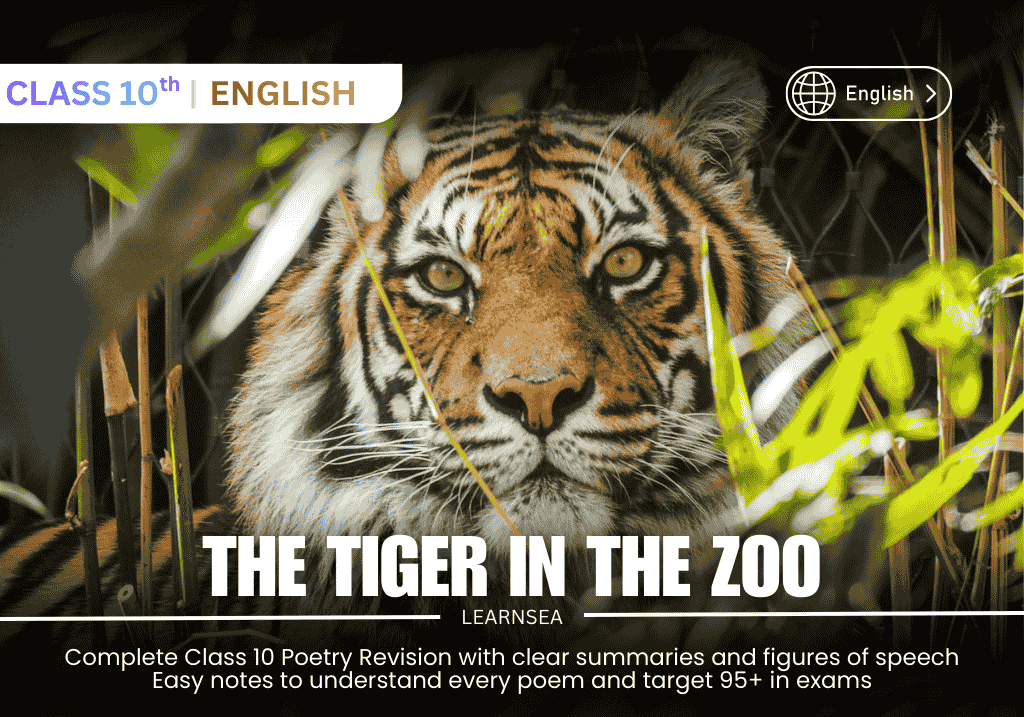
The poem focuses on the contrast between a tiger’s life in the wild and in captivity, highlighting the cruelty of confinement. In the jungle, the tiger is powerful, fearless, and free. He roams through forests, hunts boldly, and rules his territory. This is his natural life. However, in the zoo, he is reduced to a helpless creature pacing in a narrow cage. His strength becomes meaningless, and his spirit is crushed.
The poet criticizes how humans imprison wild animals for entertainment without understanding the unnatural and painful nature of this life for them. The poem encourages empathy and respect for wildlife, reminding us that animals deserve the same freedom that humans do. Through vivid description and contrast, the poet highlights the profound difference between living with dignity in nature and existing as a showpiece behind bars.
Figurative Devices
- Imagery: “Pads of velvet,” “brilliant eyes.”
- Contrast: Wild vs. caged life.
- Personification: Tiger’s emotions described like a human’s.
- Alliteration: “He stalks,” “snarling around houses.”
How to Tell Wild Animals – Carolyn Wells
This poem takes a humorous approach to describing wild animals and how one might identify them. Instead of giving scientific facts, the poet creates funny, exaggerated situations. For example, she says that if a lion attacks you and roars loudly, then you can be sure it is a lion. Similarly, she describes the leopard, bear, and crocodile in playful ways.
The poem uses humor to reduce fear and make the world of wild animals more interesting and enjoyable for young readers. Beneath the humor, the poem also suggests that nature is full of variety and wonder, and each animal has its own behavior and characteristics. It shows that learning about animals doesn’t always have to be serious—sometimes fun and laughter make learning easier. Overall, the poem celebrates wildlife in an entertaining and memorable way.
Figurative Devices
- Humour & Irony: “If the lion roars and kills you, it is a lion.”
- Alliteration: “Leopard leaped.”
- Imagery: Vivid descriptions of animals.
- Hyperbole: Exaggerated dangers for comic effect.
The Ball Poem – John Berryman
This poem teaches an important lesson about growing up and accepting loss. When the boy loses his ball, he experiences his first real sense of sadness and helplessness. At first, the ball seems like just a toy, but to the boy, it represents his childhood, comfort, and memories.
The poet wants us to understand that some losses in life cannot be replaced with money or new objects. Instead, we must learn to accept them with maturity. The poem shows how pain is a natural part of growing up and how experiences of loss help shape a person’s understanding of the world. Through a simple incident, the poet highlights deeper ideas: responsibility, change, and emotional growth. The message is that life will continue to challenge us, and we must learn to move forward even when we feel sad or helpless.
Figurative Devices
- Humour & Irony: “If the lion roars and kills you, it is a lion.”
- Alliteration: “Leopard leaped.”
- Imagery: Vivid descriptions of animals.
- Hyperbole: Exaggerated dangers for comic effect.
Amanda! – Robin Klein
The poem explores the conflict between a child’s need for imagination and an adult’s constant instructions. Amanda is frequently scolded for small things—biting her nails, not sitting properly, or not completing tasks. Feeling trapped, she escapes into her own fantasy world where she imagines herself as a mermaid, an orphan, or a princess like Rapunzel. These fantasies represent her desire for freedom, peace, and independence.
The poem shows how adults sometimes fail to understand a child’s emotional needs and unknowingly put pressure on them through constant nagging. It highlights the importance of giving children personal space and listening to them. Through Amanda’s imagination, the poet conveys that children often find comfort in creativity, especially when they feel misunderstood. The poem gently reminds parents to balance discipline with empathy.
Figurative Devices
- Contrast: Real nagging vs. Amanda’s fantasy.
- Imagery: Mermaid, orphan girl, Rapunzel.
- Allusion: Reference to fairy-tale characters.
- Irony: Amanda is scolded for being moody when she is just imagining.
The Trees – Adrienne Rich
The poem symbolizes the struggle for freedom and the desire to return to one’s natural place. The trees in the poem are trapped inside a greenhouse, representing confinement and oppression. They try to break free by moving their roots, branches, and leaves toward the door. This movement represents people who struggle for independence and fight against situations that limit their freedom, especially women who have been restricted by societal expectations. When the trees finally escape into the forest, it shows that nature cannot be controlled permanently.
The poet also highlights the bond between humans and nature—when nature is imprisoned, humans too feel trapped. The poem encourages respect for nature and supports the idea of liberation, growth, and self-expression. It is a powerful message about reclaiming one’s rightful space, whether in nature or in life.
Figurative Devices
- Personification: Trees “moving,” “shuffling,” “heading out.”
- Imagery: Dark forest, glasshouse.
- Metaphor: Trees = oppressed people.
- Symbolism: Freedom, nature’s reclaiming.
Fog – Carl Sandburg
The poem compares fog to a soft, quiet cat that arrives silently and sits without making a sound. This comparison helps readers imagine how naturally and gently fog appears in a city. It also shows how nature moves freely, without announcing itself or seeking attention. The fog covers the harbor and city just like a cat sitting quietly observing its surroundings. After a while, it quietly slips away.
The theme revolves around the mystery and unpredictability of nature. The poet reminds us that many natural events are beyond human control and happen in their own rhythm. The poem teaches us to observe nature carefully and appreciate its beauty even in simple moments. It shows that nature is alive, graceful, and full of personality, just like a living creature.
Figurative Devices
- Metaphor: Fog = a cat.
- Personification: Fog “sits,” “moves on.”
- Imagery: Harbor, sea, silent movement.
- Simplicity: Short but powerful.
The Tale of Custard the Dragon – Ogden Nash

The poem uses humor and rhyme to show that bravery cannot be judged by appearance or behavior. Custard, the dragon, is considered cowardly by everyone around him. Belinda and her pets constantly boast about their own bravery, while Custard quietly admits he is scared.
However, when a pirate attacks, all the supposedly brave characters run away, and Custard is the only one who courageously fights and protects them. This surprising twist teaches that true bravery appears in real moments of danger, not in empty boasting.
The poem celebrates humility, showing that those who brag often act weakly, while those who stay humble may possess real courage. It also reminds us not to judge others too quickly, because people may have strengths they themselves don’t show or even know about. The poem is fun, musical, and packed with a moral lesson.
Figurative Devices
- Humour: Silly names—Ink, Blink, Mustard.
- Irony: Brave ones turn coward; timid dragon saves them.
- Repetition: “Belinda lived in a little white house.”
- Imagery: Pirates, dragons, whimsical setting.
For Anne Gregory – W. B. Yeats
The poem reflects on the difference between outer beauty and inner goodness. Anne Gregory is admired for her beautiful golden hair, but the poet warns that people often fall in love with physical appearance rather than the true personality of a person. He argues that external beauty can easily influence the minds of others, leading to shallow love.
The poem suggests that real and lasting love should be based on inner qualities such as kindness, character, and purity of heart. The final stanza mentions a spiritual idea: only God can love someone for who they truly are, without being influenced by physical appearance. Through simple language and gentle advice, the poem encourages young readers to understand that beauty fades, but inner values remain. The message is clear: meaningful love grows from the inside, not from outward charm.
Figurative Devices
- Symbolism: Golden hair = outer beauty.
- Imagery: “Yellow hair,” “honey-coloured ramparts.”
- Contrast: Physical vs. spiritual love.
- Allusion: Biblical idea of divine love.
Conclusion
We hope this helpful resource on all CBSE Class 10 English poems from the First Flight book supports you in scoring higher marks. These summaries, main themes, and poetic devices will make it easier for you to understand every poem and answer questions with confidence in the exam. For more practice, you can also check our other study notes and sample papers. They will help you revise better, strengthen your concepts, and aim for top marks in Class 10 English.