

Preparing for the Class 10 Social Science MCQs board exam requires focused revision and consistent practice. One of the most effective strategies is solving previous years’ MCQs, especially from the 2021–2025 board examinations. These questions reflect the latest exam pattern, competency-based format, and frequently tested concepts across History, Geography, Political Science, and Economics.
In this blog, you will find a carefully compiled set of Class 10 Social Science MCQs from the last five years, designed to strengthen conceptual clarity and improve accuracy in objective-type questions. Practicing these questions will help you understand important trends, recurring themes, and the level of difficulty expected in the board exam.
Class 10 Social Science MCQs 2025
1. Which one of the following regions became a part of unified Italy in 1866 ?
(A) Sardinia-Piedmont
(B) Venetia
(C) Sicily
(D) Papal State
Answer (B) Venetia
2. Read the following reasons for migration of people from Europe to America till the 19th century and choose the correct option:
I. Poverty and hunger
II. Slaves for sale
III. Wide spread of diseases
IV. Religious conflicts and persecution
Options:
(A) Only I and III are correct.
(B) Only II, III and IV are correct.
(C) Only I, III and IV are correct.
(D) Only I and IV are correct.
Answer: (D) Only I and IV are correct.
3. The author of ‘Book of Marvels’ is:
(A) Marco Polo
(B) Columbus
(C) Vasco da Gama
(D) Alfred Crosby
Answer: (A) Marco Polo
4. Assume you are doing research on 15th century print culture. Which of the following would be the most significant advantage for your research?
(A) Easier access to rare manuscripts
(B) Reduced need for libraries
(C) Increase in the ability to copy text by hand
(D) Increased speed and accuracy of print
Answer: (D) Increased speed and accuracy of print
(The printing press revolutionized access to books by enabling faster, more accurate, and cheaper reproduction.)
5. Arrange the following categories of forests in India from the largest to the smallest in terms of area and choose the correct option:
I. Reserved
II. Protected
III. Unclassed
Options:
(A) III, II, I
(B) I, II, III
(C) II, III, I
(D) III, I, II
Answer: (B) I, II, III
(Reserved forests > Protected forests > Unclassed forests in area coverage.)
6. ‘Sariska Tiger Reserve’ is located in which one of the following states?
(A) Madhya Pradesh
(B) Rajasthan
(C) Uttar Pradesh
(D) Maharashtra
Answer: (B) Rajasthan
(It is in Alwar district, Rajasthan.)
7. The Hirakud Dam is built on which river?
a) Krishna
b) Chambal
c) Mahanadi
d) Kaveri
Answer: (c) Mahanadi
(Hirakud – Mahanadi; Gandhi Sagar – Chambal; Nagarjuna Sagar – Krishna; Mettur – Kaveri/Cauvery.)
8. Choose the correct option regarding major states involved in the Krishna-Godavari issue:
(A) Karnataka, Kerala and Tamil Nadu
(B) Maharashtra, Karnataka and Andhra Pradesh
(C) Gujarat, Maharashtra and Madhya Pradesh
(D) Jharkhand, Andhra Pradesh and Odisha
Answer: (B) Maharashtra, Karnataka and Andhra Pradesh
(These are the primary basin states for the Krishna River disputes; Godavari involves similar overlaps.)
9. Imagine you are travelling from Delhi to Chandigarh to attend a wedding, by road in January. Which of the following crops will you notice prominently in the fields during the journey?
(A) Paddy
(B) Maize
(C) Wheat
(D) Jowar
Answer: (C) Wheat
(Northern India in winter (Rabi season) prominently grows wheat in Punjab/Haryana regions along the Delhi-Chandigarh route.)
10. Two statements are given below. They are Assertion (A) and Reason (R).
Assertion (A): Minerals are an indispensable part of our lives.
Reason (R): All living things need minerals.
Options:
(A) Both (A) and (R) are true and (R) is the correct explanation of (A).
(B) Both (A) and (R) are true, but (R) is not the correct explanation of (A).
(C) (A) is true, but (R) is false.
(D) (A) is false, but (R) is true.
Answer: (B) Both (A) and (R) are true, but (R) is not the correct explanation of (A).
(Minerals are essential for human society/technology/life, but the reason focuses on biological needs; the assertion is more about societal dependence.)
11. Match Column I with Column II and Choose the correct option.
| Column I (Minerals) | Column II (Major Mines) |
|---|---|
| a. Iron ore | i. Gaya |
| b. Mica | ii. Singrauli |
| c. Bauxite | iii. Chandrapur |
| d. Coal | iv. Maikala |
| Option | Matching |
|---|---|
| (A) | a-iii, b-i, c-iv, d-ii |
| (B) | a-iii, b-i, c-ii, d-iv |
| (C) | a-ii, b-iii, c-i, d-iv |
| (D) | a-ii, b-iii, c-iv, d-i |
Answer: (A) a-iii, b-i, c-iv, d-ii
12. Belgium solved its problem of majoritarianism by strengthening which of the following types of government?
(A) Unity
(B) Presidential
(C) Federal
(D) Parliamentary
Answer: (C) Federal
(Belgium adopted federal arrangements with community governments to accommodate linguistic diversity.)
13. Choose the correctly matched pair from the following:
(A) Canada – Unitary
(B) Bolivia – Federal
(C) Australia – Unitary
(D) Spain – Federal
Answer: (B) Bolivia – Federal
14. Which of the following are the main components of a political party?
I. Leaders
II. Active members
III. Followers
IV. Pressure groups
Options:
(A) Only I, II and III are correct.
(B) Only II, III and IV are correct.
(C) Only I, III and IV are correct.
(D) Only I and IV are correct.
Answer: (A) Only I, II and III are correct.
(Pressure groups are separate from parties.)
15. Amongst the given countries, which one has the highest rank in Human Development Index? (India 130, Myanmar 148, Nepal 149, Pakistan 150)
(A) Pakistan
(B) India
(C) Nepal
(D) Myanmar
Answer: (B) India
(Highest rank = lowest number = best position.)
16. ‘X’ lives in a town. He cultivates flowers with animal husbandry. The work of ‘X’ will fall under which sector of the economy?
(A) Primary
(B) Secondary
(C) Tertiary
(D) Quaternary
Answer: (A) Primary
(Agriculture, animal husbandry = primary sector.)
17. The work being done in the picture falls under which sector of the economy?
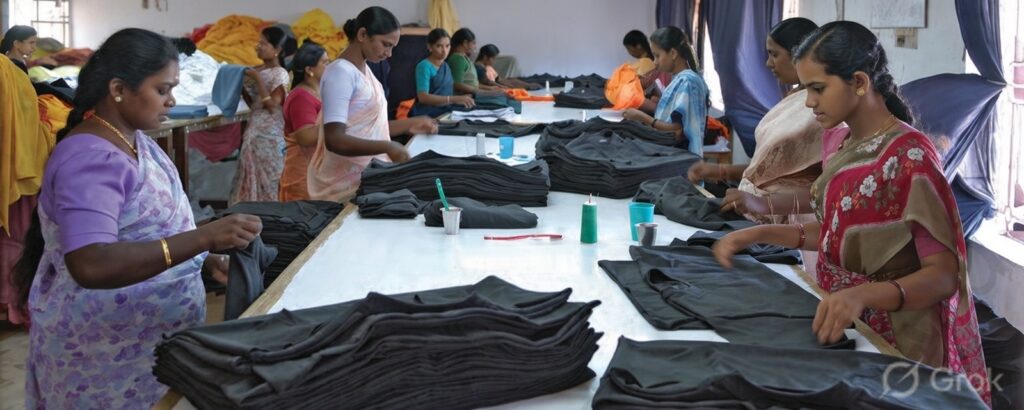
The work being done in the picture falls under which sector of the economy?
(A) Primary
(B) Quaternary
(C) Secondary
(D) Tertiary
Answer: Tertiary sector (Services)
Women are folding clothes in a market/shop setting.
18. Why does it become difficult for farmers in rural areas to take loans from government banks?
I. Lack of collateral
II. Complicated procedure
III. Higher cost of borrowing
IV. Lack of awareness
Options:
(A) Only I and II
(B) Only II, III and IV
(C) Only I and IV
(D) Only I, III and IV
Answer: (A) Only I and II
Main reasons:
- Lack of collateral
- Complicated procedures
Higher cost of borrowing usually applies to informal sources, not banks.
19. Which of the following groups in urban India depend on informal sources to meet their credit needs?
(A) Poor households
(B) Households with few assets
(C) Both poor households and households with few assets
(D) Both well-off households and households with few assets
Answer: (C) Both poor households and households with few assets
20. Two statements are given below.
Statement I: Rapid improvement in technology has been one major factor to stimulate the globalisation process.
Statement II: This has made much faster delivery of goods across long distances possible at lower costs.
Options:
(A) Both I and II are correct and II is the correct explanation of I.
(B) Both I and II are correct, but II is not the correct explanation of I.
(C) I is correct, but II is incorrect.
(D) I is incorrect, but II is correct.
Answer: (A) Both I and II are correct and II is the correct explanation of I.
Additional Question: Which one of the following regions became a part of unified Italy in 1866?
(A) Sardinia-Piedmont
(B) Venetia
(C) Sicily
(D) Papal State
Answer: (B) Venetia
(Venetia joined unified Italy after the Austro-Prussian War in 1866.)
Class 10 Social Science MCQs 2024
1. Match Column I (List) with Column II (Jurisdiction Sphere) and choose the correct option:
Column I
I. Union list subjects
II. State list subjects
III. Concurrent subjects
IV. Residuary subjects
Column II
A. State Governments alone make laws on it.
B. For uniformity Central Government Legislates on it.
C. Subjects under Jurisdiction of Centre and State Governments.
D. Central Government legislates on new subjects.
Options:
(a) I-A, II-B, III-C, IV-D
(b) I-C, II-B, III-D, IV-A
(c) I-D, II-C, III-B, IV-A
(d) I-B, II-A, III-C, IV-D
Answer: (d) I-B, II-A, III-C, IV-D
(Union List: Centre alone legislates for uniformity → B; State List: States alone → A; Concurrent: Both → C; Residuary: Centre on new subjects → D. Standard from NCERT Federalism chapter.)
2. Read the given statements:
- India has no official religion.
- All the communities have freedom to profess and practice any religion in India.
Which one of the following constitutional terms is used for the above statements?
(a) Republic
(b) Secular
(c) Sovereign
(d) Socialist
Answer: (b) Secular
(The Preamble describes India as secular, meaning no official state religion and equal freedom for all religions.)
3. Which of the following terms refers to the belief in and advocacy for the social, political and economic equality of women?
(a) Patriarchy
(b) Matriarchy
(c) Socialist
(d) Feminist
Answer: (d) Feminist (Feminism advocates for gender equality.)
4. Identify the soil with the help of following information:
• It develops in areas with high temperature.
• It is the result of intense leaching due to heavy rain.
• Humus content is low.
Soil:
(a) Arid soil
(b) Yellow soil
(c) Laterite soil
(d) Black soil
Answer: (c) Laterite soil
(Laterite forms in hot, humid tropical areas with heavy rainfall causing leaching of nutrients, resulting in low humus and iron/aluminum rich soil.)
5. Read the given statements and choose the correct option with regard to Rabi cropping season from the following:
I. Rabi crops are sown in winter.
II. Sown from October to December and harvested from April to June.
III. Important crops are Maize, Cotton, Jute.
IV. Punjab, Haryana, Uttar Pradesh are important for the production of wheat.
Options:
(a) I, II and IV
(b) II, III and IV
(c) I, II and III
(d) I and II
Answer: (a) I, II and IV
(Rabi: sown Oct-Dec in winter, harvested Apr-Jun; wheat major in Punjab, Haryana, UP. III is incorrect—maize/cotton/jute are Kharif crops.)
6. Choose the correctly matched pair:
| Column I (Type of Mineral) | Column II (Example) |
|---|---|
| (a) Ferrous | Nickel |
| (b) Non-Ferrous | Cobalt |
| (c) Non-Metallic Minerals | Limestone |
| (d) Energy Minerals | Natural Gas |
Answer: (c) Non-Metallic Minerals – Limestone
(Limestone is non-metallic; others mismatched—natural gas/energy, nickel non-ferrous, cobalt energy/mineral but not standard pair.)
7. Which one of the following pairs regarding Indian nationalism is correctly matched?
| Leaders | Contribution |
|---|---|
| (a) Sardar Patel | Hindustan Socialist Republican Army |
| (b) Bhagat Singh | Swaraj Party |
| (c) C.R. Das | Bardoli Satyagraha |
| (d) Jawaharlal Nehru | Oudh Kisan Sabha |
(a) Sardar Patel : Hindustan Socialist Republican Army
(b) Bhagat Singh : Swaraj Party
(c) C.R. Das : Bardoli Satyagraha
(d) Jawaharlal Nehru : Oudh Kisan Sabha
Answer: (d) Jawaharlal Nehru : Oudh Kisan Sabha
8. Arrange the following events in chronological order and choose the correct option:
I. Treaty of Constantinople
II. Defeat of Napoleon
III. Unification of Italy
IV. Unification of Germany
Options:
(a) I, II, IV, III
(b) II, III, I, IV
(c) II, I, IV, III
(d) IV, I, III, II
Answer: (c) II, I, IV, III
9. Two statements are given below.
Assertion (A): The most serious source of nationalist tension in Europe after 1871 was Balkan.
Reason (R): A large part of the Balkan was under the control of Ottoman Empire.
Options:
(a) Both (A) and (R) are true and (R) is the correct explanation of (A).
(b) Both (A) and (R) are true but (R) is not the correct explanation of (A).
(c) (A) is true but (R) is false.
(d) (A) is false but (R) is true.
Answer: (a) Both (A) and (R) are true and (R) is the correct explanation of (A).
(Balkans called ‘powder keg’ due to nationalism, ethnic diversity, and Ottoman decline after 1871.)
10. From which of the following countries did Giuseppe Garibaldi belong to?
(a) Austria
(b) Italy
(c) Greece
(d) Spain
Answer: (b) Italy
(Garibaldi was Italian nationalist, key in unification.)
11. Look at the given picture carefully and infer the income of the bank.
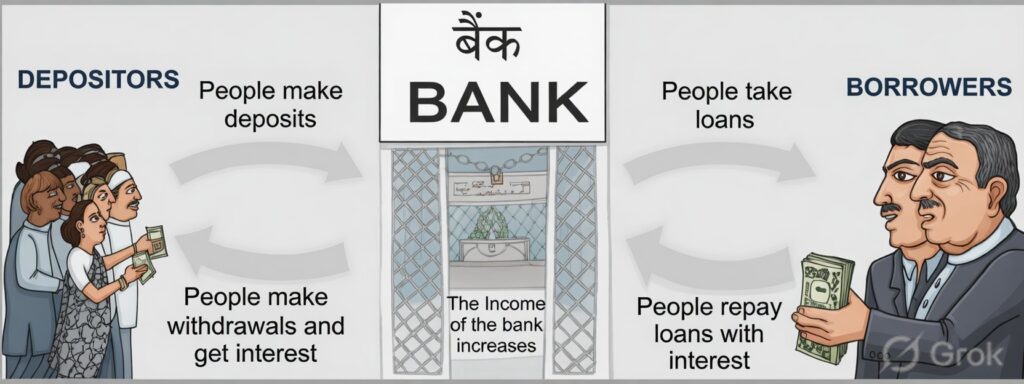
The income of the bank is:
(a) Difference between amount deposited and borrowed by the bank to Reserve Bank of India.
(b) The difference of amount of interest between what is charged from borrowers and what is paid to depositors.
(c) The difference of interest rate between what is charged from borrowers and what is charged from depositor.
(d) The difference between the amount deposited by the depositor and borrowed by the borrower.
Answer: (b) The difference of amount of interest between what is charged from borrowers and what is paid to depositors.
(Bank’s profit = interest received on loans – interest paid on deposits.)
12. Why do lenders often require collateral before lending loan? Choose the most suitable option:
(a) To lower interest rates for borrowers.
(b) To establish personal relations.
(c) To increase their profit margins.
(d) To mitigate the risk of loan default.
Answer: (d) To mitigate the risk of loan default.
13. Which of the following are the developmental goals of a prosperous farmer?
I. Better support prices for crops
II. Higher wages
III. Assured more days of work
IV. Assured high family income
Options:
(a) Only I and II are correct.
(b) Only II and IV are correct.
(c) Only II and III are correct.
(d) Only I and IV are correct.
Answer: (d) Only I and IV are correct.
(Prosperous farmers seek better MSP and high income; wages/days of work more for laborers.)
14. Which one of the following is an example of organized sector activities?
(a) A farmer irrigating his field.
(b) A handloom weaver working in her house.
(c) A headload worker carrying cement.
(d) A teacher taking classes in a government school.
Answer: (d) A teacher taking classes in a government school.
(Organized: regular salary, rules, security; government school teacher fits.)
15. Removing barriers or restrictions on business and trade set by the government is called as _________.
(a) Disinvestment
(b) Special Economic Zones
(c) Liberalisation
(d) Foreign Direct Investment
Answer: (c) Liberalisation
16. Which one of the following indices is given priority by the World Bank with respect to development?
(a) Infant Mortality Rate
(b) Equality
(c) Body Mass Index
(d) Per Capita Income
Answer: (d) Per Capita Income
(World Bank uses per capita income for classifying countries.)
17. Suppose, the monthly income of the family members is as follows:
Mother – Rs. 50,000/-, Father – Rs. 40,000/-, Son – Rs. 20,000/-, Daughter – Rs. 20,000/-.
The average income of the family would be:
(a) Rs. 32,000/-
(b) Rs. 30,000/-
(c) Rs. 32,500/-
(d) Rs. 33,500/-
Answer: (c) Rs. 32,500/-
(Total = 50k + 40k + 20k + 20k = 1,30,000; Average = 1,30,000 / 4 = 32,500.)
18. What role do ‘checks and balances’ play in a democratic country?
(a) To establish a direct form of government without representatives.
(b) To create a separation of powers to prevent from authoritarianism.
(c) To prevent any change to the Constitution.
(d) To ensure absolute power for one branch of government.
Answer: (b) To create a separation of powers to prevent from authoritarianism.
19. Which one of the following countries has two-party system?
(a) China
(b) United Kingdom
(c) India
(d) Pakistan
Answer: (b) United Kingdom
(UK has dominant two-party system: Conservatives and Labour.)
20. Which of the following was the primary objective of Belgium to form the separate government in Brussels?
(a) Promoting cultural events
(b) Managing international relations
(c) Enforcing local laws
(d) Ensuring linguistic accommodation
Answer: (d) Ensuring linguistic accommodation.
(Brussels has separate administration for Dutch/French speakers to accommodate linguistic diversity.)
Class 10 Social Science MCQs 2023
1. Match Column I with Column II and choose the correct option.
| Column I | Column II |
|---|---|
| i. Union List | 1. Agriculture |
| ii. State List | 2. Computer Software |
| iii. Concurrent List | 3. Banking |
| iv. Residuary Subjects | 4. Education |
Options:
(a) i-3, ii-1, iii-4, iv-2
(b) i-4, ii-3, iii-2, iv-1
(c) i-2, ii-4, iii-3, iv-1
(d) i-1, ii-2, iii-3, iv-4
Answer: (c) i-2, ii-4, iii-3, iv-1
(Union List: Computer Software (residuary, under Centre); State List: Education; Concurrent: Banking; Residuary: Agriculture? Wait—standard: Union: Banking; State: Agriculture; Concurrent: Education; Residuary: Computer Software. Yes, matches (c).)
2. Which one of the following is an example of ‘coming together federation’?
(a) India
(b) USA
(c) Belgium
(d) Spain
Answer: (b) USA
(Coming together: Independent states voluntarily join for common benefits, e.g., USA; India is ‘holding together’ federation.)
3. There are two statements given as Assertion (A) and Reason (R). Read both the statements and choose the correct option.
Assertion (A): Belgium amended their constitution four times.
Reason (R): Amendments were to enable everyone to live together in the same country.
Options:
(a) Both Assertion (A) and Reason (R) are true and Reason (R) is the correct explanation of Assertion (A).
(b) Both Assertion (A) and Reason (R) are true but Reason (R) is not the correct explanation of Assertion (A).
(c) Assertion (A) is true, but Reason (R) is false.
(d) Assertion (A) is false, but Reason (R) is true.
Answer: (a) Both Assertion (A) and Reason (R) are true and Reason (R) is the correct explanation of Assertion (A).
(Belgium amended its constitution 4 times (1970–1993) to create power-sharing for linguistic harmony.)
4. Match Column I with Column II and choose the correct option.
| Column I (Port) | Column II (Type) |
|---|---|
| i. Kandla | 1. Riverine port |
| ii. Mumbai | 2. Deepest landlocked port |
| iii. Visakhapatnam | 3. Biggest port |
| iv. Kolkata | 4. Port developed after independence |
Options:
(a) i-4, ii-3, iii-2, iv-1
(b) i-2, ii-1, iii-3, iv-4
(c) i-2, ii-4, iii-1, iv-3
(d) i-1, ii-2, iii-4, iv-3
The correct answer is (a) i-4, ii-3, iii-2, iv-1
- i. Kandla → 4. Port developed after independence
- ii. Mumbai → 3. Biggest port
- iii. Visakhapatnam → 2. Deepest landlocked port
- iv. Kolkata → 1. Riverine port
5. There are two statements given as Assertion (A) and Reason (R). Read both the statements and choose the correct option.
Assertion (A): Agriculture and industry move hand in hand.
Reason (R): Industrial development is a precondition for eradication of unemployment and poverty from the country.
Options:
(a) Both Assertion (A) and Reason (R) are true and Reason (R) is the correct explanation of Assertion (A).
(b) Both Assertion (A) and Reason (R) are true, but Reason (R) is not the correct explanation of Assertion (A).
(c) Assertion (A) is true, but Reason (R) is false.
(d) Assertion (A) is false, but Reason (R) is true.
Answer: (b) Both Assertion (A) and Reason (R) are true, but Reason (R) is not the correct explanation of Assertion (A).
(Agriculture and industry interdependent, but R is broader—industrialization helps poverty but not direct explanation for ‘hand in hand’.)
6. Which one of the following soils develops in an area with high temperature and heavy rainfall?
(a) Red and Yellow
(b) Black
(c) Alluvial
(d) Laterite
Answer: (d) Laterite
(Laterite soil forms in tropical regions with high temp/rainfall; leaching leaves iron/aluminum, low humus.)
7. Look at the picture given below. Identify the name of the senior litterateur shown in the image and choose the correct option.
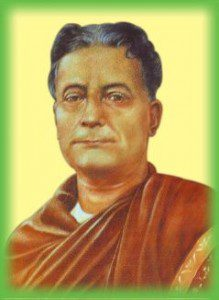
Options:
(a) Ram Mohan Roy
(b) Raja Ravi Varma
(c) Lakshminath Bezbarua
(d) Gangadhar Bhattacharya
Answer: (c) Lakshminath Bezbarua
(Assamese Literature, founder of modern Assamese literature)
8. In which one of the 1920s countries was ‘mass production’ an important feature?
(a) United States
(b) Poland
(c) France
(d) Japan
Answer: (a) United States
(USA pioneered assembly line/mass production in 1920s via Fordism.)
9. Choose the correct option: from the following regarding Central Powers in First World War:
(a) Germany, Austria-Hungary and Ottoman Turkey
(b) Britain, France and Russia
(c) Italy, France and Russia
(d) France, Austria-Hungary and China
Answer: (a) Germany, Austria-Hungary and Ottoman Turkey
(Central Powers: Germany, Austria-Hungary, Ottoman Empire, Bulgaria.)
10. Which one of the following was driven by one of the following ideologies in Europe after the defeat of Napoleon in 1815?
(a) Socialism
(b) Conservatism
(c) Liberalism
(d) Romanticism
Answer: (b) Conservatism
After the defeat of Napoleon Bonaparte in 1815, European powers met at the Congress of Vienna.
11. Which one of the following is a challenge of Globalisation?
(a) Access to New Markets
(b) Access to New Talent
(c) International Recruitment
(d) Disproportionate Growth
Answer: (d) Disproportionate Growth
(Globalisation leads to uneven benefits, widening inequality.)
12. Which one of the following categories of urban households take the highest percentage of loan from?
(a) Poor households
(b) Households with few assets
(c) Well-off households
(d) Rich households
Answer: (a) Poor households
(Poor urban households rely heavily on informal loans due to lack of collateral.)
13. Which one of the following is the medium of exchange?
(a) Paper notes
(b) Gold form of currency
(c) Silver coins
(d) Copper coins
Answer: (a) Paper notes
(Paper currency is modern legal tender/medium of exchange.)
14. Which of the following is true regarding the unorganized sector?
(a) Terms of employment are regular.
(b) People have assured work.
(c) They have some formal processes and procedures.
(d) There are some rules and regulations but these are not followed.
Answer: (d) There are some rules and regulations but these are not followed.
(Unorganized sector lacks enforcement of rules.)
15. Natural products being changed into other forms is known as:
(a) Primary product
(b) Secondary product
(c) Tertiary product
(d) Quaternary product
Answer: (b) Secondary product
(Secondary sector: Manufacturing/processing raw materials.)
16. Study the given table and answer the following: Which of the following countries has the highest level of Human Development Index (HDI)?
| Country | Gross National Income (GNI) per capita (2011 PPP $) | Life Expectancy at birth | Mean Years of Schooling (25+) | HDI Rank in the world (2018) |
|---|---|---|---|---|
| Sri Lanka | 12,707 | 77 | 10.6 | 73 |
| India | 6,681 | 69.7 | 6.5 | 130 |
| Myanmar | 4,961 | 67.1 | 5.0 | 148 |
| Pakistan | 5,005 | 67.3 | 5.2 | 154 |
| Nepal | 3,457 | 70.8 | 5.0 | 143 |
| Bangladesh | 4,976 | 72.6 | 6.2 | 134 |
Options:
(a) Sri Lanka
(b) Bangladesh
(c) India
(d) Nepal
Answer: (a) Sri Lanka
(Highest HDI = best rank = lowest number: 73 for Sri Lanka.)
17. Choose the correct option to fill in the blank. For comparing countries, there ________ is considered to be one of the most important attributes by the World Bank.
(a) Education
(b) Income
(c) Health Status
(d) Living Standard
Answer: (b) Income
(World Bank uses per capita income for development comparison.)
18. Which one of the following countries adopted multi-party system
(a) China
(b) United Kingdom
(c) India
(d) USA
Answer: (c) India
19. Which of the following States is ruled by a single party?
(a) Haryana
(b) Madhya Pradesh
(c) Odisha
(d) Rajasthan
Answer: (c) Odisha
(Biju Janata Dal has ruled Odisha continuously since 2000, a single-party dominance.)
20. In which one of the following regions is the participation of women in the workforce the highest?
(a) Latin America
(b) European countries
(c) Middle East and North Africa
(d) Asian countries
Answer: (b) European countries
(Europe has highest female labour participation rates globally, ~60-70%.)
Class 10 Social Science MCQs 2022
1. The Act was passed by the Imperial Legislative Council. It gave power to the government to repress political activities. It empowered the government to detain political prisoners without trial.
a) Rowlatt Act
b) Vernacular Press Act
c) Government of India Act
d) Inland Emigration Act
Answer: a) Rowlatt Act (1919 – used to arrest without trial)
2. Which place in India has an artificial lake to conserve water that dates to the 11th century?
a) Delhi
b) Bhopal
c) Mumbai
d) Kolhapur
Answer: d) Kolhapur (Rankala Lake built by Shilahara dynasty)
3. Who has the least percentage of literacy rate in rural population?
| Category | Male | Female |
|---|---|---|
| Literacy rate for rural population | 76% | 54% |
| Literacy rate for rural children in age group 10–14 years | 90% | 87% |
| Percentage of rural children aged 10–14 attending school | 85% | 82% |
a) Male
b) Children
c) Male & Female
d) Female
Answer: d) Female (gender gap common in such data)
4. Potential measures to mitigate threats to tiger population and biodiversity:
i. Banning hunting, giving legal protection to habitats, restricting trade
ii. Prohibiting visit of public into forest area
iii. Establishing wildlife sanctuaries and National Parks
iv. Converting forests into Reserved and Protected forests
a) i and ii
b) ii, iii & iv
c) ii only
d) i, iii & iv
Answer: d) i, iii & iv
5. When many countries of Europe came together to form the European Union, ___ was chosen as its headquarters
a) Brussels
b) Paris
c) London
d) Zurich
Answer: a) Brussels
6. Which statement accurately distinguishes Majoritarianism and Power sharing?
a) Majoritarianism emphasizes dominance of majority, Power sharing emphasizes sharing among groups
b) Majoritarianism emphasizes consensus, Power sharing excludes minorities
c) Majoritarianism accommodates minorities, Power sharing emphasizes majority rule
d) Majoritarianism peaceful resolution, Power sharing uses force
Answer: a)
7. Assertion (A): Democracies are based on political equality
Reason (R): All individuals have equal say in electing representatives.
a) Both A and R true, R explains A
b) Both true, R does not explain A
c) A true, R false
d) A false, R true
Answer: a) Both A and R true, R explains A
8. Absence of double coincidence of wants in barter — best solution:
a) Double coincidence of want, Exchanging commodity for commodity
b) Double Coincidence of want, Credit on Commodity
c) Double coincidence of want, Loan on commodity
d) Double coincidence of want, Money
Answer: d) Money (eliminates need for coincidence)
9. To ensure no branch has absolute power (effective power-sharing):
a) All power in legislature
b) Power divided between central & states
c) Power separated among legislature, executive, judiciary
d) Power shared among national, regional, local
Answer: c) (separation of powers)
10. Identify the painting:
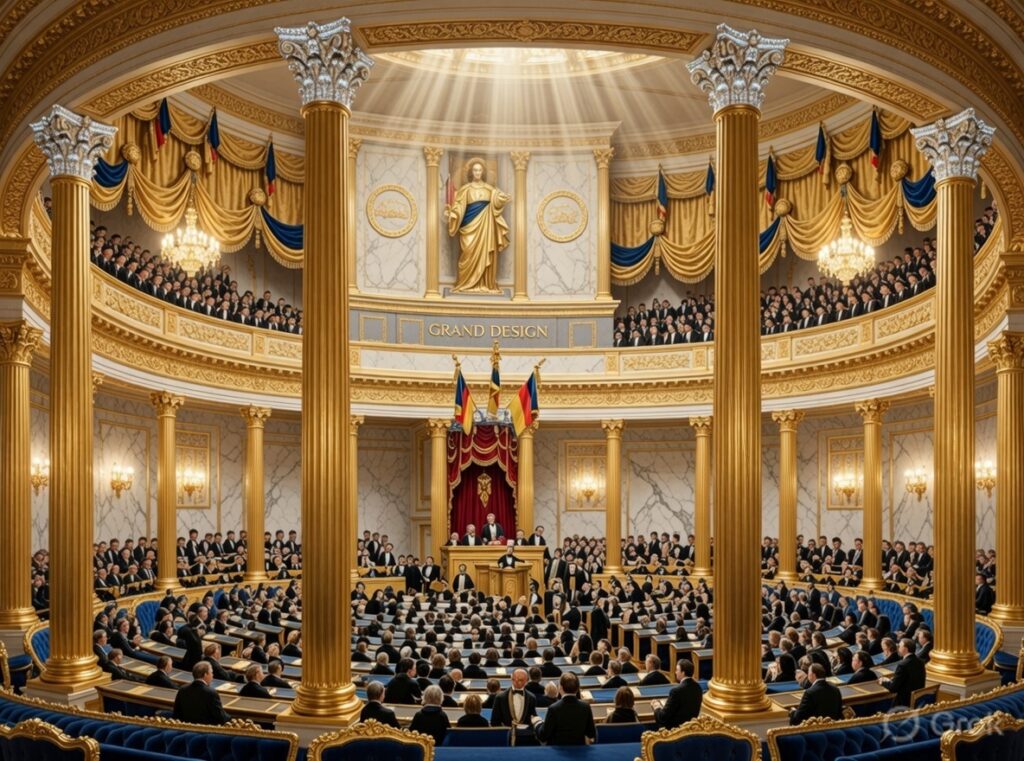
a) Frankfurt Parliament
b) Reichstag
c) Duma
d) The House of Parliament
Answer: a) Frankfurt Parliament
11. Impacts of foreign trade on global economy:
i. Choice of goods increases
ii. Producers compete despite distance
iii. Connects / integrates markets
iv. Quality always good
a) i and ii
b) i, ii and iii
c) All
d) Only iv
Answer: b) i, ii and iii
12. Government provides right & means to examine decision process → it is:
a) Accountable
b) Responsible
c) Transparent
d) Stable
Answer: c) Transparent
13. Sequence of events for Non-cooperation movement:
i. Jallianwala Bagh massacre
ii. Forced recruitment & economic hardships in WW1
iii. Khilafat movement after Ottoman defeat
iv. Rowlatt satyagraha by Gandhi
a) iv, iii, ii, i
b) ii, i, iv, iii
c) i, iv, iii, ii
d) i, ii, iii, iv
Answer: ii, iv, i, iii
- WWI hardships → 1914–18
- Rowlatt Satyagraha → Early 1919
- Jallianwala Bagh → April 1919
- Khilafat Movement → 1919–20
14. Transporters strike → vegetables/milk scarce in cities, farmers can’t sell: sectors affected?
a) Primary & Secondary
b) Secondary & Tertiary
c) Tertiary, Primary & Secondary
d) Tertiary & Primary
Answer: d) Tertiary & Primary
15. Printing in China (late 19th century):
I. Western printing & mechanical press imported
II. Beijing hub of new print culture for western-style schools
a) I correct, II incorrect
b) I incorrect, II correct
c) Both incorrect
d) Both correct
Answer: a) I correct, II incorrect (Shanghai was main hub)
16. Soil for cotton clues:
i. Holds moisture well
ii. Turns yellow when hydrated
iii. Rich in kankar & bhangar
iv. Well-drained loamy
a) i
b) i and iii
c) i and ii
d) iv
Answer: c) i and ii (Black soil / Regur)
17. Emergence of ___ directly connected to rise of political parties.
a) Monitory democracies
b) Direct democracies
c) Representative democracies
d) Constitutional democracies
Answer: c) Representative democracies
18. Process of integration between countries
a) Privatization
b) Globalization
c) Liberalization
d) Competition
Answer: b) Globalization
19. Correct statement on government formation:
i. Independent candidates can form govt
ii. Only political parties
iii. Only elected political parties
iv. Only elected parties with majority
a) i & ii
b) i, ii, iii
c) iii
d) Only iv
Answer: d) Only iv
20. Assertion (A): India has multi-party system
Reason (R): It often messy & leads to instability
a) Both true, R explains A
b) Both true, R does not explain A
c) A true, R false
d) A false, R true
Answer: Both true, R does not explain A
Class 10 Social Science MCQs 2021
1. Industrialisation began in which one of the following European countries in the second half of the eighteenth century?
A. Germany
B. France
C. Italy
D. England
Answer: D. England (The First Industrial Revolution began in England around 1760–1780)
2. Which type of governments were mainly driven in Europe after the defeat of Napoleon in 1815?
A. Conservative
B. Liberal
C. Federal
D. Feudal
Answer: A. Conservative
(Congress of Vienna restored conservative monarchies.)
3. Which one of the following group of countries collectively defeated Napoleon in 1815?
A. Britain, Russia, Prussia and Austria
B. Britain, Russian, Prussia and Australia
C. Britain, Russia, Netherlands and Germany
D. Britain, Luxembourg, Germany and Italy
Answer: A. Britain, Russia, Prussia and Austria
4. In which one of the following countries did the first liberalist-nationalist upheaval take place in July 1830?
A. France
B. Germany
C. England
D. Italy
Answer: A. France
(July Revolution 1830 in France.)
5. Who among the following remarked “When France sneezes, the rest of Europe catches cold”?
A. Lord Byron
B. Metternich
C. Johann Herder
D. Napoleon
Answer: B. Metternich
6. Who among the following was the architect for the unification of Germany?
A. Otto Von Bismarck
B. William I
C. Frederick III
D. William II
Answer: A. Otto Von Bismarck
7. Who among the following had sought to put together a coherent programme for a unitary Italian Republic during 1830s?
A. Victor Emmanuel I
B. Victor Emmanuel II
C. Giuseppe Mazzini
D. Count Cavour
Answer: C. Giuseppe Mazzini
8. In which one of the following states is overgrazing the main reason for land degradation?
A. Punjab
B. Maharashtra
C. Haryana
D. Uttar Pradesh
Answer: B. Maharashtra
9. Identify the soil which ranges from red to brown in colour and is saline in nature:
A. Red soil
B. Laterite soil
C. Arid soil
D. Alluvial soil
Answer: C. Arid soil
10. Which of the following forces leads to maximum soil erosion in plains?
A. Wind
B. Running water
C. Glacier
D. Earthquake
Answer: B. Running water
11. Deforestation due to mining has caused severe land degradation in which one of the following states?
A. Odisha
B. Tamil Nadu
C. Kerala
D. Gujarat
Answer: A. Odisha
12. Who among the following was proclaimed King of united Italy in 1861?
A. Charles I
B. Victor Emmanuel II
C. Giuseppe Garibaldi
D. Nero
Answer: B. Victor Emmanuel II
13. Which one of the following subjects is included in the Union List?
A. Communication
B. Trade
C. Commerce
D. Irrigation
Answer: A. Communication
14. Which of the following elements is not included in the Belgium model?
A. Dutch and French speaking ministers shall be equal in the government.
B. Powers of the central government have been given to state governments.
C. Brussels has a separate government in which both the communities have equal representation.
D. There is a community government which has special powers of cultural, educational and language-related issues.
Answer: B. Powers of the central government have been given to state governments.
15. Which of the following countries is an example of ‘Holding together federation’?
A. Australia
B. India
C. USA
D. Switzerland
Answer: B. India
16. Which of the following ethnic communities is in majority in Sri Lanka?
A. Sri Lankan Tamils
B. Indian Tamils
C. Muslims
D. Sinhalese
Answer: D. Sinhalese
17. Which one of the following subjects is included in the State List?
A. Banking
B. Business
C. Currency
D. Communication
Answer: B. Business
18. Activities that help in the development of Primary and Secondary sector come under which of the following sectors?
A. Primary
B. Secondary
C. Tertiary
D. Quaternary
Answer: C. Tertiary
19. Identify the correct feature of Unitary form of government from the following:
A. There are two or more levels of government.
B. Different tiers of government govern the same citizens.
C. Each tier of government has its own jurisdiction.
D. The sub-units are subordinate to the central government.
Answer: D. The sub-units are subordinate to the central government.
20. At the initial stages of development, which one of the following sectors was the most important economic activity?
A. Primary
B. Secondary
C. Tertiary
D. Quaternary
Answer: A. Primary
21. Activities in which natural products are changed into other forms come under which one of the following sectors?
A. Primary
B. Secondary
C. Tertiary
D. Quaternary
Answer: B. Secondary
22. The products received by exploiting natural resources come under which one of the following sectors?
A. Quaternary
B. Tertiary
C. Secondary
D. Primary
Answer: D. Primary
23. Which one of the following factors is mainly responsible for declining water level in India?
A. Irrigation
B. Industrialization
C. Urbanisation
D. Over-utilization
Answer: D. Over-utilisation
24. Which one of the following subjects is included in the Concurrent List?
A. Trade
B. Commerce
C. Agriculture
D. Marriage
Answer: D. Marriage
Read More
Class 10 Social Science Map Practice with Important Locations
Class 10 History Important Dates You Must Know for Board Exams
Conclusion
Class 10 Social Science MCQs from the 2021–2025 board exams is one of the smartest ways to prepare. These questions give you a clear idea of what the exam actually looks like and which topics matter most. Instead of guessing what to study, you practice exactly what has been asked in recent years.
If you revise your concepts and regularly attempt these previous year MCQs, you’ll notice a real improvement in speed and accuracy. Over time, your confidence will grow, and the exam won’t feel overwhelming. Keep practicing consistently, focus on understanding rather than memorizing, and you’ll be well prepared to score high in your Class 10 Social Science board exam.