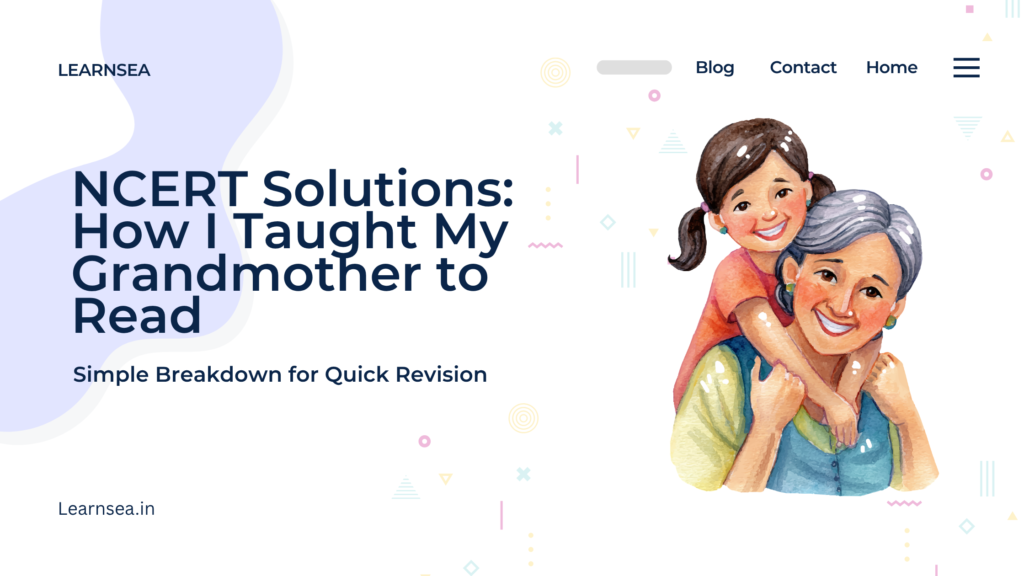

How I Taught My Grandmother to Read is a touching story that highlights the value of education, determination, and the deep bond between a grandmother and her granddaughter. This lesson shows that learning has no age limit and that true motivation can overcome any barrier.
In this blog, you’ll find a simple and clear NCERT solution along with a concise summary and key insights to help you understand the chapter quickly and effectively. Whether you’re preparing for exams or just revising, this guide will make the lesson easy to grasp.
How I Taught My Grandmother to Read NCERT solutions
Check Your Understanding
I State whether the following sentences are true or false.
- The grandmother wanted to learn the Kannada alphabet to gain independence.
Answer: True
(She wanted to read stories like Kashi Yatre on her own without depending on anyone.) - The grandmother asked someone in the village to read Kashi Yatre to her while the narrator was away.
Answer: False
(She felt too embarrassed to ask anyone else in the village.) - The narrator was the grandmother’s first teacher and taught her how to read Kannada.
Answer: True
(The granddaughter herself taught her the Kannada alphabet.) - The grandmother believed that there was no age limit for learning.
Answer: True
(She said, “For learning there is no age bar.”) - The grandmother touched the narrator’s feet as a mark of respect for her as a teacher.
Answer: True
(On Saraswati Puja day, she touched her granddaughter’s feet to show respect as a guru.) - The narrator was disappointed with the progress her grandmother made in learning to read.
Answer: False
(The narrator was proud and felt her student had “passed with flying colours.”)
Critical Reflection
I Read the extracts given below and answer the questions that follow.
Extract 1
When I came back to my village, I saw my
grandmother in tears. I was surprised, for I had never
seen her cry even in the most difficult situations.
What had happened? I was worried.
‘Avva, is everything all right? Are you okay?’
I used to call her Avva, which means mother in the
Kannada spoken in north Karnataka.
She nodded but did not reply. I did not understand
and forgot about it. In the night, after dinner, we were
sleeping in the open terrace of our house. It was a
summer night and there was a full moon. Avva came
and sat next to me. Her affectionate hands touched
my forehead.
(i) Complete the following sentence with the appropriate option.
The phrase ‘never seen her cry in the most difficult situations’ tells us that the grandmother was ________________________.
Answer: A. strong-willed
(ii) Complete the following with the correct option from those given in the brackets.
Grandmother did not reply when the narrator asked if she was alright because she might have been too ________________________ (emotional/tired) to respond.
Answer: emotional
(iii) Identify the clue from the extract that indicates a rural setting with traditional customs.
Answer:
- Sleeping in the open terrace of the house on a summer night with a full moon.
- The narrator calling her grandmother “Avva”.
(iv) Which lines of the extract establish a tender atmosphere?
Answer:
“Avva came and sat next to me. Her affectionate hands touched my forehead.”
(v) Which of the following aspect is NOT emphasized in the given extract?
Answer: C. the grandmother’s regret over her lack of education
Extract 2
‘I have decided I want to learn the Kannada alphabet
from tomorrow onwards. I will work very hard. I
will keep Saraswati Puja day during Dassara as the
deadline. That day I should be able to read a novel on
my own. I want to be independent.’
I saw the determination on her face. Yet I laughed
at her.
‘Avva, at this age of sixty-two you want to learn
the alphabet? All your hair is grey, your hands
are wrinkled, you wear spectacles and you work
so much in the kitchen…’
Childishly I made fun of the old lady. But she
just smiled.
‘For a good cause if you are determined, you can
overcome any obstacle. I will work harder than
anybody but I will do it. For learning there is
no age bar.
(i) What does the grandmother’s statement, “I want to be independent,” reveal about her character?
Answer: B. She desires self-sufficiency.
(ii) Fill in the blank with the appropriate option from those given in the brackets.
The grandmother’s determination shows that learning has no ___________________.
Answer: age limit
(iii) Complete the following with a suitable reason.
The narrator laughs at her grandmother’s decision to learn the alphabet at the age of sixty-two because ___________________.
Answer: the narrator found it childish and unrealistic for a 62-year-old woman with grey hair, wrinkled hands and heavy kitchen work to start learning the alphabet.
(iv) List any two qualities displayed by the grandmother.
Answer:
- Strong determination / willpower
- Humility and openness to learning
(v) How can we say that the narrator is making assumptions about her grandmother?
Answer: The narrator assumed that at the age of 62, with grey hair, wrinkles and household responsibilities, her grandmother could not learn, underestimating her mental strength.
NCERT Solutions – How I Taught My Grandmother to Read
II Answer the following questions.
1. Why did the grandmother feel embarrassed to ask others to read to her?
Answer:
The grandmother felt embarrassed because asking others to read for her would expose her illiteracy. She valued her dignity and did not want to appear dependent on others. She was comfortable relying only on her granddaughter, with whom she shared a close emotional bond.
2. Why did the narrator laugh at her grandmother’s decision to learn at the age of sixty-two?
Answer:
The narrator initially found it amusing because she believed it was too late to start learning at such an old age. She associated old age with physical limitations and household responsibilities, making the grandmother’s determination seem unrealistic at first.
3. What is the significance of ‘Kashi Yatre’ in the story?
Answer:
In the grandmother’s life:
Kashi Yatre was her favorite story, and she strongly related to its main character.
In the story’s context:
It becomes the turning point. When the narrator leaves, the grandmother cannot follow the story and feels helpless. This motivates her to learn reading and become independent.
4. What does the grandmother’s desire to learn the Kannada alphabet reveal about her character?
Answer:
Her desire reflects determination, self-respect, and a strong will to be independent. It also shows her belief that learning has no age limit and that one should not remain helpless due to illiteracy.
5. What lessons can we learn from the grandmother touching the narrator’s feet?
Answer:
- A teacher deserves respect, regardless of age.
- One should remain humble and grateful towards their teacher.
- True education fosters humility and respect.
6. What does the line “For a good cause, if you are determined, you can overcome any obstacle” convey?
Answer:
This line highlights the central theme of the story—strong determination and willpower can help overcome any obstacle. It emphasizes that age, difficulties, or limitations cannot stop a person who is truly committed to a meaningful goal.
7. How effectively does the story highlight the value of education in achieving independence?
Answer:
The story highlights this very effectively. The grandmother transforms from being dependent and helpless to confident and independent. Her ability to read Kashi Yatre on her own brings her immense joy and self-respect, showing that education empowers individuals at any stage of life.
Vocabulary and Structures in Context
I Binomials Matching
- sink or swim → (vii) succeed or fail without help
- on and off → (v) sometimes, occasionally
- mix and match → (i) put different things together to get a range of possibilities
- all or nothing → (viii) something to be done completely or not at all
- part and parcel → (ii) complete part of or belong to
- pick and choose → (iii) choose only the best (things, people, etc.)
- sooner or later → (iv) at sometime in the future
- leaps and bounds → (vi) increase or develop very quickly
Use any five binomials in sentences of your own:
- In life, it is often sink or swim – you have to succeed on your own.
- The electricity supply in our village works on and off.
- She loves to mix and match different outfits to create new looks.
- For him, studies are all or nothing; he gives his full effort or nothing.
- Learning new words is part and parcel of language learning.
II Prefixes
| Column 1 | Column 2 |
| 1. popular | unpopular |
| 2. belief | disbelief / misbelief |
| 3. important | unimportant |
| 4. respect | disrespect |
| 5. correct | incorrect |
| 6. continue | discontinue |
| 7. understand | misunderstand |
| 8. ordinary | extraordinary |
| 9. interesting | uninteresting |
| 10. possible | impossible |
III Identify any five words with prefixes from the story and make sentences:
- Independent – The grandmother wanted to become independent in reading.
- Unfortunately – Unfortunately, she could not read the story when her granddaughter was away.
- Unhappy – She felt unhappy and helpless without being able to read.
- Irrespective – Irrespective of age, she decided to learn.
- Unusual – It was unusual for a 62-year-old woman to start learning the alphabet.
IV Idioms Matching
- to hit the books → (iii) to study seriously
- to draw a blank → (v) to be unable to remember
- to learn the ropes → (vi) to understand how to do an activity
- to rack one’s brain → (ii) to think very hard
- to learn by heart → (i) to memorise something
- burn the midnight oil → (iv) to study or work late into the night
Use these idioms in sentences:
- Students should hit the books regularly before exams.
- When the teacher asked a question, I drew a blank.
- New employees take time to learn the ropes of the job.
- She racked her brain to solve the difficult sum.
- Many students burn the midnight oil during exam time.
V Tenses
(i) Fill in the blanks with simple past and past perfect:
A. arrived, had already begun
B. had learned, started
C. started, had ensured
D. recognised, had exhausted
E. logged in, had already discussed
(ii) Fill in the blanks with the correct form of verbs:
A. took
B. reviewed
C. had spent
D. discussed
E. opened
F. set
G. had already introduced
H. hurried
I. had completed
J. enjoyed
Read More
Class 9 English Chapter 1: How I Taught My Grandmother to Read by Sudha Murty
Class 9 Syllabus 2026: What’s New in Books and Subjects
Conclusion
How I Taught My Grandmother to Read NCERT solutions provide a clear and simple explanation of the chapter along with a concise summary and important questions.This NCERT Solutions of How I Taught My Grandmother to Read helps students understand key themes, characters, and messages effectively. Whether you are preparing for exams or revising the lesson, these NCERT solutions make learning quick and easy.