
The rise of Nationalism in India was a response to British colonial rule and global events like the First World War. From the economic hardships of the war to the emergence of mass movements led by Mahatma Gandhi, India witnessed a transformation in social, political, and cultural life. This blog covers key movements, personalities, events, and concepts of modern Indian history for Class 10 History Notes
The First World War (1914-1918)
The First World War (1914–1918) had far-reaching consequences for India. Defence expenditure rose sharply, funded through war loans, higher taxes, and new income tax, leading to a significant increase in prices. Inflation and the doubling of commodity prices affected the common people the most, while crop failures and influenza epidemics caused millions of deaths.
The forced recruitment of rural men into the army and rising economic burdens fueled anger against the British. Additionally, the colonial administration cracked down on nationalist leaders, creating a climate of political unrest across India.
Jallianwala Bagh Massacre (13 April 1919)
On 13 April 1919, the Jallianwala Bagh Massacre shocked the nation. Following the arrest of Dr. Saifuddin Kitchlew and Dr. Satya Pal under the Rowlatt Act, General Dyer ordered troops to fire on a peaceful crowd in Amritsar. Hundreds of men, women, and children were killed, igniting widespread outrage and strengthening the resolve for independence.
The massacre exposed the brutal nature of colonial rule and marked a turning point in Indian nationalism, demonstrating the need for organized mass movements against oppression.
Peasants’ Movements in India
Peasants across India protested against high taxes, exploitative zamindari systems, and oppressive policies. Movements in regions like Awadh aimed to reduce revenue demands, abolish unjust levies, and protect agrarian rights.
The tribal peasant movements focused on resisting forest laws and restrictions on grazing or collecting forest produce. These movements played a crucial role in building collective political consciousness among rural communities and linking them to the national freedom struggle.
The Idea of Satyagraha
Satyagraha, introduced by Mahatma Gandhi, is the principle of non-violent resistance based on truth. Gandhi believed that a just cause could be pursued without physical aggression, relying on moral strength and civil courage.
Key early movements include the Champaran Satyagraha (1917) against oppressive plantation systems, the Mill Workers’ Movement in Ahmedabad (1918), and the Kheda Peasant Movement (1918). These campaigns demonstrated the power of peaceful mass mobilization in challenging British authority.
The Rowlatt Act (1919) and Nationwide Satyagraha
The Rowlatt Act granted the British government enormous powers to suppress political activities, including the detention of political prisoners without trial for two years. Gandhi launched a nationwide Satyagraha on 6 April 1919, which saw widespread participation across cities, shops, and workshops.
The peaceful protests culminated in the Jallianwala Bagh tragedy, further galvanizing the Indian population against colonial rule. The Act highlighted the urgent need for organized resistance and laid the foundation for subsequent mass movements.
Khilafat Movement and Hindu-Muslim Unity
The Khilafat Movement (1919–1924) aimed to protect the Ottoman Khalifa after World War I. Gandhi allied with Muslim leaders like Muhammad Ali and Shaukat Ali to unify Hindus and Muslims on a common platform for Swaraj.
This alliance strengthened the Indian nationalist movement and provided the momentum to launch the Non-Cooperation Movement in 1920. The collaboration demonstrated the potential of mass-based political unity in India.
Non-Cooperation Movement (1920–1922)
Gandhi’s Non-Cooperation Movement emphasized the refusal to cooperate with the British government. It included surrendering titles, boycotting government offices, courts, schools, foreign goods, and resisting oppressive laws through civil disobedience.
The movement formally began in January 1921 and brought together peasants, workers, students, and urban middle classes. While diverse groups had varying aspirations for Swaraj, the movement fostered a shared sense of national identity and mobilized millions of Indians.
Differing Strands Within the Non-Cooperation Movement
- Peasants in Awadh: Led by Baba Ramchandra, demanded reduction of revenue and abolition of zamindari oppression.
- Tribal communities: Resisted forest laws and restrictions on natural resources.
- Plantation workers: Defied the Inland Emigration Act, leaving tea plantations despite strikes.
- Industrial workers: Participated selectively due to industrialist influence.
- Depressed classes: Poona Pact (1932) resolved disputes between Gandhi and Ambedkar over electoral representation.
- Women: Participated in urban and rural movements, mainly symbolically at leadership levels.
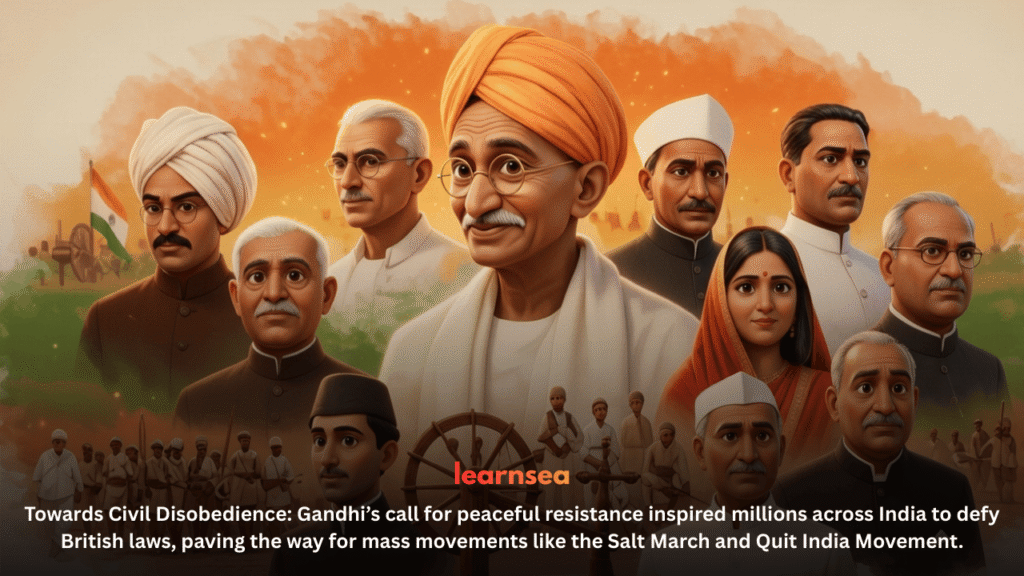
Towards Civil Disobedience
Simon Commission (1928)
The all-British Simon Commission faced nationwide protests, with the slogan “Go back, Simon!” Indian leaders rejected it as illegitimate, increasing the momentum for self-rule.
Salt March (1930)
Gandhi’s 240-mile march from Sabarmati to Dandi protested the British salt tax. This civil disobedience campaign mobilized thousands across India, breaking laws peacefully and inspiring nationwide participation in the independence struggle.
Gandhi-Irwin Pact (1931)
The agreement allowed Gandhi to attend the Second Round Table Conference in London, and the British released political prisoners. It temporarily paused the Civil Disobedience Movement, though nationalistic fervor continued.
Quit India Movement (1942)
Launched after the failed Cripps Mission and World War II, the movement called for immediate British withdrawal with Gandhi’s “Do or Die” speech. Students, workers, peasants, and women actively participated despite mass arrests and repression.
Sense of Collective Belonging and National Symbols
Nationalism in India was strengthened by cultural and symbolic representation:
- Bharat Mata image (Bankim Chandra Chattopadhyay)
- Folk songs and tales by Rabindranath Tagore and Natesa Sastri
- Swadeshi symbols like the tri-color flag representing provinces and religious unity
- Reinterpretation of history to instill pride and a shared sense of identity
These symbols helped build a shared national consciousness across regions and communities.
Key Personalities
- Mahatma Gandhi: Leader of Satyagraha, Non-Cooperation, and Civil Disobedience movements.
- Dr. B.R. Ambedkar: Advocate for Dalit rights, architect of Poona Pact.
- Bankim Chandra Chattopadhyay: Creator of Bharat Mata image, author of Vande Mataram.
- Rabindranath Tagore: Poet, social reformer, promoted folk culture.
- Baba Ramchandra & Jawaharlal Nehru: Leaders of peasant movements.
- Lord Irwin: Viceroy of India during Gandhi-Irwin Pact.
Important Dates at a Glance
| Year | Event |
|---|---|
| 1885 | First Congress meeting, Bombay |
| 1905 | Partition of Bengal |
| 1906 | Formation of Muslim League |
| 1914–18 | WWI, price rise |
| 1915 | Gandhi returns to India |
| 1917 | Champaran Satyagraha |
| 1918 | Mill Workers’ & Kheda Peasant Satyagraha |
| 1919 | Rowlatt Act & Jallianwala Bagh |
| 1920 | Non-Cooperation movement decided |
| 1921 | Start of Non-Cooperation |
| 1930 | Salt / Dandi March |
| 1931 | Gandhi-Irwin Pact |
| 1932 | Poona Pact signed |
| 1942 | Quit India Movement begins |
Read More Class 10 History Notes
Class 10 History Important Dates You Must Know for Board Exams
Class 10 Social Science MCQs (2021–2025) for Quick Revision
FAQs Nationalism in India
1. What was the impact of the First World War on India?
The First World War caused economic hardship in India, including high prices, inflation, famine, and forced recruitment of rural men into the army. These factors fueled anger against British colonial rule.
2. What happened during the Jallianwala Bagh Massacre?
On 13 April 1919, General Dyer ordered troops to fire on a peaceful crowd in Amritsar, killing hundreds. The massacre became a turning point in India’s struggle for independence
3. What is Satyagraha and who introduced it?
Satyagraha is a method of non-violent resistance introduced by Mahatma Gandhi. It relies on truth and moral courage to fight injustice without physical aggression.
4. What was the Rowlatt Act?
Passed in 1919, the Rowlatt Act allowed the British government to detain political prisoners without trial. It led to widespread protests and Gandhi’s first nationwide Satyagraha.
5. How did the Khilafat Movement unite Hindus and Muslims?
The Khilafat Movement (1919–1924) aimed to protect the Ottoman Khalifa. Gandhi allied with Muslim leaders to bring Hindus and Muslims together for mass participation in the Non-Cooperation Movement.
6. What were the key features of the Non-Cooperation Movement?
The movement involved boycotting British institutions, schools, courts, and foreign goods. Indians refused to cooperate with the government, promoting Swaraj (self-rule) through peaceful protest.
7. What was the significance of the Salt / Dandi March?
The Salt March in 1930 protested the British salt tax. Gandhi and volunteers marched 240 miles, inspiring nationwide civil disobedience and mobilizing millions in the freedom struggle.
8. What was the Gandhi-Irwin Pact?
The Gandhi-Irwin Pact (1931) was an agreement between Gandhi and Viceroy Lord Irwin. The British released political prisoners, and Gandhi agreed to attend the Second Round Table Conference in London.
9. What was the Poona Pact?
The Poona Pact (1932) resolved disagreements between Gandhi and Dr. B.R. Ambedkar over Dalit representation, giving them reserved seats while promoting social integration.
10. How did the Quit India Movement of 1942 impact India?
The Quit India Movement, launched with Gandhi’s “Do or Die” call, mobilized millions across India in non-violent protest. Despite British crackdowns and arrests, it marked a decisive push for independence.
In a Nutshell
The rise of Nationalism in India united people against British colonial rule through mass movements like Satyagraha, Non-Cooperation, and Quit India. Leaders like Mahatma Gandhi, B.R. Ambedkar, and Jawaharlal Nehru inspired Indians to fight for Swaraj (self-rule) using non-violent resistance. Understanding these movements helps Class 10 History Notes students grasp the freedom struggle, social reforms, and the making of modern India.