
In this blog, we will explore the history of print culture, its significance in the modern world, and how it impacted society over time. You will also find Class 10 history notes, important questions and key points designed to help you understand and revise this topic efficiently.
Print Culture and the Modern World Class 10 History Notes. Enhance your understanding of the printing revolution and its impact on the modern world. Check out our notes and important questions for Class 10 History Notes.
Beginning of Printing in East Asia
The earliest print technology developed in China, Japan, and Korea using hand-printing methods. In China, books were printed by rubbing paper against inked woodblocks, and the imperial state became a major producer of printed materials, especially civil service examination books. Skilled craftsmen reproduced beautiful calligraphy styles with great accuracy, making China the leading producer of printed material for centuries.
- Hand printing started in China, Japan, and Korea
- China used woodblock printing from around 594 CE
- Books rubbed on inked woodblocks → very accurate reproduction of calligraphy
- China produced large quantities of printed material (especially for exams)
- Oldest printed book: Diamond Sutra (Japan, AD 868) – Buddhist text with illustrations
- In medieval Japan, poems and prose were printed cheaply and became abundant
Print Comes to Europe
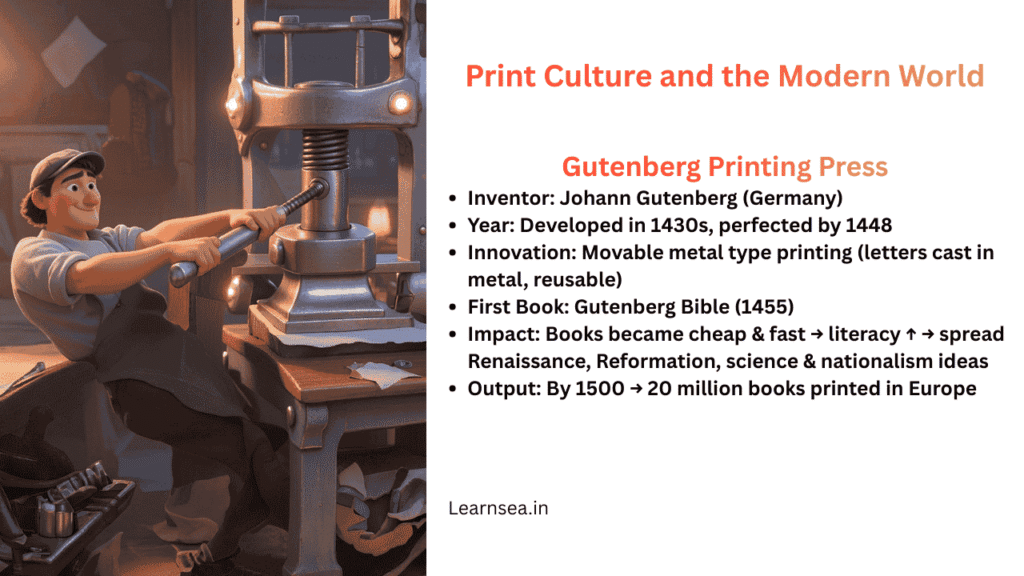
Print technology reached Europe via the Silk Route; Chinese paper arrived in the 11th century and woodblock knowledge came with Marco Polo in 1295. The real breakthrough came with Johann Gutenberg’s invention of movable type printing press around 1448 in Germany. His first major printed work was the Bible (about 180 copies in three years). Early printed books looked similar to handwritten manuscripts.
- Paper reached Europe in 11th century via Silk Route
- Marco Polo brought woodblock printing knowledge to Europe in 1295
- Johann Gutenberg invented movable type printing press ~1448
- First book printed: Gutenberg Bible
- Early printed books imitated manuscripts in layout and appearance
- Luxury books still handwritten on expensive vellum for rich people
The Print Revolution and Its Impact
The shift from hand printing to mechanical printing is called the Print Revolution. It made books cheaper, faster to produce, and available to many more people. This created a new reading public and helped spread revolutionary ideas quickly across Europe.
- Print Revolution = hand printing → mechanical printing
- Books became cheap and widely available
- New reading public emerged (common people started reading)
- Ideas of liberty, freedom, and equality spread rapidly
- Enlightenment thinkers (Newton, Voltaire, Rousseau, Thomas Paine) reached large audiences
- Printing helped cause the French Revolution by spreading ideas of nationalism and freedom
Reading Mania in 19th Century Europe
In the 19th century, compulsory primary education made children important readers. Cheap books, penny magazines for women, and novels became very popular. Libraries, cheap paperbacks, and new printing machines increased reading among workers and women.
- Compulsory primary education → children became major readers
- Children’s press started in France in 1857 (fairy tales, stories)
- Penny magazines specially for women readers
- Famous women novelists: Jane Austen, Bronte sisters, George Eliot
- Libraries in England educated factory workers and lower-middle class
- Self-educated workers wrote political tracts and autobiographies
- New machines: metal press → cylindrical press (8,000 sheets/hour) → offset press
- Cheap paperbacks appeared in 1930s during Great Depression
India and the World of Print
India had a rich tradition of handwritten manuscripts in Sanskrit, Arabic, Persian, and regional languages on palm leaves and handmade paper. Printing reached India with Portuguese missionaries in Goa in mid-16th century. The real growth of print culture happened in the 19th century with newspapers, religious texts, and social reform debates.
- Rich manuscript tradition in many Indian languages
- First printing in India: Portuguese in Goa (mid-16th century)
- Dutch missionaries printed 32 Tamil books in 1710
- First newspaper: Bengal Gazette by James Augustus Hickey (1780)
- Many newspapers and journals started by late 18th century
Religious Reform and Print in India
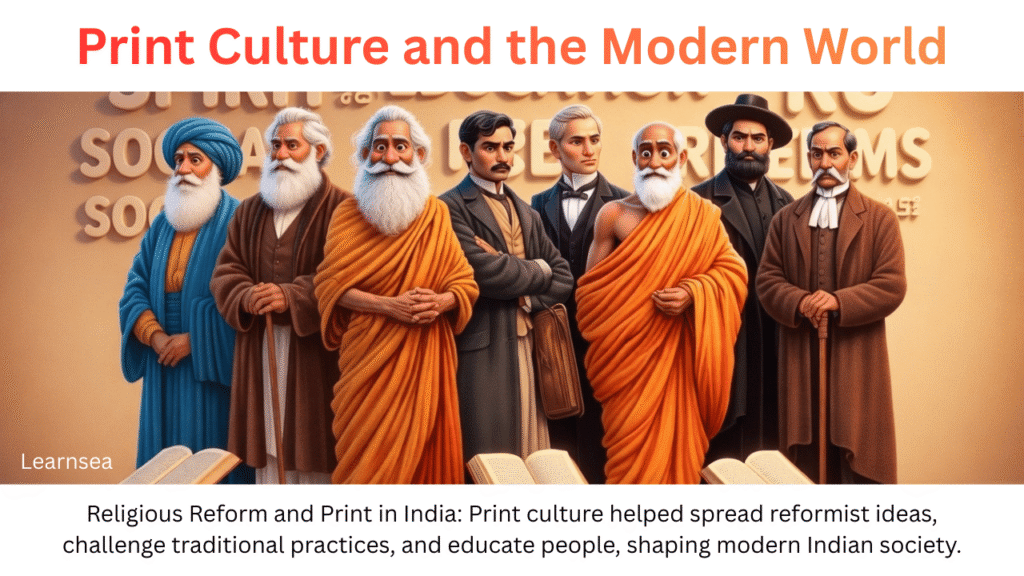
In the early 19th century, print was used for intense debates on religious and social issues. Reformers criticized practices like sati, idolatry, and Brahmanical dominance. Religious groups also used print to spread their teachings in vernacular languages.
- Intense debates on religious issues in 19th century
- Reformers attacked widow immolation, idolatry, Brahmanical priesthood
- Raja Ram Mohan Roy’s Sambad Kaumudi (1821) supported reforms
- Samachar Chandrika supported Hindu orthodoxy
- Ulama used lithographic presses for Persian-Urdu religious texts
- Deoband Seminary (1867) published thousands of fatwas
- Ramcharitmanas first printed in Calcutta (1810)
- Naval Kishore Press (Lucknow) and Shri Venkateshwar Press (Bombay) printed many vernacular religious books
New Forms of Publication in India
Towards the end of the 19th century, a new visual and literary culture emerged. Cheap prints, calendars, cartoons, and novels appeared. Women writers highlighted gender issues, and regional language printing grew rapidly.
- Raja Ravi Varma’s mass-produced mythological images and calendars
- Caricatures and cartoons published in journals from 1870s
- Women writers: Kailashbashini Debi (1860s), Tarabai Shinde, Pandita Ramabai
- Begum Rokeya (1926) criticized lack of education for women
- Hindi printing became serious in 1870s
- Punjab folk literature printed from early 20th century
- Battala publications in Bengal: cheap popular books sold to homes (women readers)
- Public libraries set up in early 20th century
Print and Censorship in Colonial India
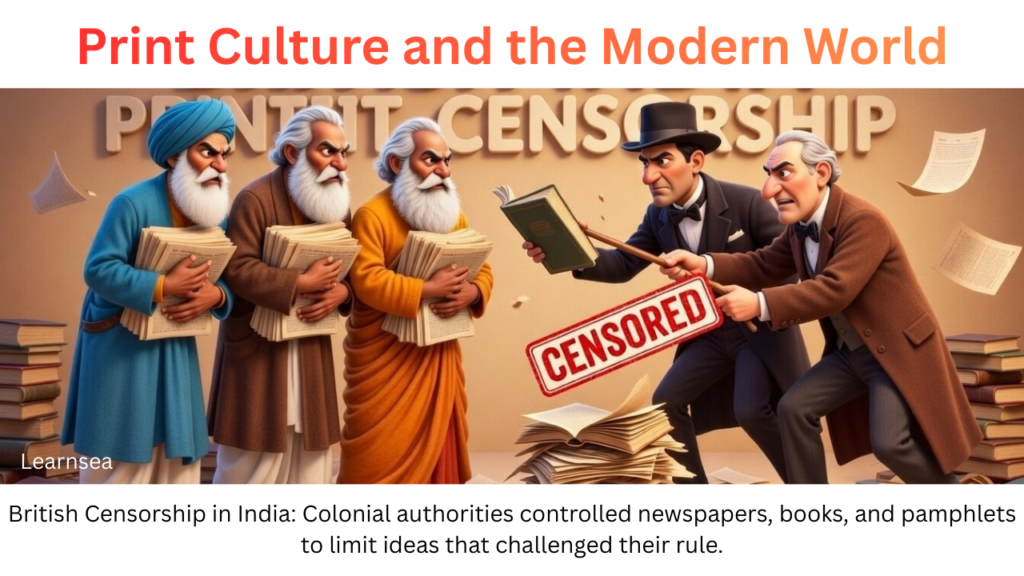
After the Revolt of 1857, the British became strict about Indian-language newspapers. They feared nationalist ideas spreading through the press. The Vernacular Press Act (1878) was passed to control and censor regional language papers.
- Revolt of 1857 changed British attitude towards Indian press
- Vernacular Press Act (1878) → harsh control on Indian-language newspapers
- No censorship on English papers initially
- Bal Gangadhar Tilak imprisoned (1908) for article in Kesari supporting revolutionaries
- Nationalist journals and protest movements used print to spread ideas
Read More Class 10 History Notes
Class 10 History Important Dates You Must Know for Board Exams
Class 10 Social Science MCQs (2021–2025) for Quick Revision
FAQs: Print Culture and the Modern World – Class 10 History
1. What is print culture?
Print culture refers to the spread and influence of printed materials such as books, newspapers, and pamphlets, which shaped knowledge, communication, and society in the modern world.
2. Who invented the printing press?
The printing press was invented by Johannes Gutenberg in the 15th century, revolutionizing how information was produced and shared globally.
3. How did print culture impact education?
Print culture made books more affordable and accessible, allowing more people to learn, promoting literacy, and expanding educational opportunities.
4. Why is print culture important in history?
It played a crucial role in spreading ideas, influencing religion, science, politics, and social change, and laying the foundation of the modern world.
5. What are some key examples of print media?
Important print media include books, newspapers, pamphlets, magazines, and scientific journals that circulated ideas widely.
6. How did print culture influence the modern world?
Print culture accelerated the spread of knowledge, encouraged critical thinking, enabled social reforms, and connected people across countries.
7. What was the role of print in the Renaissance?
During the Renaissance, print culture helped spread humanist ideas, classical knowledge, and artistic concepts throughout Europe.
8. How does print culture differ from digital media?
Print culture relies on physical materials for sharing knowledge, while digital media uses the internet. However, both aim to spread information widely.
9. Can print culture affect society today?
Yes. Even in the digital age, printed books, newspapers, and journals continue to influence education, public opinion, and cultural awareness.
10. Where can Class 10 students find notes on print culture?
Students can refer to textbooks, educational blogs, online history notes, and exam preparation websites for Class 10 history notes, summaries, and key points.
In a Nutshell
Print culture changed the modern world by spreading knowledge, education, and ideas widely. The printing press made books and newspapers accessible, shaping society and learning. Even today, print remains important for students and historical understanding.