
The chapter The Making of a Global World explores how the world became interconnected through trade, exploration, and colonization. In Class 10 History Notes, this chapter highlights the rise of global trade networks, the expansion of European empires, and the economic and cultural transformations that shaped modern societies.
These notes provide a clear summary, key events, important questions, and exam focused points to help Class 10 students understand the formation of a global world and prepare effectively for board exams.
The Pre-Modern World (1815–1914)
Globalisation refers to the economic system that emerged in the last 50 years. However, it actually has a much longer past, rooted in historic trade, migration, movement of capital, ideas, technology, and even diseases.
In pre-modern times, → Travellers, traders, priests & pilgrims travelled vast distances for:
- Goods
- Money
- Knowledge
- Opportunity
- Spiritual fulfilment
- Escape persecution
The Silk Routes
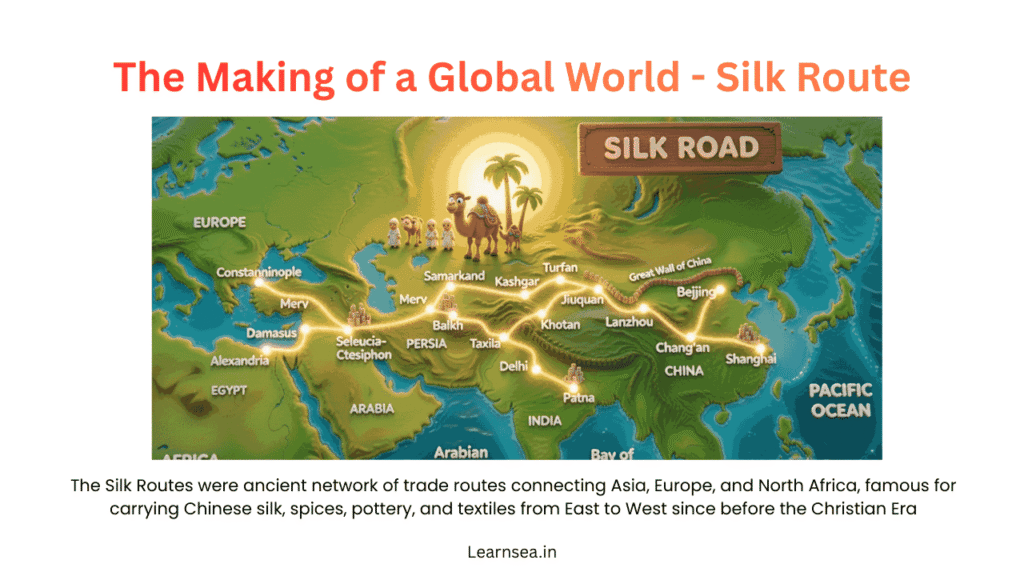
- Name ‘Silk Routes’ → Points to the importance of West-bound Chinese silk cargoes.
- Linked distant parts of the world → Asia with Europe & northern Africa (over land & sea).
- Existed since before the Christian Era → Thrived till the 15th century.
- Goods traded: Chinese silk, pottery, Indian textiles & spices from Southeast Asia.
- In return, → Precious metals (gold & silver) flowed from Europe to Asia.
- Cultural exchange: Early Christian missionaries, Muslim preachers, and Buddhism spread from eastern India via these routes.
- Food travels example: Noodles from China → became spaghetti in Italy (possibly via Arab traders); common foods like spaghetti & noodles show long-distance cultural contact.
Food Travels & New Crops
- New crops introduced by traders & travellers:
- America’s foods reached Europe & Asia after Columbus discovered the Americas (16th century): potatoes, soybeans, groundnuts, maize, tomatoes, chilies, and sweet potatoes.
- Potato → Staple food in Europe (improved nutrition & diets).
- Ireland → Dependent on potato → Mid-1840s potato blight → Great Irish Potato Famine (1845–1849) → Around 1 million died of starvation, 2 million emigrated.
Conquest, Disease, and Trade
- 16th century → European sailors found a sea route to Asia & crossed the Western Ocean to America.
- Indian Ocean → Already had bustling trade (goods, people, knowledge, customs).
- Europeans redirected flows towards Europe.
- America’s original inhabitants → No immunity to European diseases (smallpox most deadly).
- Smallpox → Spread ahead of conquerors → Killed & decimated communities → Paved way for conquest (biological warfare-like effect).
- Portuguese & Spanish → Conquered & colonised America (mid-16th century) → Vast lands, crops, minerals transformed trade & lives.
- Precious metals (silver from Peru & Mexico) → Boosted Europe’s wealth → Financed trade with Asia.
The Nineteenth Century (1815–1914)
- Global agricultural economy emerged by 1890 → Reshaped labour, capital flows, ecologies & technology.
- Dramatic changes: Food no longer local → Sourced from distant places → Specialisation in commodities (wheat, meat, cotton, rubber).
- Technological advancements → Railways, steamships, telegraph → Transformed world (better connectivity, faster trade).
- Refrigerated ships → Made meat trade accessible (e.g., frozen meat from Argentina/Australia to Europe).
- Britain’s Corn Laws → Prevented cheap wheat import → Kept prices high → Repealed in 1846 → Cheaper food imports → Unemployment in agriculture → Mass migration to cities & overseas.
- Irish Potato Famine → Highlighted dependence on a single crop & impact of global food shifts.
Indentured Labour Migration from India
- 19th century → Poverty & hunger were common in India → Hundreds of thousands of Indian labourers migrated.
- Destinations: Caribbean, Mauritius, Fiji, Ceylon (Sri Lanka), Malaya.
- Recruitment → Harsh & deceptive practices → Agents tricked people → Contract (indenture) for 5 years → Poor conditions, low wages → Like slavery.
- Many settled → Formed new communities → Cultural fusion (music, food, traditions).
Rinderpest – Cattle Plague in Africa
- Late 1880s → Rinderpest arrived in Africa → Terrifying disease → Killed 90% of cattle in some areas.
- Impact: Destroyed African livelihoods (pastoral economy) → Forced Africans into labour market (mines, plantations) → Helped European conquest & colonisation.
Berlin Conference (1884–1885)
- Major European powers met in Berlin → Divided Africa among themselves → Redrew boundaries arbitrarily.
- No African representation → Led to colonial exploitation.
Indian Role in Global Trade
- Indian entrepreneurs (Shikarpuri shroffs, Nattukottai Chettiars) → Financed exports → Intricate money transfer systems.
- Indian traders → Expanded to Central Asia, Southeast Asia → Exported cotton, opium, indigo.
- Late 19th century → British cotton imports hurt Indian textiles → But India exported raw materials (cotton, jute) → Helped global trade.
Read More Class 10 History Notes
Class 10 History Important Dates You Must Know for Board Exams
Class 10 Social Science MCQs (2021–2025) for Quick Revision
FAQs for The Making of a Global World Class 10 History Notes
1. What is The Making of a Global World?
The Making of a Global World is a Class 10 History chapter that explains how trade, exploration, and colonization connected continents, created global trade networks, and transformed societies socially, economically, and culturally.
2. How did trade contribute to a global world?
Trade connected Asia, Europe, Africa, and the Americas through networks like the Silk Route, Atlantic trade, and colonial markets. This exchange of goods, ideas, and culture laid the foundation for a globally connected world.
3. What role did European empires play?
European empires expanded through exploration and colonization, controlling trade routes and resources. They influenced local economies, cultures, and political systems, shaping modern global interactions.
4. How did colonization impact societies?
Colonization introduced new crops, goods, and technologies while also causing cultural exchange, exploitation, and social changes in colonized regions. Local communities became part of a larger global system.
5. Why is this chapter important for Class 10 students?
This chapter helps Class 10 students understand global connections, trade, and colonization. The notes, key terms, and important questions make exam preparation easier and strengthen understanding of world history. Question Paper for Examination
In a Nutshell
The Making of a Global World is a Class 10 History Notes chapter that explains how trade, exploration, and colonization connected continents and shaped modern societies. These notes cover key events, terms, and exam-focused points for easy revision and understanding of global connections.