
Complete student friendly revision notes covering every topic and sub-topic from the NCERT Class 10 History Chapter 1: The Rise of Nationalism in Europe (India and the Contemporary World-II). The Rise of Nationalism in Europe is one of the most important chapters in Class 10 History Notes, explaining how modern nation-states emerged after the impact of the French Revolution.
These Class 10 History notes provide a clear and structured summary of key events, including the influence of the French Revolution, the role of liberalism and conservatism, and the political changes brought by the Napoleon Bonaparte and the Napoleonic Code.
The Rise of Nationalism in Europe Class 10 History Notes
1. Introduction & Frédéric Sorrieu’s Vision (1848)
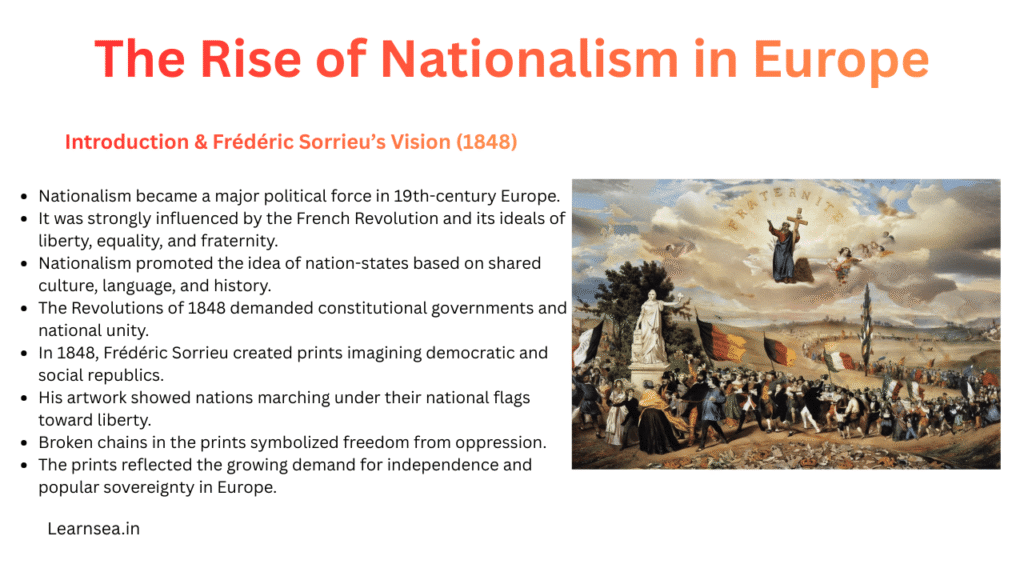
- In 1848, French artist Frédéric Sorrieu made four prints showing his dream of a world of ‘Democratic and Social Republics’.
- Print 1: People from Europe and America marching in a long line, offering gifts to Statue of Liberty (torch = Enlightenment; broken chains = end of absolutism).
- People from France, Germany, Italy, Poland, etc., stand together as equals.
- Background: Statue of Liberty holds torch & Charter of Rights of Man.
- Idea: World free from kings/monarchs, full of free democratic nations.
- Nationalism in 19th century Europe brought big changes → replaced multi-national empires with nation-states.
2. The French Revolution and the Idea of the Nation (1789)
- First clear expression of nationalism → French Revolution (1789).
- France was absolute monarchy before 1789 → king had unlimited power.
- Revolution transferred sovereignty from king to French citizens.
- Key ideas: Liberty, Equality, Fraternity (famous slogan).
- New symbols: Tricolour flag, La Patrie (fatherland), Le Citoyen (citizen).
- National Assembly formed (from Estates General) → elected by active citizens.
- Declaration: Men & women born free & equal in rights.
- French armies (1790s) entered Holland, Belgium, Switzerland, Italy → promised liberation from despots → spread nationalist ideas.
- Result: Idea of nation as community with equal rights & collective identity.
3. The Making of Nationalism in Europe
3.1 The Aristocracy and the New Middle Class
- Mid-18th century Europe: No nation-states → divided into kingdoms, duchies, cantons with autonomous rulers.
- Aristocracy (landed class): Owned estates across Europe, spoke French, followed common lifestyle, married across regions.
- But industrialisation & new trade → rise of middle class (educated professionals, businessmen).
- Middle class demanded end to privileges of aristocracy → supported liberalism & nationalism.
3.2 What did Liberal Nationalism Stand for?
- Liberalism (19th century): Freedom for individuals, equality before law, end to aristocracy & clerical privileges.
- Economic meaning: Freedom of markets, removal of state restrictions on trade (e.g., customs duties).
- Political meaning: Government by consent, constitution, parliament, press freedom.
- Liberals opposed monarchical absolutism but feared mass democracy (only propertied men should vote).
- Wanted nation-states based on liberty & equality.
4. A New Conservatism after 1815
- Napoleon defeated (1815) → conservative order restored.
- Congress of Vienna (1814-15): Hosted by Austrian Chancellor Duke Metternich.
- Goal: Restore old monarchies, prevent French expansion.
- Territories redrawn → Bourbon dynasty back in France.
- Series of states created to buffer France (e.g., Netherlands, Piedmont).
- Conservatism: Favoured tradition, monarchy, church, slow change (not revolution).
- But could not stop nationalist & liberal ideas completely.
5. The Revolutionaries
- Secret societies formed after 1815 to spread liberal-nationalist ideas.
- Giuseppe Mazzini (Italian, born 1805):
- Founded Young Italy (Marseilles) & Young Europe (Berne).
- Believed in unified Italian republic.
- Exiled in 1831 after failed revolt in Liguria.
- Members from Poland, France, Italy, German states joined.
- Revolutionaries trained & plotted against monarchies → seen as threat.
The Age of Revolutions: 1830-1848
- Series of revolutions against conservatism.
- 1830: France – July Revolution → constitutional monarchy; Belgium – independence from Netherlands.
- Greek War of Independence (1821-1832): Greeks fought Ottoman Empire → got independence (supported by liberals in Europe).
- 1848 Revolutions: France – monarchy overthrown, republic set up.
- Demands: End to autocracy, press freedom, constitution.
- Middle class led, but workers & artisans also joined → wanted social & economic rights.
- Frankfurt Parliament (1848): German middle class tried to unify Germany → offered crown to Prussian king (he refused).
- Women formed political associations but not allowed to vote.
- Revolutions failed → monarchs crushed them with army help.
- But ideas of nation & democracy spread widely.
Greek War of Independence (1821–1832)
- Greece had been under Ottoman (Turkish) rule since the 15th century (almost 400 years).
- Ottoman Empire was multi-ethnic and ruled by Muslim sultans → Greeks (Orthodox Christians) felt suppressed.
- Growth of revolutionary nationalism in Europe (inspired by French Revolution) sparked the struggle.
- Started in 1821 with uprisings in Peloponnese, islands, and other areas.
- Secret society Philikí Etaireía (Friendly Brotherhood) organised from exile (e.g., in Odessa).
- Greeks declared independence in 1822 (at Epidaurus).
- Faced brutal Ottoman response (massacres, e.g., in Chios).
- Civil wars among Greek leaders weakened them temporarily.
- Ottoman + Egyptian forces (under Ibrahim Pasha) nearly crushed the revolt (captured Athens, Missolonghi in 1826).
International support
- The West Europeans (especially liberals, Romantics) saw Greece as the cradle of European civilisation (ancient Greek heritage).
- Poets/artists supported: Lord Byron (English poet) raised funds, fought, and died in 1824 from fever.
- Sympathy from Russia (fellow Orthodox Christians), Britain, and France.
- Battle of Navarino (1827): British, French, Russian navies destroyed Ottoman-Egyptian fleet → decisive turning point.
Outcome
- Treaty of Constantinople (1832) recognised Greece as an independent nation.
- First subject people of Ottoman Empire to gain full independence.
- Became a monarchy under King Otto (Bavarian prince) → borders smaller than hoped (excluded many Greek areas).
- Inspired other nationalist movements in Europe (showed empires could be broken).
The Making of Germany
- Germany divided into 39 states (German Confederation after 1815).
- Prussia strongest → led unification.
- Otto von Bismarck (Chief Minister of Prussia):
- Used wars (against Denmark, Austria, France) to unify Germany.
- 1871: Prussian king Wilhelm I proclaimed German Emperor (Hall of Mirrors, Versailles).
- Process: Blood and iron policy (not votes/parliament).
- New German Empire: Strong, authoritarian, anti-democratic.
The Making of Italy
- Italy divided into many states → ruled by Austria, Pope, others.
- Giuseppe Mazzini → inspired unification (Young Italy).
- Count Camillo di Cavour (Chief Minister of Sardinia-Piedmont):
- Diplomatic & military alliances.
- Helped by France against Austria.
- Giuseppe Garibaldi → led army of Red Shirts → conquered south.
- 1861: Victor Emmanuel II (King of Sardinia) became King of united Italy.
- Rome joined in 1870 → complete unification.
- But unification incomplete in spirit → regional differences remained.
Unification of Britain
- Britain’s nation-building was gradual and peaceful (no sudden revolution or war like France/Italy/Germany).
- It happened through Acts of Union and English dominance over other nations (Scotland, Wales, Ireland).
- Key steps:
- Wales → Annexed by England in 1284 (Statute of Wales); fully incorporated by Acts of Union 1536–1543 under Henry VIII → Welsh law replaced by English law; Welsh sent MPs to English Parliament.
- Scotland → From 1603: Union of Crowns (James VI of Scotland became James I of England → same monarch, but separate parliaments).
- Economic issues (Scotland poor after failed Darien scheme) + English fear of French/Jacobite threats.
- Act of Union 1707 → England + Scotland united into Kingdom of Great Britain (one Parliament at Westminster).
- Scotland lost its Parliament but kept Scottish law, church, education.
- English culture/language imposed → suppressed Scottish identity (e.g., Highland Clearances later).
- Ireland → Gradually conquered; Act of Union 1800 → Ireland joined to form United Kingdom of Great Britain and Ireland (effective 1801).
- After Irish Rebellion (1798) + fear of French invasion.
- Ireland became subordinate; English dominance led to suppression of Irish culture/language.
- How nationalism worked here:
- Not through mass uprising or middle-class revolution.
- English Parliament/middle class gained power → imposed English identity (language, flag, anthem) on others.
- Older nations (Scotland, Ireland, Wales) survived as subordinate partners → no equal status.
- Symbols: Union Jack (combined flags), God Save the King (anthem), English language promoted.
- Unlike rest of Europe:
- No violent unification (like Bismarck’s “blood and iron” in Germany).
- No mass nationalist movements/revolutions (like 1848 in Italy/Germany).
- England was already strong → used economic/political power to unite.
Visualising the Nation
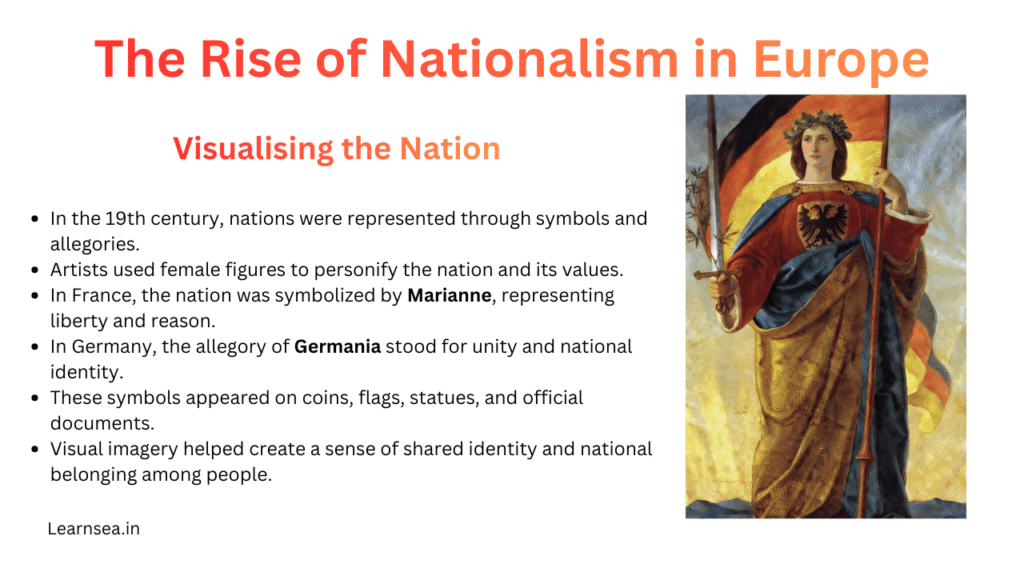
- Artists personified nation as female figures (allegory).
- Marianne (France): Liberty & Republic (red cap, tricolour, sword).
- Germania (Germany): Oak leaves (heroism), sword (readiness to fight), black-red-gold flag.
- Other symbols: Broken chains, Statue of Liberty, national colours/flags.
Nationalism and Imperialism
- After 1871: Nationalism became aggressive & narrow.
- Balkan region (under Ottoman Empire): Mixture of races, languages → called “powder keg of Europe”.
- Slavic nationalities wanted independence → Russia supported them (Pan-Slavism).
- Rivalries among big powers (Russia, Germany, Austria-Hungary) → led to First World War (1914).
- Idea: Nationalism united people but also divided (e.g., competition for colonies).
- Final note: By early 20th century, nationalism linked to imperialism & conflict.
Quick Revision Table: Key Figures & Contributions
| Figure | Country | Contribution/Key Role |
| Frédéric Sorrieu | France | Prints of democratic republics (1848) |
| Giuseppe Mazzini | Italy | Young Italy, Young Europe, republican ideas |
| Count Cavour | Italy | Diplomatic unification (Sardinia-Piedmont) |
| Giuseppe Garibaldi | Italy | Red Shirts army, conquered south |
| Otto von Bismarck | Germany | Blood & iron, unified Germany (1871) |
| Duke Metternich | Austria | Congress of Vienna, conservatism |
Must-Memorize Key Dates (Board Exams)
- 1789 → French Revolution
- 1799–1815 → Napoleon rules
- 1804 → Napoleonic Code
- 1814–15 → Congress of Vienna
- 1821 → Greek independence begins
- 1830–31 → Revolutions in France, Belgium, Poland
- 1848 → Revolutions across Europe; Sorrieu’s prints
- 1859–70 → Italian unification
- 1871 → German unification
FAQs for The Rise of Nationalism in Europe Class 10 History
1.How Did the Idea of Nation-States Develop in Europe?
The Rise of Nationalism in Europe refers to the 19th-century movement where people united based on shared language, culture, and history, aiming to form independent nation-states. It was strongly influenced by the French Revolution and liberal ideas of liberty and equality
2. Who was Frédéric Sorrieu and what was his vision?
Frédéric Sorrieu was a French artist who, in 1848, created prints imagining a world of democratic and social republics. His artwork depicted nations marching under their flags toward liberty, symbolizing freedom and national unity.
3. What were the Revolutions of 1830 and 1848?
The 1830 Revolution in France overthrew King Charles X and inspired nationalist movements across Europe. The Revolutions of 1848 spread demands for constitutional governments, political rights, and national unity, influencing unification movements in Italy and Germany.
4. How did nationalism affect Italy and Germany?
Nationalism encouraged the unification of fragmented states. In Italy and Germany, it inspired political leaders and citizens to fight for national unity, ultimately leading to the creation of modern nation-states in the late 19th century.
5. Why is the Rise of Nationalism in Europe important for Class 10 History?
This chapter is crucial for understanding how Europe transformed politically and socially in the 19th century. It explains the formation of nation-states, the impact of revolutions, and the spread of nationalist ideas, all of which are key topics for Class 10 board exams. Question Paper for Examination
In a Nutshell
These Class 10 History notes on The Rise of Nationalism in Europe provide a clear summary, key concepts, important dates, and exam-oriented points for effective revision. By understanding this chapter thoroughly, students can confidently answer board exam questions and build a strong foundation in modern European history and nation state formation.